
Quick Summary: Where Does ChatGPT Get Its Information From?
- ChatGPT gets information in 2 main ways: from knowledge learned during model training and, when Search or other tools are used, from information retrieved at answer time.
- Its training data comes from multiple sources. OpenAI says its models are developed using publicly available internet content, third-party data, and information provided or generated by users, trainers, and researchers. These can include text sources, images, audio, and video.
- ChatGPT does not rely on one fixed database or a single list of websites. The exact sources used in training are not exhaustively disclosed, while web-enabled responses can cite distinct sources retrieved for a particular query.
- Newer ChatGPT models can go beyond their built-in knowledge. At a specific point, a model's learned knowledge reaches its cutoff, but ChatGPT Search can retrieve newer information from the web when current data is needed.
- For brands, visibility depends on making useful content easy to discover and understand. Good LLM SEO focuses on clear answers, reliable information, accessible key pages, and regular practical testing of how your brand and content appear across AI search.
OpenAI says the models behind ChatGPT are developed using 3 primary information sources: publicly available internet content, third-party data, and information provided or generated by users, trainers, and researchers. But that is only part of the picture.
A current ChatGPT answer can also use live web search, uploaded files, memory, and connected tools when available. So asking where ChatGPT gets its information really means separating what the model learned during training from what it can retrieve at answer time.
This guide explains both, along with knowledge cutoffs, citations, crawlers, and what this means for AI search visibility.
Where Does ChatGPT Get Its Data From?
ChatGPT can get information in 2 different ways: from what its underlying model learned during training and from sources it can access when generating a current response.
For model training, OpenAI says its foundation models are developed using 3 primary sources:
- Publicly available information on the internet.
- Information accessed through third-party partnerships.
- Information provided or generated by users, human trainers, and researchers.
The model learns patterns and relationships from this data rather than storing a searchable copy of every source.
For a current ChatGPT response, information can also come from sources beyond its training knowledge. Depending on the tools and permissions available, ChatGPT can search the web for current information, use files or content provided in the conversation, and reference authorized connected apps.
So, the data used to train ChatGPT is not necessarily the same as the information used to answer a specific question today.
How Was ChatGPT Trained?
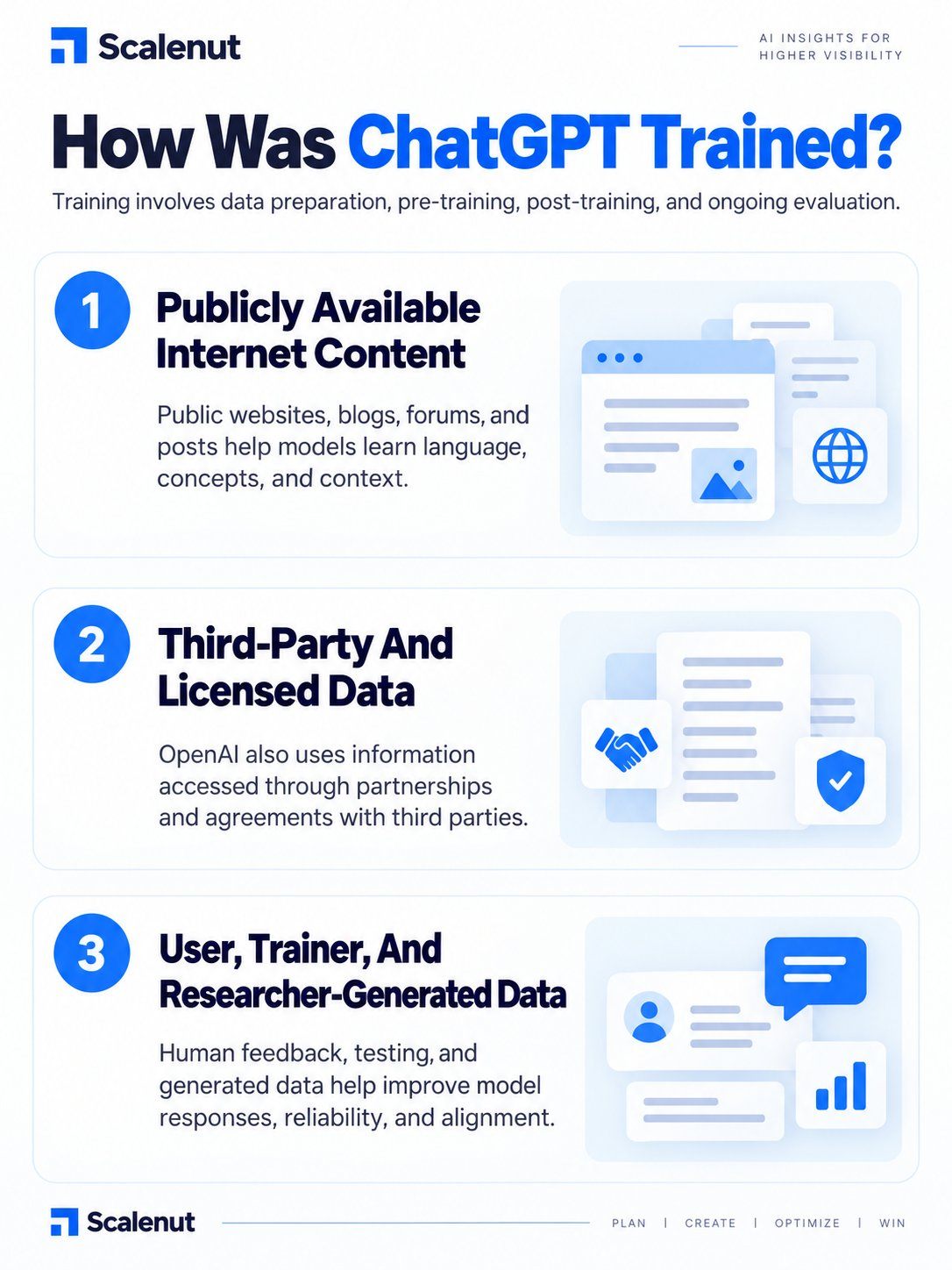
Training a large language model (LLM) like those powering ChatGPT involves preparing training data, pre-training, post-training, and ongoing evaluation.
During this process, models learn patterns from large amounts of information, including text, images, audio, and video. OpenAI identifies three primary sources used to develop its models:
1. Publicly Available Internet Content
OpenAI uses freely available online content, including public websites, blogs, forums, and posts. This helps models learn language patterns, concepts, and relationships between information.
OpenAI also applies filters to remove certain unwanted material, such as spam and some sources containing large amounts of personal information.
2. Third-Party And Licensed Data
OpenAI also uses information accessed through partnerships and agreements with third parties.
Depending on the dataset, this can include text, images, audio, video, and other information used to improve model performance, reliability, and safety.
3. User, Trainer, And Researcher-Generated Data
Information provided or generated by users, human trainers, and researchers can also contribute to model development.
During post-training, human feedback and other techniques help models produce more useful and reliable responses that better align with user intent.
OpenAI continues evaluating and improving its models after deployment to improve their capabilities, reliability, and safety.
What Is ChatGPT’s Knowledge Cutoff?
ChatGPT's knowledge cutoff is the point up to which a particular model has learned information during training. Because different ChatGPT models can have different cutoff dates, there is no single knowledge cutoff date that applies to every model.
Without web search or other retrieval tools, ChatGPT's answers are based on what the model learned during training. This means it may not know about events, product updates, research, or other developments that happened after its specific cutoff date.
However, a knowledge cutoff does not prevent ChatGPT from accessing newer information. With Search or Deep Research, it can retrieve current web sources and use them alongside its existing knowledge to answer more recent queries.
Does ChatGPT Search The Internet In Real Time?
Yes, ChatGPT can search the internet for current information. ChatGPT Search is available across Free, Go, Plus, Pro, Business, Enterprise, and Edu plans, although usage limits and workspace settings can vary.
ChatGPT may search the web automatically when a question would benefit from up-to-date information, or users can start a web search manually. It can then retrieve relevant web results, use them to generate an answer, and provide links to the sources it used.
Without web search, ChatGPT relies on knowledge learned during training, which has a model-specific knowledge cutoff. Search helps bridge that gap for recent news, changing product information, live data, and other time-sensitive queries.
Does ChatGPT Read Websites Like Google Does?
ChatGPT and Google access web content differently. Google Search uses crawlers such as Googlebot to discover and index pages so they can appear in search results.
OpenAI uses different crawlers and user agents for different purposes:
- OAI-SearchBot: Crawls websites so pages can be surfaced in ChatGPT Search.
- GPTBot: Crawls content that may be used to improve OpenAI's generative AI foundation models.
- ChatGPT-User: Visits specific pages when a user or Custom GPT requests them. It is user-triggered and is not used for automatic web crawling or deciding what appears in ChatGPT Search.
These functions are separate. A publisher can, for example, allow OAI-SearchBot so its content is eligible for ChatGPT Search while blocking GPTBot from using that content for potential model training.
So, while both Google and ChatGPT can access web pages, ChatGPT combines learned model knowledge with targeted web retrieval rather than functioning exactly like a traditional search engine.
What Sources Can ChatGPT Pull From During Live Search?
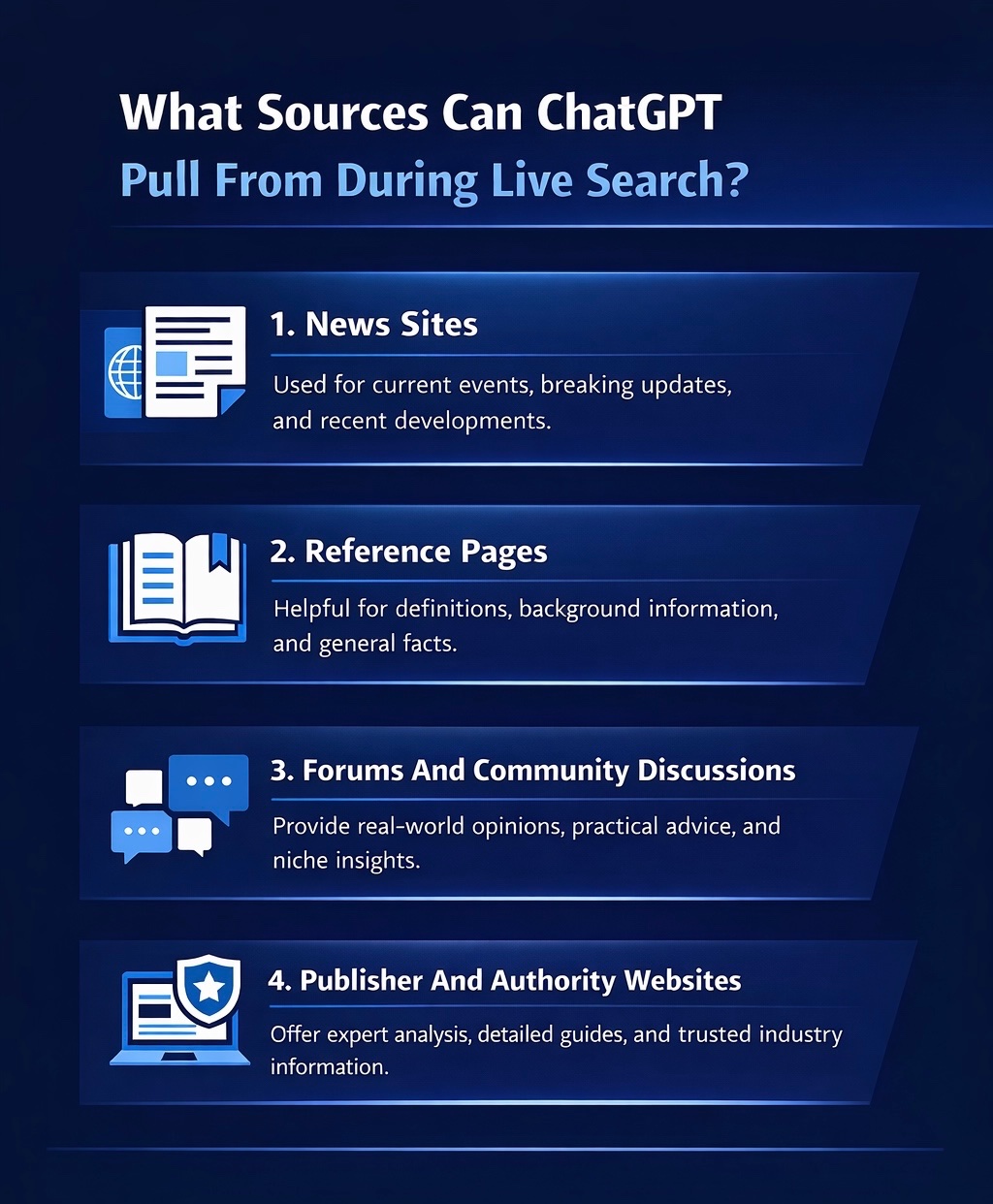
When the AI chatbot performs a live search, it prioritizes reputable sources to deliver balanced answers. It draws from news sites, authority websites, and relevant forums to incorporate factual data, expert opinions, and real-world experiences. This triangulation of information is a key strength, ensuring comprehensive responses.
The following sections will explore the main categories of sources ChatGPT utilizes during a live search.
1. News Sites
When a query relates to current events or breaking news, ChatGPT often turns to established news sites. These sources are critical for providing up-to-the-minute information that would not be present in the model's static training data. The model can access and synthesize information from various news outlets to offer a summary of recent happenings.
By pulling from reputable news organizations, the model can answer questions about politics, technology, finance, and other fast-moving topics. The search results it uses are often from globally recognized sources, which helps ensure the information is timely and credible. This allows users to get quick overviews without having to sift through multiple articles themselves.
Examples of news sources that might appear in search results include:
- Reuters
- Associated Press
- Major national and international newspapers
2. Reference Pages
For factual and definitional queries, ChatGPT frequently relies on reference pages. These are sources that act as a foundational knowledge base, offering structured and verified information on a wide array of subjects. Wikipedia is a primary example, appearing in a significant number of conversations that include citations.
These reference pages provide the model with a baseline of factual information that it can use to ground its answers. AI tools are often programmed to trust these sources for definitions, historical context, and general knowledge. This is because they are typically well-organized, comprehensive, and collaboratively edited for neutrality and accuracy.
Other important reference sources include:
- Government agency websites (e.g., NIH.gov)
- Academic encyclopedias and digital libraries
3. Forums And Community Discussions
To capture authentic, real-world perspectives and niche knowledge, ChatGPT also draws from forums and community discussions. User-generated content from these platforms provides insights that are often not available in traditional publications. This includes practical advice, product reviews, and personal experiences.
Sources like Reddit are particularly valuable because they host dedicated communities for virtually every topic imaginable. The model can analyze discussions to understand common problems, popular opinions, and specific solutions that have worked for others. This type of information adds a layer of authenticity and specificity to its responses.
Examples of platforms with valuable community discussions include:
- Stack Exchange for technical questions
4. Publisher And Authority Websites
For in-depth analysis and expert opinion, the AI chatbot turns to publisher and authority websites. These are trusted sources known for their expertise in a particular field, such as technology, health, or finance. These sites publish high-quality content, including reviews, guides, and research-backed articles.
Being cited alongside these authoritative domains can significantly boost a brand's credibility. The model identifies these sites as reliable sources, and their content is often used to provide detailed and nuanced answers. For instance, in a query about personal finance, the AI might pull information from top financial advice websites.
Key authority websites often include:
- Industry-leading blogs and publications
- Websites of professional organizations and research institutions
Does ChatGPT Use Private, Paywalled, Or Personal Information?
ChatGPT does not have unrestricted access to private or personal information. However, OpenAI says publicly available training data may incidentally contain personal information, although it does not intentionally collect personal data specifically to train its models.
For personal ChatGPT accounts, eligible conversations may also be used to improve OpenAI's models unless the user turns off Improve the model for everyone. ChatGPT can access private information when users upload it, provide it in a conversation, or authorize access through connected apps, subject to their permissions.
ChatGPT also does not have blanket access to paywalled content. OpenAI says it does not intentionally collect training data from sources known to be behind paywalls, although its models may use licensed third-party data. Access to restricted content can also depend on services, permissions, or accounts a user has connected.
How Does ChatGPT Decide Which Sources To Cite?
When ChatGPT searches the web, it can cite the sources used to support its response. OpenAI says ChatGPT Search ranks results using multiple factors designed to surface relevant and reliable information, but it does not publish a specific formula for how individual sources are selected.
The sources cited can also vary depending on the query, available search results, and how current or specific the information needs to be. ChatGPT may reference one or multiple sources within the same response.
These AI citations let users open the original pages and verify the information themselves. However, citations can still be incomplete, outdated, or incorrect, so important claims should always be checked against the source.
Why Being Cited Matters?
In the age of AI-driven answers, being cited by a model like ChatGPT is a powerful endorsement. When your content is used as a source, it positions your brand as an authority on the topic. This direct citation is a strong signal of trust, as the AI has identified your content as a reliable source of information.
This new form of visibility goes beyond traditional search rankings. Instead of just appearing in a list of links, your information is integrated directly into the user's answer. This can lead to increased brand awareness and credibility, as users see your name associated with a helpful and accurate response.
Key benefits of being cited include:
- Enhanced Authority: Being chosen as a source validates your expertise.
- Increased Trust: Users are more likely to trust information that is clearly sourced.
- Direct Visibility: Your brand is placed directly in front of the user within the answer.
Why Visibility Is Different From Traditional SEO?
Traditional Search Engine Optimization (SEO) has long focused on achieving top rankings on search engine results pages (SERPs). Success is measured by your position in a list of blue links. The goal is to attract clicks by having a compelling title and meta description.
Answer Engine Optimization (AEO) represents a paradigm shift. Here, the goal is not just to rank high but to be the definitive source of information that an AI chatbot uses to construct its answer. Visibility is achieved when your content is directly cited or synthesized within the generated response. It's about becoming part of the answer itself, not just a link to it.
This means the focus moves from keyword optimization for rankings to creating content that directly and comprehensively answers a user's question. The AI model is the new intermediary, and influencing it requires a strategy centered on clarity, authority, and factual accuracy, which differs from classic SEO tactics aimed at pleasing search engines' ranking algorithms.
How To Increase The Chances Of Your Content Being Used By ChatGPT?
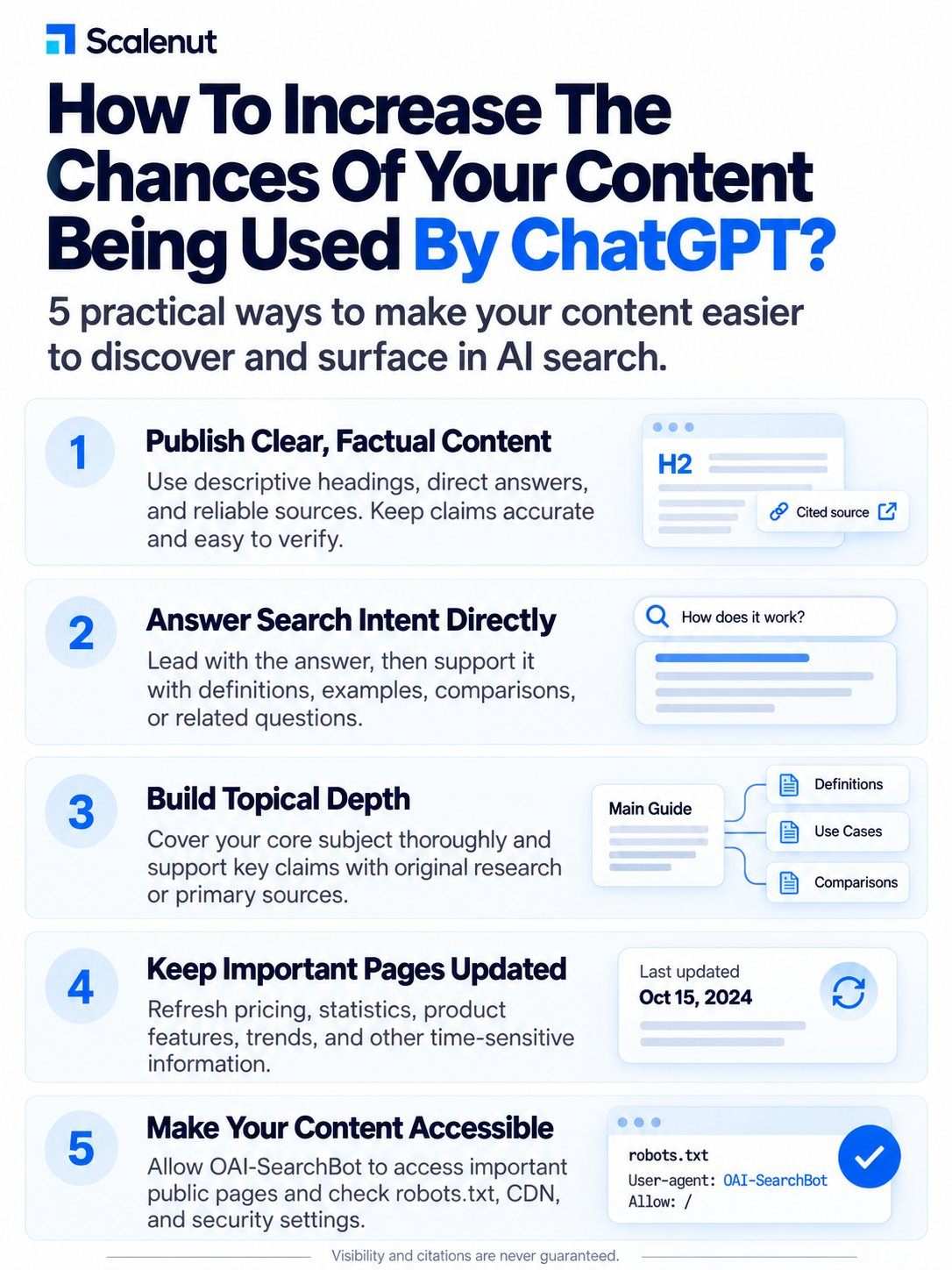
You can't guarantee that ChatGPT will use or cite your content. However, you can improve your chances by making your pages relevant, reliable, current, and accessible to ChatGPT Search.
1. Publish Clear, Factual Content
Make your information easy to understand and verify. Use:
- Descriptive H2 and H3 headings.
- Short, direct answers.
- Clear paragraphs and lists.
- Reliable sources for important claims.
Avoid vague statements, unsupported claims, and unnecessary filler.
2. Answer Search Intent Directly
Create content that clearly answers the questions your audience is searching for.
Put the main answer early, then support it with definitions, examples, comparisons, or related questions. This makes it easier for search systems to identify the most relevant information on the page.
3. Build Topical Depth
Cover your core subject thoroughly instead of publishing disconnected content across unrelated topics.
Create supporting pages around important definitions, comparisons, use cases, and questions. Cite original research, official documentation, and reliable primary sources where appropriate.
4. Keep Important Pages Updated
Review content regularly, especially pages covering:
- Pricing and product features.
- Statistics and research.
- Industry trends.
- Software capabilities.
- Other time-sensitive information.
For current queries, recency can help determine which results ChatGPT Search surfaces.
5. Make Your Content Accessible To ChatGPT
Make sure OAI-SearchBot can access important public pages and that your robots.txt, CDN, or security settings are not blocking it.
OpenAI states that allowing OAI-SearchBot helps content become discoverable, surfaced, cited, and linked in ChatGPT Search. GPTBot is separate, so publishers can control potential training access independently.
These steps can improve your eligibility and AI search visibility, but placement or citations are never guaranteed.
Curious how AI engines portray your brand? Scalenut’s AI Visibility tool helps you track mentions, uncover competitor wins, spot missed opportunities, and turn those insights into action. Book a demo today!
Conclusion
ChatGPT gets information through fundamentally different processes: model training and answer-time retrieval. During training, raw web crawls and other inputs can form part of a massive raw collection that undergoes massive filtering before contributing to the final filtered dataset. At answer time, learned knowledge, web search, files, connected sources, and instructions such as a system prompt can shape the response.
This is why ChatGPT does not work the same way Google does, and why significant milestones such as a model's knowledge cutoff matter when evaluating detailed information. For digital marketers, the takeaway is practical: you do not need months of research or completely different tactics for every AI platform.
Strengthen your digital presence by publishing accurate content for potential customers, keeping important pages current and crawlable, and, where relevant, use schema markup to clarify page structure. These steps cannot guarantee citations, but they can make your content easier for AI and search systems to discover and understand.
Frequently Asked Questions
Does ChatGPT make up sources?
Yes, ChatGPT can sometimes generate incorrect information or citations, often called hallucinations. While newer models have improved, errors can still occur, including when web search is used. For important information, users should open cited sources and verify that they support the answer.
Can ChatGPT use sources?
Yes. ChatGPT can use different information sources depending on the question and available tools. It may answer from learned knowledge, search the web for current information, or use uploaded reference files. Some custom GPTs can also use configured knowledge files and enabled web search capabilities.
How does ChatGPT source its information?
ChatGPT's AI training data comes from publicly available internet content, information accessed through third parties, and information provided or generated by users, trainers, and researchers. Its training methodologies include stages such as preparing data, pre-training, post-training, evaluation, and ongoing improvement.
What sources does ChatGPT use to generate its responses?
ChatGPT does not rely on a single source to generate responses. Its models learn from a broad mix of publicly available content, third-party data, and human-generated information. When web search is used, ChatGPT can also retrieve online sources relevant to a user's specific query.
Is ChatGPT connected to the internet for real-time information?
Yes, ChatGPT can search the internet to retrieve current data when a question benefits from up-to-date information. Web search is available across ChatGPT plans, although usage limits and some capabilities can vary by subscription level, account, or workspace settings.
How up-to-date is the information that ChatGPT provides?
It depends on how the answer is generated. Without web search, ChatGPT relies on knowledge learned during training and is limited by the model's knowledge cutoff. With Search, it can retrieve more recent and relevant information from the web when answering a query.
Can ChatGPT provide verified sources for its answers?
ChatGPT can provide citations and links when it searches the web, but citations do not automatically guarantee accuracy. OpenAI says search rankings use multiple factors intended to surface relevant and reliable results, but it does not publish a definitive list of trust signals used to rank sources.
Can I make ChatGPT include information about my business?
You cannot guarantee that ChatGPT will mention or cite your business. However, generative engine optimization can improve your AI search visibility by making content easier for AI systems to access, understand, and retrieve. Among the most important factors you can control are publishing useful content, answering relevant queries clearly, and ensuring OpenAI's search crawler can access your site.
Is ChatGPT's information pulled directly from Google or Bing results?
No. ChatGPT does not simply copy results from Google or Bing. When using web search, it can work with third-party search providers, including Bing in some contexts, along with direct web sources and partner data, then synthesize relevant information into its response.