What Is ZipTie AI Search Analytics? Cost, Uses & Limits

ZipTie AI Search Analytics at a glance
- Tool type: Specialized AI search monitoring and GEO optimization platform
- Supported platforms: ChatGPT, Perplexity, and Google AI Overviews
- Core metrics: Brand mentions, citations, sentiment, competitor visibility, share of voice, and AI Success Score
- Query setup: Manual prompts, URL-based generation, Google Search Console imports, and conversational query enhancement
- Content optimization: Analyzes existing pages and recommends topics, sections, or improvements that may increase mentions and citations
- Starting price: $69 per month for the Basic plan
- Free trial: 14 days with access to the platform’s core features
- Best suited for: SEO, GEO, brand, PR, and agency teams that already have an established content execution workflow
- Main limitation: ZipTie identifies visibility and content gaps, but teams may still need separate tools for research, long-form creation, audits, internal linking, and publishing
Your Google rankings may look solid, but that does not tell you whether ChatGPT, Perplexity, or Google AI Overviews mention your brand, cite your website, or recommend a competitor instead.
ZipTie AI Search Analytics is built to measure that missing visibility layer. It tracks prompts, mentions, citations, sentiment, share of voice, and the sources shaping AI-generated answers.
In this guide, I break down how ZipTie works, its key features and pricing, who it suits, and where its monitoring-led workflow may require additional content execution tools.
What is ZipTie AI Search Analytics?
ZipTie AI Search Analytics is a GEO monitoring and optimization platform that tracks how brands, websites, and competitors appear across ChatGPT, Perplexity, and Google AI Overviews. It helps teams see whether their brand is mentioned, whether their website is cited, how positively it is presented, and which competitors appear more often in relevant AI responses.
Unlike traditional SEO tools that focus on rankings, clicks, and organic traffic, ZipTie measures visibility inside AI-generated answers. Its reports cover brand mentions, citations, sentiment, share of voice, competitor performance, and the sources shaping those answers. This makes it a specialized AI search visibility tool rather than a complete SEO suite.
How does ZipTie AI Search Analytics work?
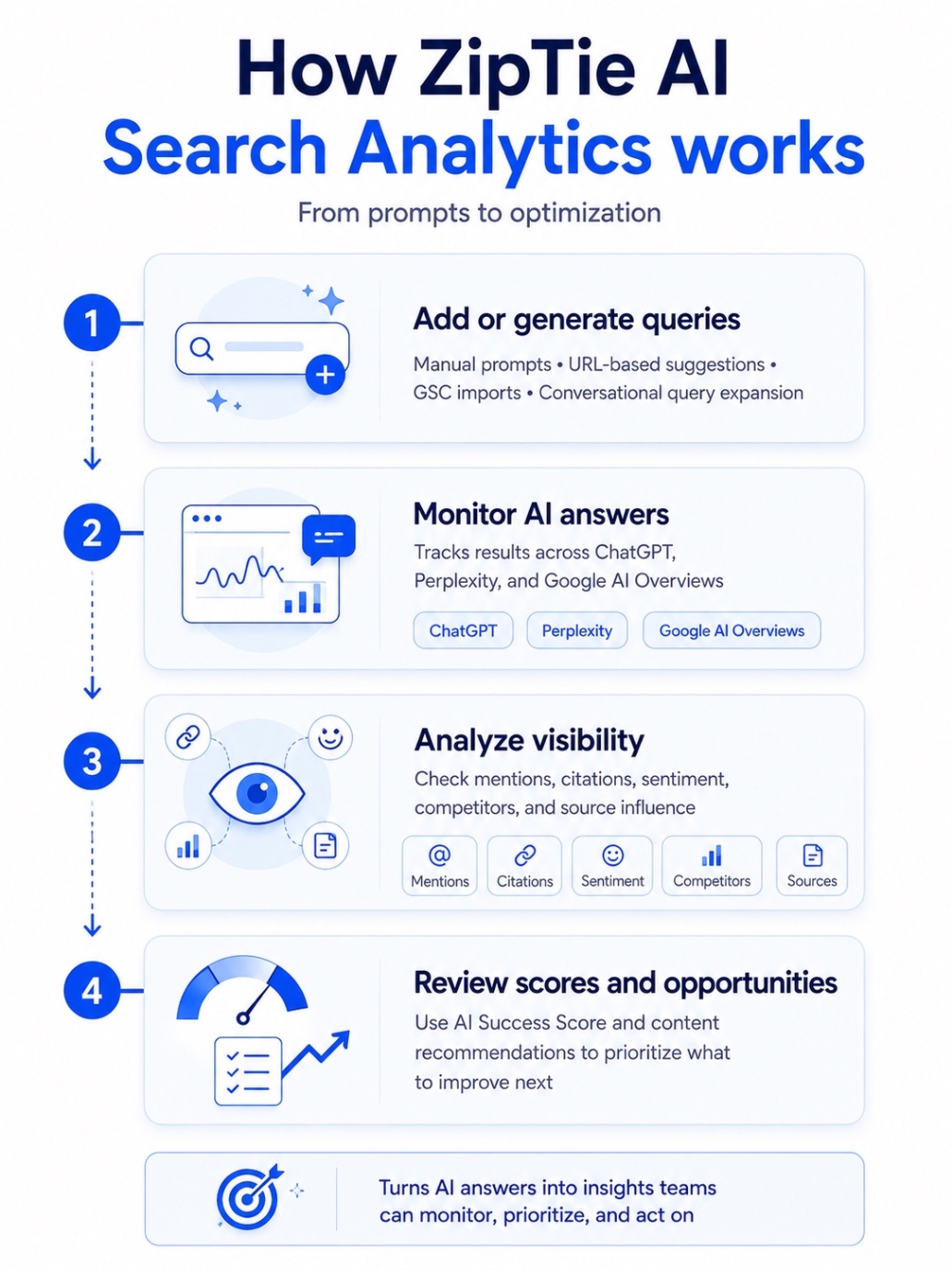
ZipTie follows a simple monitoring-to-optimization workflow. Teams first define the AI queries they want to track, then review how their brand, website, and competitors appear across supported AI platforms.
Here is how the process works.
1. Add or generate relevant queries
Users can enter prompts manually, generate query suggestions from a website URL, or import existing searches from Google Search Console. ZipTie also expands traditional search terms into more conversational questions that better reflect how people interact with AI platforms.
For example, a keyword such as “best CRM software” may become “Which CRM tools are best for a growing sales team?” This helps teams monitor prompts that are closer to real AI search behavior.
2. Monitor answers across AI search platforms
ZipTie runs the selected queries across ChatGPT, Perplexity, and Google AI Overviews. It captures the resulting answers so users can review what the AI platform displayed, including brand mentions, citations, competitors, and supporting sources.
Queries can be grouped by topic, intent, or customer journey stage, making it easier to analyze performance across different products and use cases.
3. Analyze brand and competitor visibility
The platform identifies whether the brand appears, whether its website is cited, and how positively or negatively it is described. It also shows which competitors appear instead, how prominent they are, and which external websites support their visibility.
This helps teams distinguish between different problems. A brand may be missing from an answer entirely, mentioned without a citation, or cited while a competitor receives the recommendation.
4. Review scores and optimization opportunities
ZipTie consolidates the results into project, category, and query-level reports. Its AI Success Score helps users prioritize weaker or commercially important prompts, while its insights highlight influential pages, citation gaps, and content opportunities.
The content optimization module can then analyze an existing page and recommend topics or sections to improve. Teams must still review and implement those recommendations through their content workflow.
Overall, ZipTie turns individual AI answers into structured insights that teams can monitor, prioritize, and act on.
What are the core features of ZipTie AI Search Analytics?
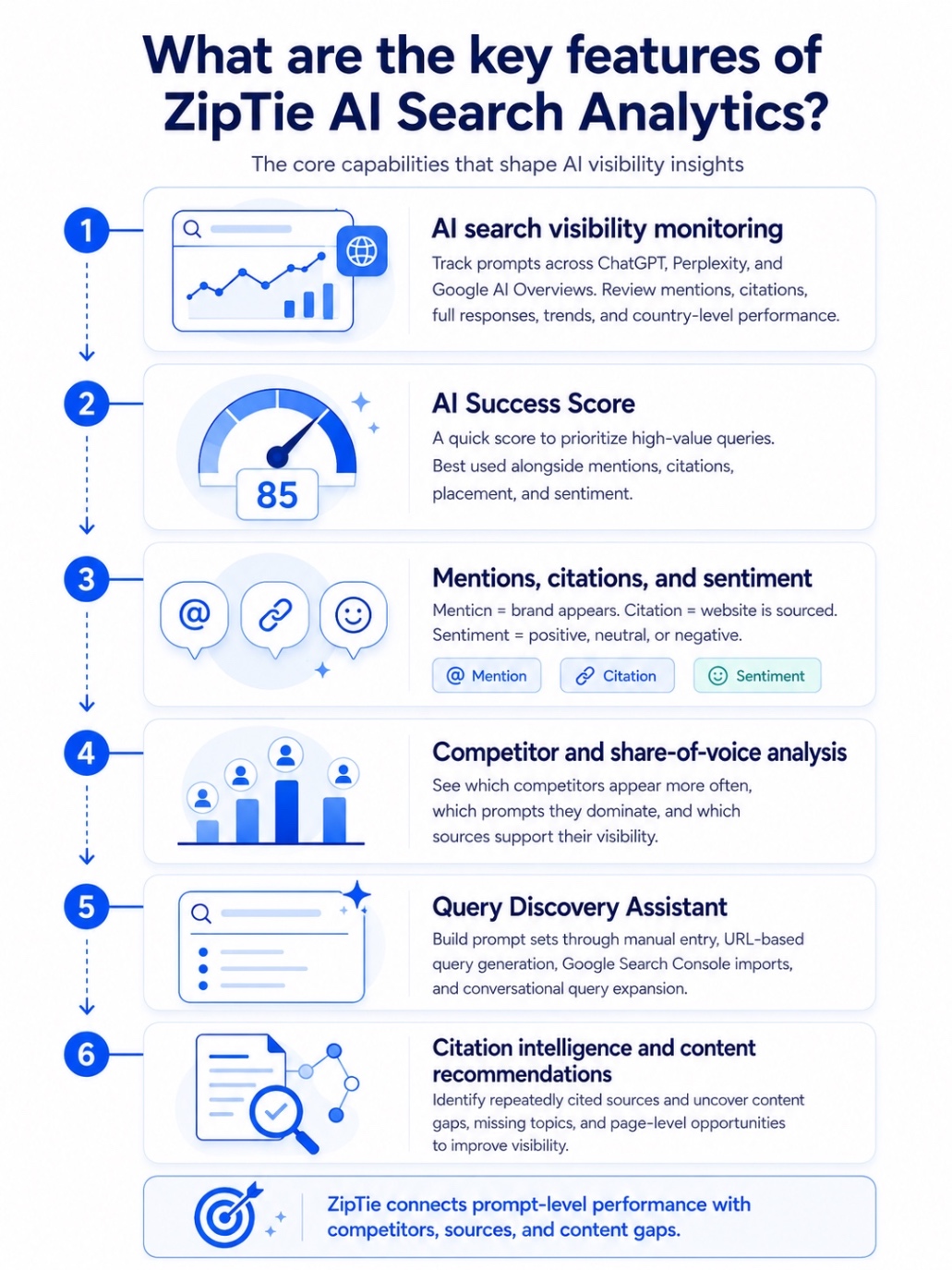
ZipTie combines AI visibility tracking, competitor analysis, source intelligence, and content recommendations. It helps SEO specialists and teams understand where their brand appears, why competitors may be performing better, and which opportunities deserve attention.
Here are the key features of ZipTie AI Search Analytics.
1. AI search visibility monitoring
ZipTie tracks individual prompts across ChatGPT, Perplexity, and Google AI Overviews. Users can analyze performance at the project, category, or query level and review the complete AI-generated response for each monitored prompt.
The dashboard shows whether the brand was mentioned, whether its website was cited, and how results differ across platforms. Its Trends view also tracks changes in mentions, citations, and sentiment over time. Monitoring is available across multiple countries, with daily or weekly checks depending on the campaign.
2. AI Success Score
Every monitored query receives an AI Success Score based on brand mentions, sentiment, and website citations for your target queries. ZipTie also considers the commercial value of the query to help teams prioritize opportunities that may have a stronger business impact.
The score provides a useful performance snapshot, but it should not be viewed in isolation. Teams still need to examine the actual answer, brand placement, citation source, sentiment, and competitor presence to understand what is driving the result.
A single score cannot explain the complete picture, so use these AI brand visibility metrics to measure meaningful progress.
3. Brand mention, citation, and sentiment tracking
ZipTie separates three important AI visibility signals:
- Mention: The brand or product appears in the answer.
- Citation: The company’s website is linked or used as a source.
- Sentiment: The brand is presented positively, negatively, or neutrally.
These signals do not always occur together. ChatGPT may recommend a brand while citing a third-party review instead of the company’s own website. In this case, the brand receives visibility, but the external publication influences the answer.
ZipTie also analyzes sentiment in relation to the query, helping teams understand how specific products, features, or use cases are being presented.
Want to understand what these signals reveal beyond the dashboard? Learn how to track, measure, and improve brand mentions in LLMs.
4. Competitor and share-of-voice analysis
ZipTie identifies which competitors appear most often across the monitored prompts and platforms. Teams can see which queries competitors dominate, how prominently they appear, and whether their visibility comes from mentions, citations, or both.
Users can also review the pages and third-party sources supporting competitor visibility. This helps uncover important prompts where the brand is absent and reveals which content or external domains may be influencing the competitive landscape.
5. Query Discovery Assistant
ZipTie offers several ways to build a relevant prompt set. Users can generate queries from a website URL, add prompts manually, or import existing searches from Google Search Console.
Its query enhancement feature converts traditional keywords into conversational questions that better reflect how people use AI search. ZipTie also categorizes queries automatically, making it easier to compare performance across topics, products, audiences, and search intent.
6. Citation intelligence and content recommendations
ZipTie shows which websites and pages AI platforms repeatedly cite. These insights can guide content planning, digital PR, partnerships, review-site outreach, and participation in trusted industry communities.
Its content optimization module also analyzes existing content and identifies missing topics or sections that could improve the chances of earning mentions and citations. The recommendations make content gaps easier to understand, but teams must still implement the changes through their existing writing, optimization, and publishing process.
Overall, ZipTie is strongest at connecting prompt-level performance with the competitors, sources, and content gaps that may be shaping a brand’s AI visibility.
How much does ZipTie AI Search Analytics cost?
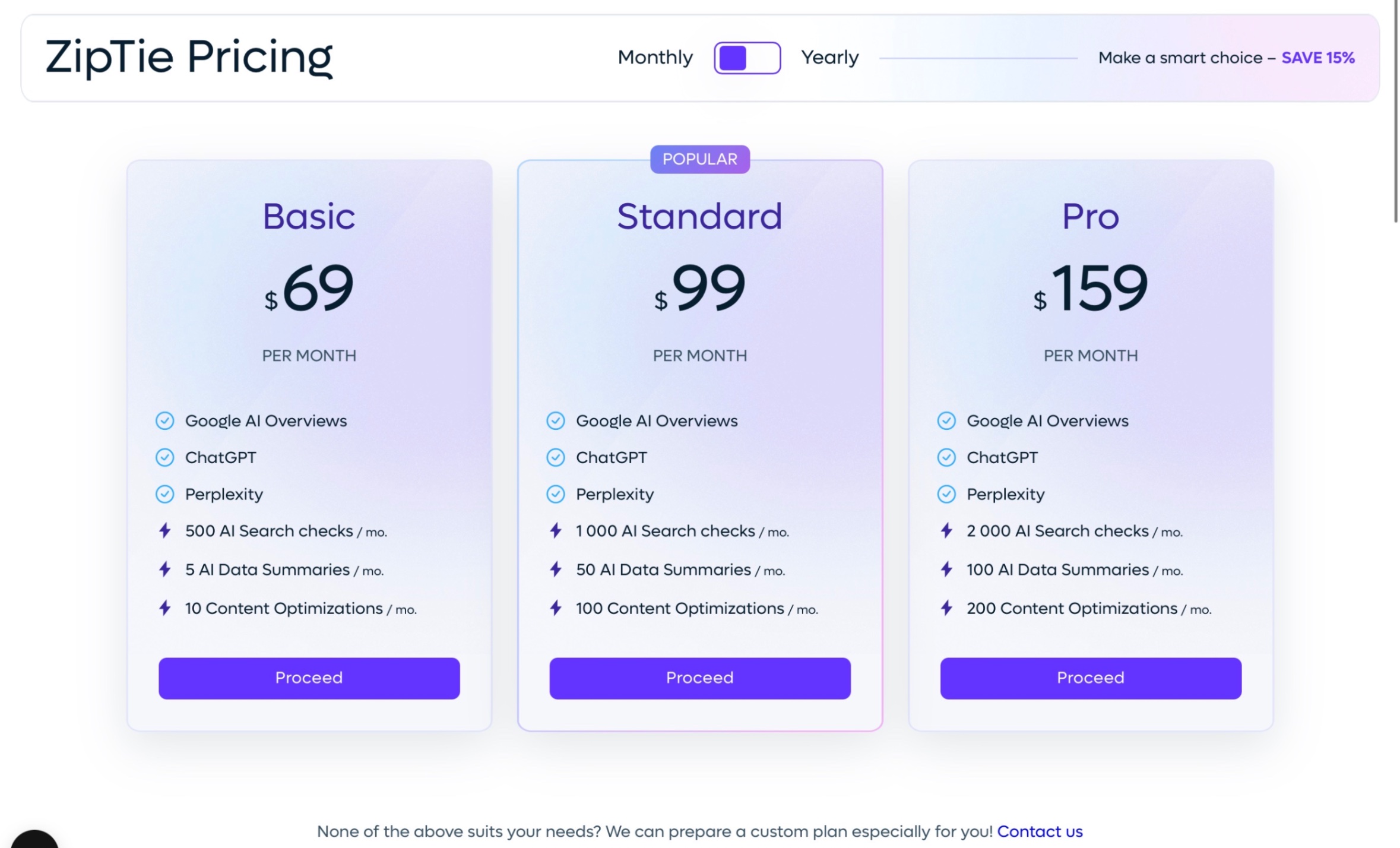
ZipTie offers three public plans: Basic at $69 per month, Standard at $99 per month, and Pro at $159 per month. Each plan supports Google AI Overviews, ChatGPT, and Perplexity, while custom pricing is available for teams with higher requirements.
All plans include one seat and come with a 14-day free trial. ZipTie also offers a stated 15% discount on annual billing.
Who is ZipTie best suited for?
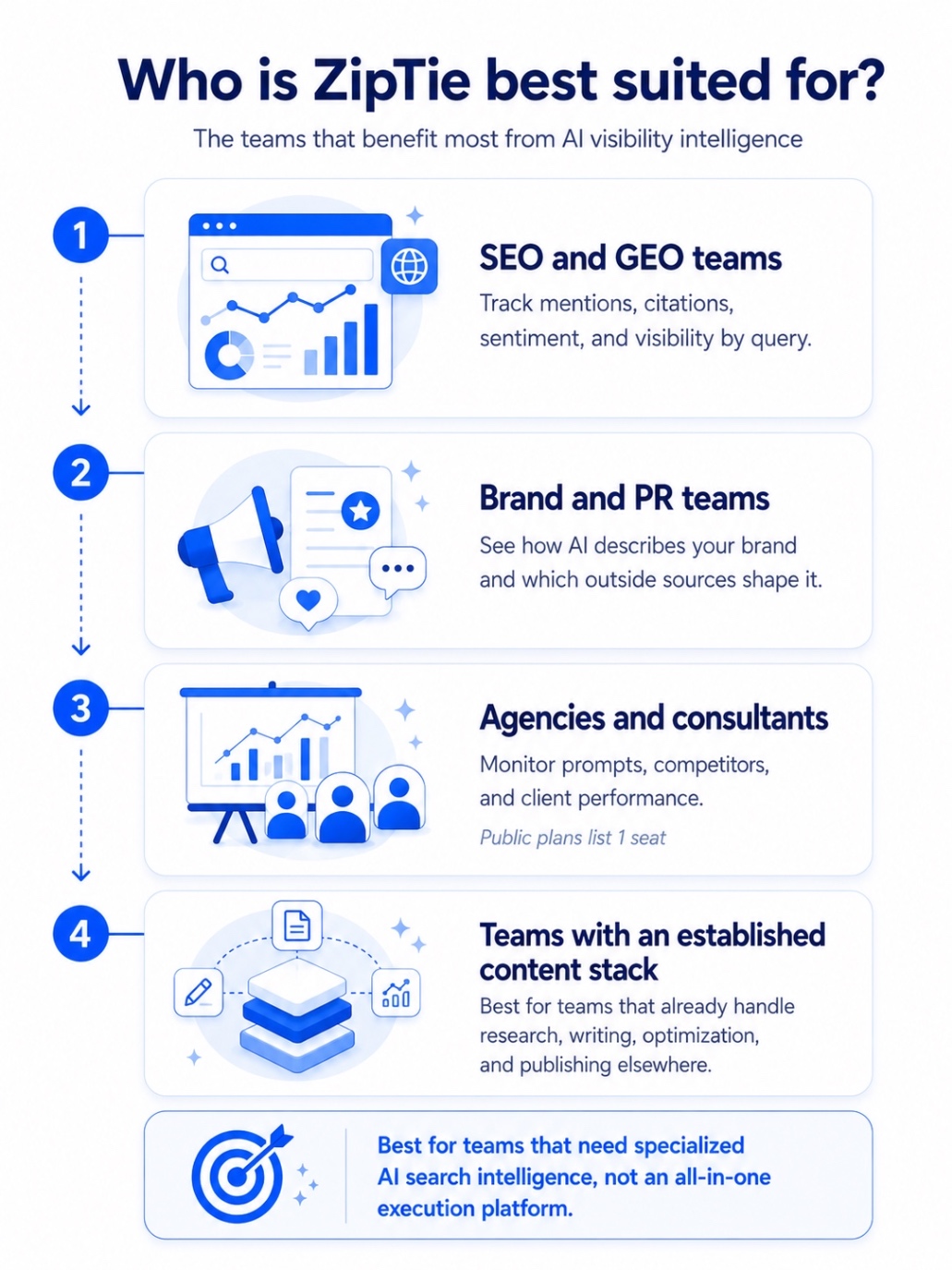
ZipTie is best suited for teams that already have a content and SEO workflow but need a clearer view of how their brand appears across AI-generated answers.
Here are the teams most likely to benefit from it.
1. SEO and GEO teams
SEO and GEO teams can use ZipTie to track whether optimization efforts improve brand mentions, citations, sentiment, and overall visibility across ChatGPT, Perplexity, and Google AI Overviews. It is especially useful for comparing performance at the project, category, and individual query levels.
2. Brand and PR teams
Brand and PR teams can see how AI engines describe the company, products, and key use cases. Citation and source reports also reveal which publishers, review sites, and third-party pages influence that representation, helping teams prioritize digital PR and reputation-building opportunities.
3. Agencies and consultants
Agencies can use ZipTie for prompt monitoring, competitor benchmarking, source analysis, and client reporting. However, the public Basic, Standard, and Pro plans currently include one seat, so agencies that need broader collaboration or account access should confirm whether a custom plan is required.
4. Teams with an established content stack
ZipTie is a stronger fit for teams that already use separate tools for keyword research, content creation, page optimization, internal linking, audits, and publishing. It adds an AI search intelligence layer that shows where visibility gaps exist and which prompts or pages need attention.
Overall, ZipTie fits teams that primarily need specialized AI visibility intelligence, not an all-in-one platform for planning, creating, optimizing, and publishing content.
Where may ZipTie AI Search Analytics fall short?
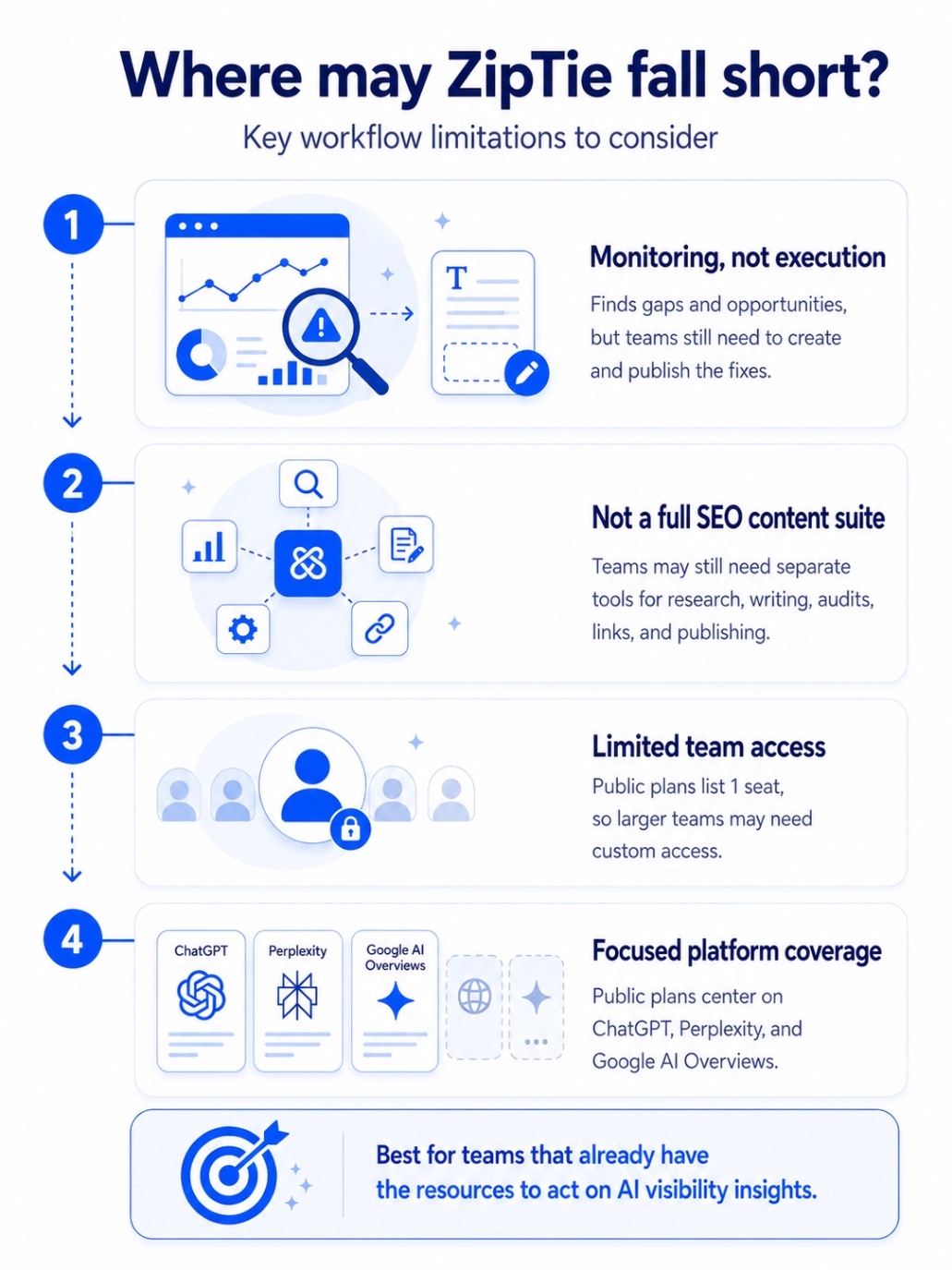
ZipTie provides detailed AI visibility insights and content recommendations, but it may not cover every stage of a broader SEO and content workflow. Its fit depends largely on the tools and processes a team already has in place.
Here are the main limitations to consider.
1. Its strongest value lies in monitoring and diagnosis
ZipTie helps teams find weak prompts, missing citations, competitor advantages, influential sources, and content gaps. These insights make it easier to understand a different layer of visibility and why a brand may be underperforming across AI search platforms.
However, identifying an opportunity is only the first step. Teams must still turn those findings into finished articles, updated landing pages, digital PR campaigns, or other published assets. The platform recommends what to improve, but the wider production process remains with the user.
2. It may not replace a complete SEO and content platform
ZipTie includes AI search monitoring and a content optimization module, but it is not positioned as an all-in-one platform for every SEO and content task.
Teams may still need separate tools for keyword clustering, SERP research, content briefs, long-form article creation, website-wide audits, internal-link optimization, cannibalization analysis, and publishing. This can create extra handoffs between finding a visibility gap and implementing the solution.
3. Public plans include limited team access
ZipTie’s Basic, Standard, and Pro plans currently include one seat. This may work well for individual marketers and smaller teams, but agencies and larger organizations may need a custom plan to provide access across multiple contributors or client accounts.
Teams should confirm collaboration options before choosing a plan, particularly when several writers, strategists, and account managers need to use the data.
4. Its public platform coverage is focused
ZipTie currently lists ChatGPT, Perplexity, and Google AI Overviews across its public plans. These platforms cover several major AI search experiences, but teams that also want to monitor Claude, Gemini, Copilot, or other engines should verify whether broader coverage is available.
Overall, ZipTie is most useful when a team already has the resources to act on its insights. The larger the execution gap, the more likely additional tools will be required.
How does Scalenut fill the execution gaps in ZipTie?
ZipTie helps teams identify where their brand appears in AI search and where visibility gaps exist. Scalenut extends that workflow with tools to create, optimize, and publish the content needed to address those gaps.
Here is how Scalenut moves teams from insight to execution.
1. Turn visibility gaps into complete GEO articles
Teams can take a missing topic or prompt opportunity into Cruise Mode for research, outlining, and long-form content creation. Scalenut uses SERP insights, competitor coverage, and relevant prompts to build articles designed for both traditional search and AI discovery.
2. Apply recommendations to existing pages
Scalenut’s Content Optimizer evaluates prompt coverage, relevant terms, structure, readability, metadata, schema, and missing sections. Instead of leaving teams with a list of suggestions, Auto Optimize can apply selected improvements to headings, terms, and on-page elements.
3. Connect prompts to a broader content strategy
Scalenut places individual prompt gaps within the wider website strategy. Its tools cover keyword clustering, topic planning, content audits, internal linking, traffic analysis, and cannibalization detection.
This helps teams decide whether an opportunity requires a new article, an update to an existing page, stronger internal links, or a broader topic cluster.
4. Move optimized content toward publication and authority building
Depending on the plan, teams can publish or update content through WordPress and Shopify integrations. Social UpReach helps identify relevant Reddit conversations, while the Backlinks Marketplace supports off-page authority building.
Scalenut is therefore a stronger fit for teams that want AI visibility data and the execution workflow needed to act on it within one platform.
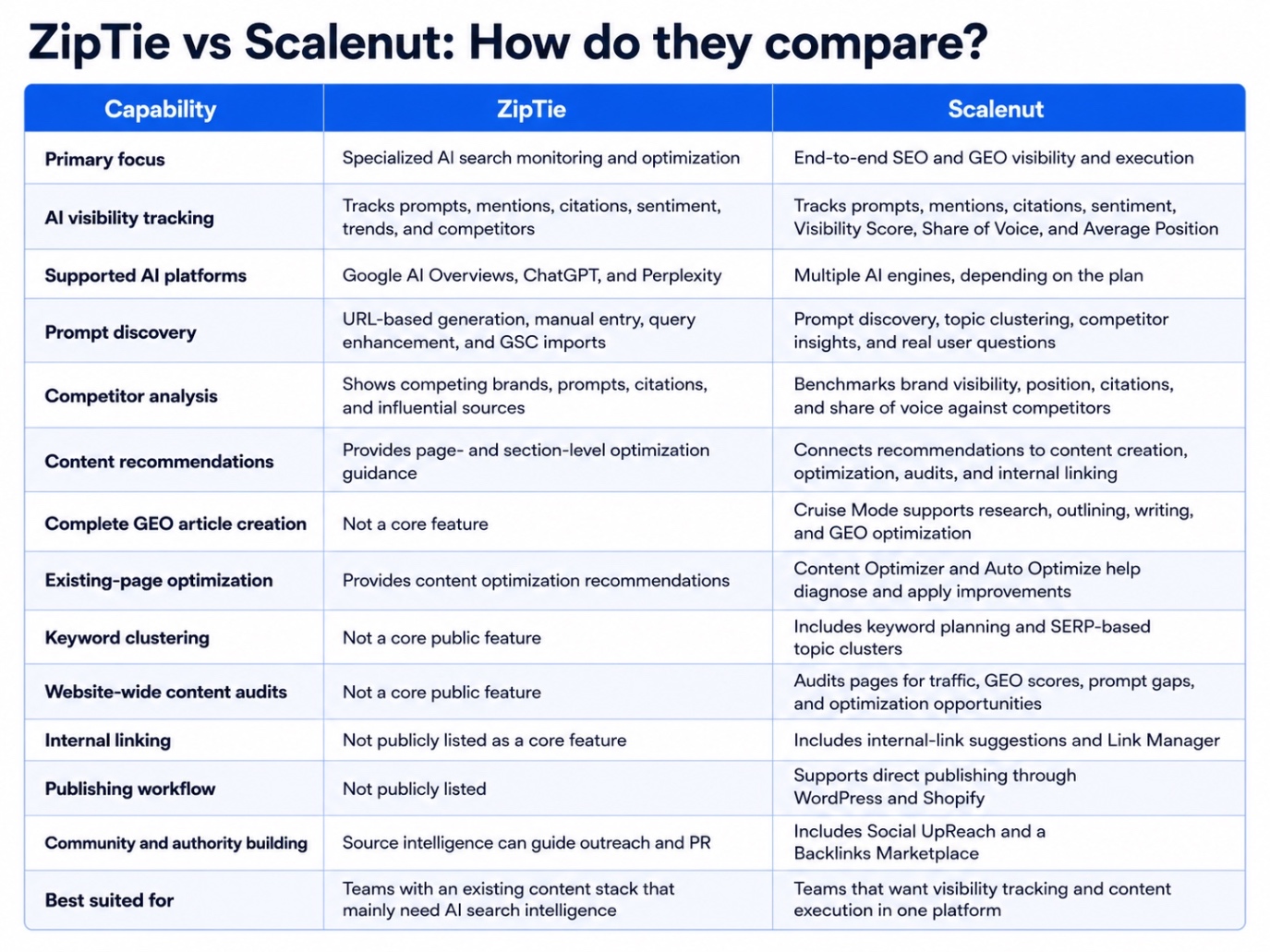
Is ZipTie AI Search Analytics worth it?
ZipTie is worth considering for SaaS companies and teams that already have a strong content and SEO stack and mainly need clearer visibility into brand mentions, citations, sentiment, competitors, and influential sources across AI search platforms.
However, if you also need to turn those insights into new articles, optimized pages, stronger internal links, and published updates, Scalenut offers a more complete execution workflow. Book a free strategy call with Scalenut to see how your team can improve AI visibility and act on the gaps you uncover.
Frequently asked questions
What is AI search analytics and why is it important?
AI search analytics measures how brands appear across AI search engines, including mentions, citations, sentiment, competitors, and source influence. It matters because traditional search rankings do not show whether a brand is included in organic results, recommended, or accurately represented inside generated answers.
Why choose ZipTie AI Search Analytics?
Choose ZipTie when your main goal is understanding your brand’s visibility across ChatGPT, Perplexity, and Google AI Overviews. It combines prompt monitoring, citation tracking, competitor benchmarking, and sentiment analysis, including brand mention frequency, so teams can diagnose where their AI presence is strong or weak.
What is the ZipTie AI search performance tool?
The ZipTie AI search performance tool is a monitoring platform that records how brands and websites appear in AI search results. It tracks prompts, mentions, citations, sentiment, competitors, and influential sources, then organizes those signals into query, category, and project-level reports.
Why choose the ZipTie AI search performance tool?
ZipTie is useful for teams that want prompt-level reporting without checking each AI assistant manually. Its performance reports connect mentions, citation presence, sentiment, and competitor activity, making it easier to prioritize commercially valuable queries and identify where closer investigation is needed.
Is ZipTie.ai effective for search optimization?
ZipTie can support generative engine optimization by identifying weak prompts, missing citations, influential sources, and content gaps. Its effectiveness depends on whether the team can turn those findings into stronger pages, external mentions, and repeated testing across the supported platforms.
What are the pros and cons of using ZipTie.ai for SEO?
ZipTie’s main advantages are specialized AI monitoring, query discovery, source intelligence, and competitor analysis. Its limitations are narrower platform coverage, one seat on public plans, and a monitoring-led workflow. Content teams may still need separate creation, auditing, linking, and publishing tools.
Why choose ZipTie for AI search monitoring?
Choose ZipTie for AI search monitoring when you need consistent prompt tracking across changing search environments. It captures full responses in real time and separates mentions, citations, sentiment, and competitor visibility, giving teams more reliable trend data than occasional manual searches or isolated screenshots.
How effective is ZipTie AI search optimization?
ZipTie is effective at showing where visibility gaps exist and which pagesmissing entities or sources may influence them. However, improving an AI citation still requires content updates, stronger evidence, better source authority, and ongoing testing. The platform guides prioritization rather than completing every optimization task.
Which is better: ZipTie or other AI search monitoring tools like Scalenut?
The better choice depends on workflow needs. ZipTie suits teams that already have an execution stack and mainly need specialized monitoring. Scalenut is stronger when visibility data must connect directly to new content, existing-page optimization, audits, internal linking, and publishing within one platform.
How does ZipTie.ai compare to other AI search tools?
ZipTie is more specialized than many broader AI search tools, focusing on prompt monitoring, citations, sentiment, competitors, and source intelligence. Other platforms may cover additional engines or provide deeper content execution than traditional tools, so the best fit depends on coverage, collaboration, and workflow requirements.
Is ZipTie better than other AI search monitoring tools?
ZipTie may be better for teams prioritizing focused monitoring across ChatGPT, Perplexity, and Google AI Overviews. It may be less suitable when broader platform coverage, multiuser collaboration, website-wide SEO analysis, or built-in content production matters more than specialized visibility reporting.
Can ZipTie optimize content or only track AI visibility?
ZipTie does more than track visibility. Its content optimization module can analyze existing pages and recommend topics or sections that may improve mentions and citations. However, users must still review, write, implement, publish, and measure those changes through their wider content workflow.
Is ZipTie suitable for agencies and larger teams?
ZipTie can support agencies through prompt tracking, competitor benchmarking, source analysis, and client reporting. However, its public Basic, Standard, and Pro plans currently list one seat, so agencies and larger teams should confirm custom access, workspace, and collaboration options before subscribing.
Is Scalenut an alternative to ZipTie?
Yes. Scalenut is an alternative for teams that want AI visibility tracking combined with keyword planning, article creation, page optimization, audits, internal linking, and publishing. ZipTie is better aligned with SEO teams that already have those execution capabilities and need a focused intelligence layer.
Which AI platforms does ZipTie track?
ZipTie’s public self-service plans track ChatGPT, Perplexity, and Google AI Overviews. This coverage includes several major AI discovery channels, but businesses that also require Claude, Gemini, Copilot, or other platforms should verify whether broader monitoring is available through a custom arrangement.


.svg)


.webp)