
Quick summary
- Content priorities: Clear, accessible pages, accurate brand information, third-party validation, query fan-out coverage, and original research remain central to GEO.
- Discovery developments: Multimodal and personalized search, platform-specific analysis, AI agents and product feeds, and native AI reporting expand opportunities beyond citations.
- SEO foundations still matter: Google’s AI search features require no special schema, mandatory content chunking, or ideal page length.
- Brand accuracy needs attention: Keep pricing, features, and positioning consistent, and review third-party sources that influence AI descriptions of your business.
- Refresh selectively: Correct outdated facts, answer missing customer questions, add firsthand evidence and useful visuals, and connect relevant supporting pages.
- Measure meaningful progress: Track mentions, linked citations, factual accuracy, native visibility reports, referral traffic, and conversions across consistent questions and comparable periods.
Some familiar GEO advice has aged poorly. Breaking pages into tiny chunks or adding special schema is not a requirement for Google’s AI search features. Meanwhile, visual discovery, personalized answers, and AI shopping are creating practical new priorities.
The trends in generative engine optimization that deserve your attention are the ones connected to how customers research and choose. This guide explains eight developments shaping GEO in 2026, shows what to update in existing content, and covers the metrics you need to assess visibility, accuracy, and customer actions.
What is generative engine optimization?
Generative engine optimization (GEO) focuses on improving how your content and brand appear in AI-generated answers, including mentions and source citations. It overlaps with answer engine optimization (AEO) and builds on established SEO practices.
How does GEO work in AI search?
Web-connected AI search engines retrieve information and combine it into answers. Some systems, including Google AI Mode, use query fan-out to investigate related questions across multiple sources.
Your content needs to address relevant questions with useful, verifiable information. Retrieval and citation are not guaranteed, so assess visibility across repeated questions rather than relying on one answer.
Why does GEO matter in 2026?
AI experiences increasingly help people research options and compare products before visiting a website. ChatGPT’s expanded shopping experience is one example.
For businesses, the practical priority is accurate representation: current pricing, clear product capabilities, relevant use cases, and evidence supporting your claims.
How does generative engine optimization differ from SEO?
When comparing generative engine optimization vs SEO key features, focus on the visibility each approach measures:
- SEO: Track how pages perform across traditional search engine results through rankings, impressions, clicks, and conversions.
- GEO: Track brand mentions, linked citations, answer accuracy, and traffic or conversions from AI experiences.
A combined SEO and GEO approach shares the same foundations: accessible pages, useful original content, relevant internal links, and accurate information. Google confirms that its AI search features use its core Search ranking and quality systems.
Use keywords naturally instead of chasing a fixed keyword density. Likewise, marking up FAQs is not a requirement for Google’s AI features. Formatting and structured data should support the page’s purpose; they do not guarantee rankings or citations.
What are the biggest trends in generative engine optimization in 2026?
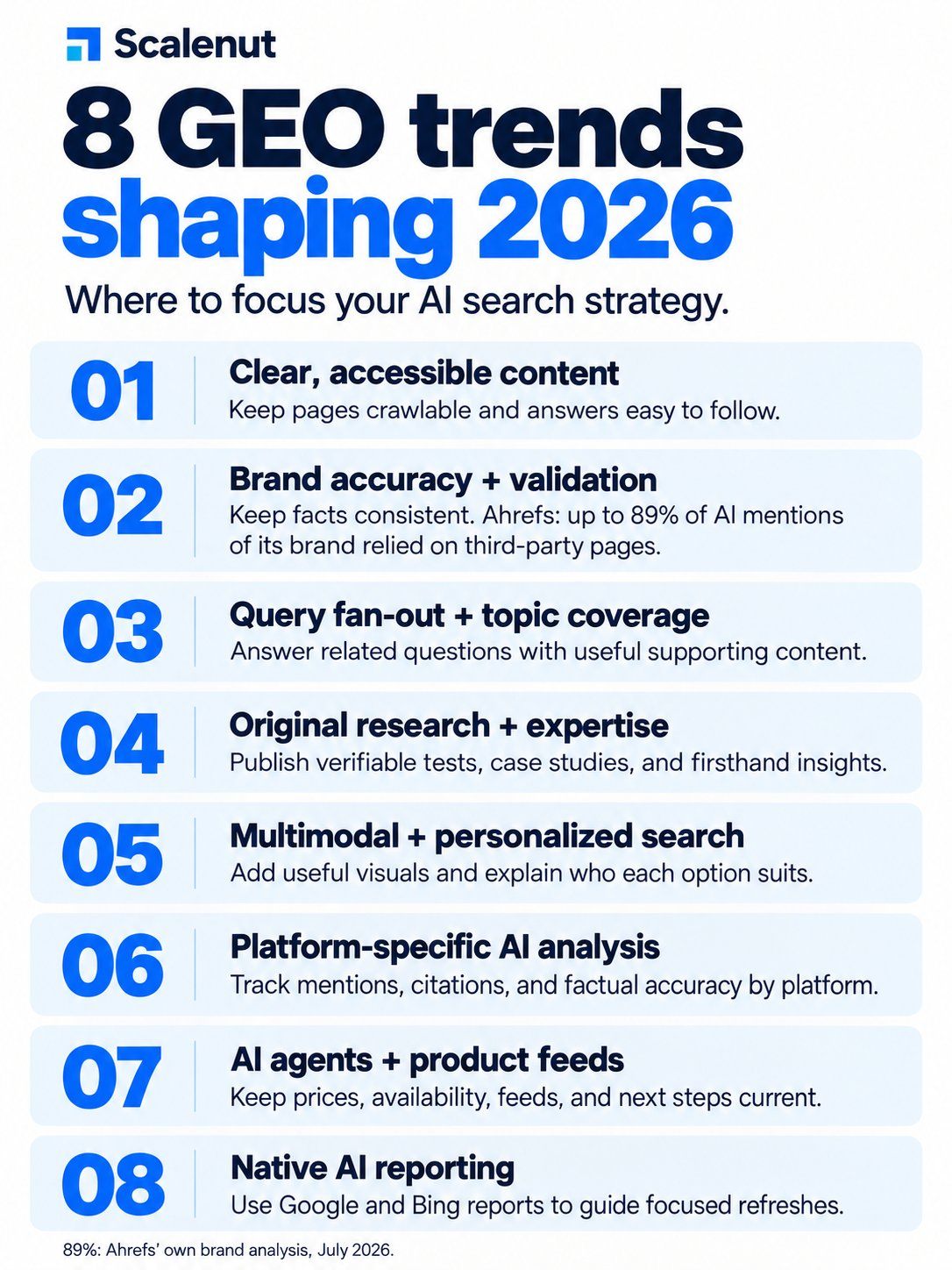
Current trends in generative engine optimization combine strong search engine optimization foundations with visual discovery, personalized answers, AI shopping, and better measurement. The priority is keeping useful information accessible, accurate, and relevant to customer decisions.
Here are eight developments shaping GEO priorities in 2026.
1. Clear, accessible content remains essential for AI discovery
Clear writing and accessible pages remain foundational. Google’s updated guidance confirms that its AI search features have no ideal page length, mandatory content “chunking,” or special schema requirement. Give readers enough detail to answer their question.
Place the main answer near the relevant heading, organize supporting details logically, and use lists where they improve readability. Keep important explanations available as readable page content.
Check technical eligibility too. Alongside crawling, indexing, and snippet eligibility, review Google’s Search generative AI control. Rolled out worldwide in August 2026, it manages inclusion in AI Overviews, AI Mode, and generative Discover features.
2. Accurate brand information and third-party validation shape AI answers
AI answers can draw on your website, reviews, industry coverage, and customer discussions. In its own brand analysis, Ahrefs reported that up to 89% of AI answers mentioning Ahrefs relied on third-party pages, illustrating the importance of information beyond your website.
Keep your company name, product category, features, pricing, and target audience consistent across pages and profiles you control. Earn relevant coverage through customer results, expert contributions, and useful industry participation.
When reviewing AI answers, check how your business is described, which sources support that description, and whether the recommendation fits the customer’s needs.
3. Query fan-out expands the need for useful topic coverage
A detailed question can trigger several related searches. Google calls this query fan-out: investigating subtopics and sources before combining findings into a response. Supporting questions therefore deserve attention in content planning.
Someone researching GEO software may also need answers about platform coverage, pricing, reporting, and implementation. Build topical authority by addressing these practical questions and linking related explanations.
Expand existing pages where the missing information belongs. Create separate pages when a subject needs depth. Google cautions against producing content for every possible query variation primarily to manipulate visibility.
4. Original research and firsthand expertise help content stand out
Original information gives readers a reason to consult your page. Google’s content guidance emphasizes research, meaningful analysis, clear sourcing, and demonstrable firsthand experience.
Useful additions include:
- Customer case studies explaining the starting point, changes, and results.
- Surveys documenting sample size, collection dates, and limitations.
- Product tests supported by screenshots and a clear method.
- Expert observations explaining practical tradeoffs or common failures.
Identify who conducted the work and how conclusions were reached. Distinguish measured results from interpretation. A focused, verifiable example can add more value than another broad list of familiar tips.
5. Multimodal and personalized search are reshaping discovery
Discovery increasingly includes images and user context. In September 2026, Google began rolling out multimodal reporting for Lens, Circle to Search, image uploads, and Chrome’s “Search this image” feature.
Google also expanded Personal Intelligence in AI Mode in May 2026 to nearly 200 countries and territories across 98 languages. Users can choose to connect supported apps for more contextual responses.
Add useful visual evidence, such as product screenshots, demonstrations, or original photographs, with descriptive supporting text. Explain how recommendations change with budget, location, experience, or business size. A software comparison becomes more useful when it distinguishes the needs of a small content marketing team from an enterprise.
6. AI visibility needs platform-specific analysis
AI platforms have different search features, access controls, and reporting coverage. Analyze the platforms your audience uses individually.
For example, OpenAI separates OAI-SearchBot, which supports ChatGPT search discovery, from GPTBot, which concerns model training. Publishers can manage these permissions independently. Check platform documentation before changing crawler settings.
Test a consistent set of customer questions across relevant platforms. Record brand mentions, linked citations, cited pages, and factual errors separately. Repeat checks over time, noting the platform, date, and testing conditions.
This helps identify specific gaps, such as outdated pricing in one platform or missing comparison coverage in another.
7. AI agents and product feeds extend discovery beyond citations
AI search increasingly supports product selection and actions. OpenAI’s March 2026 shopping update introduced richer visual comparisons and expanded the Agentic Commerce Protocol to support discovery through merchant feeds and promotions.
Google’s July 2026 connected-apps rollout in the US brought actions into AI Mode, including adding groceries to Instacart carts and accessing Canva templates.
Ecommerce businesses should review product specifications, prices, availability, images, and supported catalog feeds. SaaS and service businesses should prioritize clear integration details, requirements, availability, and signup or booking instructions. Consider deeper integrations where a supported experience matches how customers buy.
8. Native AI reporting makes GEO measurement more actionable
Google’s dedicated Generative AI performance reports reached websites worldwide in August 2026. They provide impressions and breakdowns by page, country, date, and device where supported, helping identify which URLs appear in Google’s AI features.
Bing’s June 2026 reporting expansion added preview features for Intents, Topics, Citation Share, and period comparisons. Citation Share measures a site’s proportion of citations for a grounding query; it is an observational metric rather than a ranking or traffic score.
Use visibility changes to prioritize focused refreshes. Check affected pages for inaccurate facts, outdated examples, and missing developments. Record updates and compare performance across comparable periods.
Review referral traffic and conversions alongside visibility. Impressions, citations, and customer actions measure different stages of discovery.
Your next GEO priority should address the weakest step in that journey: being found, being described accurately, or helping the customer take the next action.
How can you apply these GEO trends to your existing content?
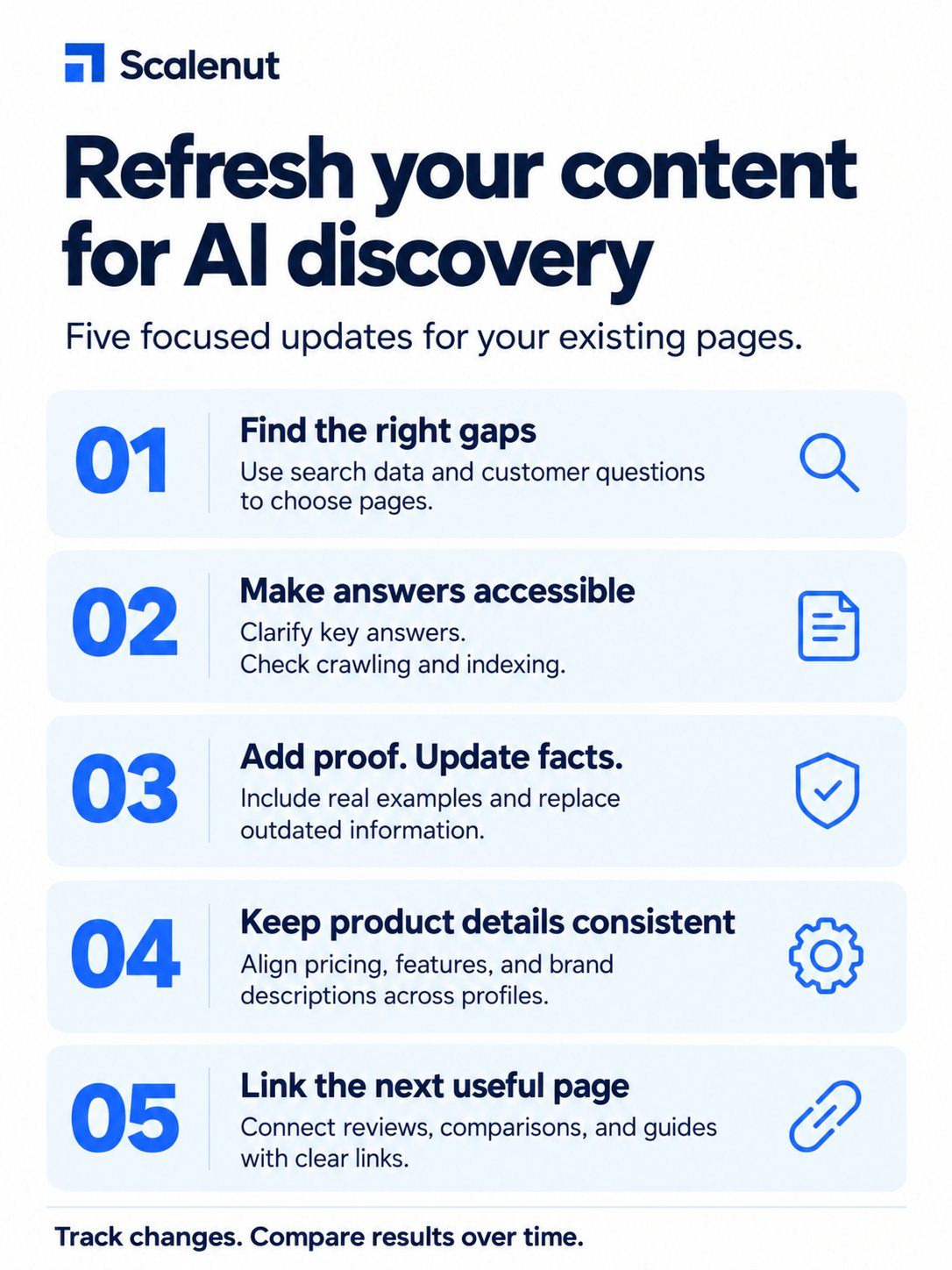
Apply the best generative engine optimization techniques through focused updates to pages that support customer decisions. Use search performance, recurring questions, and accuracy checks to identify where an update would be most useful.
Here are five steps to guide your refresh.
1. Choose pages and customer questions that need attention
Prioritize important pages with declining visibility, outdated information, or unanswered customer questions. Review Search Console queries alongside sales and support conversations.
For example, if customers repeatedly ask whether an SEO tool supports Perplexity, add a verified platform-coverage explanation to the relevant review or comparison page.
2. Clarify answers and check technical accessibility
Place the main answer near its heading, then add the evidence and context readers need. Check that important text is accessible and relevant search crawlers can reach the page.
For Google’s AI features, confirm indexing, snippet eligibility, and inclusion through Search Console’s Search generative AI setting. These establish eligibility, not guaranteed visibility.
3. Add original evidence and correct outdated facts
Replace old statistics, discontinued features, and unsupported claims with verified information. Add a useful example, such as a documented product test, customer result, or expert observation.
Explain who conducted the work, when it happened, and how conclusions were reached. This gives readers evidence they can assess rather than another generic recommendation.
4. Keep brand and product information consistent
Audit pages and profiles you control for mismatched names, pricing, features, and audience descriptions. Update outdated details and explain product limitations clearly.
If AI repeatedly misrepresents your offering, inspect the sources it cites. Correct information you own and flag inaccuracies in relevant third-party listings. Ahrefs’ documented examples show how gaps in product information can contribute to inaccurate answers.
5. Connect relevant supporting pages through internal links
Add contextual links where readers need further explanation, using anchor text that describes the destination.
A comparison article could link to a detailed review for testing evidence and a pricing guide for plan limits. Relevant links help readers navigate and support search discovery; avoid adding links solely to increase their number.
Record what you changed and compare performance over time, using the customer question each edit resolves as the basis for judging its value.
How do you measure success in GEO AI search optimization?
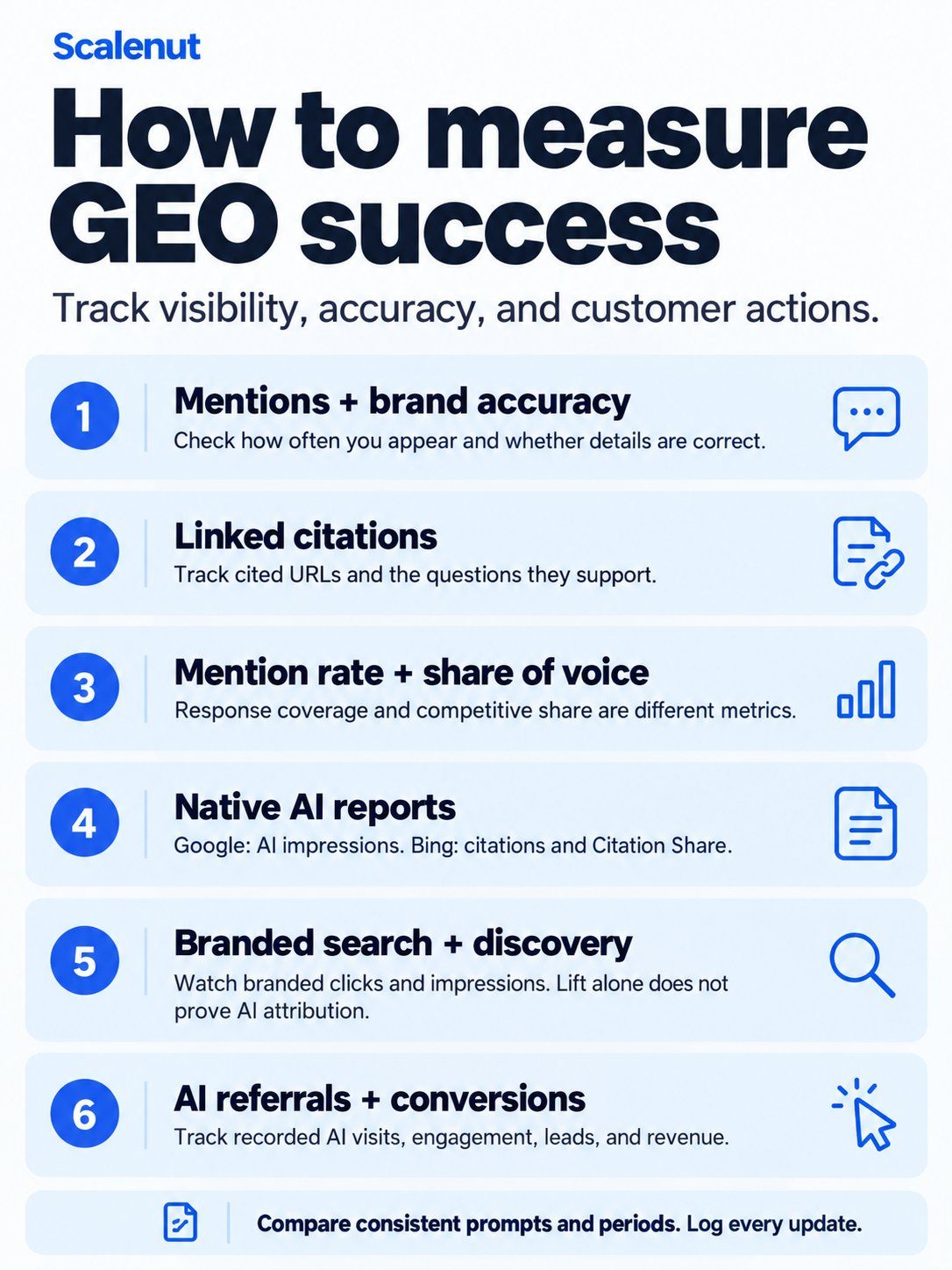
Measure GEO through brand visibility, accurate brand representation, and customer actions. Mentions and citations show exposure, while qualified leads, purchases, and revenue help assess business value.
Here are six areas to track.
1. AI answer mentions and brand accuracy
Monitor brand mentions across relevant questions on ChatGPT, Gemini, and Perplexity. Check whether answers describe your features, pricing, and audience correctly.
Review repeated answers across a consistent prompt set. A negative mention or unsuitable recommendation needs investigation, even if your visibility increases.
2. Linked citations and cited pages
Record which URLs appear as linked sources and which questions they support. Distinguish citations to your website from third-party pages mentioning your brand.
Use citation patterns to identify useful content and investigate gaps. A citation records a reference; it does not establish traffic, sales, or a quality score.
3. Mention rate and competitive share of voice
Keep the denominators clear:
- Mention rate: Responses mentioning your brand ÷ total responses checked × 100.
- Competitive share of voice: Your brand’s mentions ÷ mentions of all tracked brands, including yours, × 100.
Appearing in 20 of 100 responses gives a 20% mention rate. Check your tool’s definitions before comparing scores, since visibility and competitive share measure different things.
4. Native AI visibility reports
Use Google’s Generative AI performance reports in Search Console to review impressions and appearing URLs across AI Overviews, AI Mode, and generative Discover features.
Bing Webmaster Tools adds citation reporting and preview features for Topics, Intents, Citation Share, and period comparisons. Citation Share describes citation presence, not ranking or traffic share.
5. Branded search and indirect discovery
Track branded-query impressions and clicks in Search Console. These measure your site’s search performance, not total branded search volume.
Branded search and direct-traffic growth can suggest increased awareness, but cannot prove AI caused it. Direct traffic can also reflect missing referral information. Supplement analytics with customer discovery feedback where practical.
6. AI referral engagement and conversions
In GA4’s Traffic acquisition report, use Session source / medium to identify recorded AI referrals. Review engagement rate, average engagement time per session, lead or purchase key events, and revenue where configured.
Compare similar landing pages and periods. Evaluate your own results before concluding that AI visitors convert better than other audiences.
Record content updates and compare equivalent periods under consistent testing conditions. Use visibility changes to guide focused refreshes, and assess ROI against attributable business value and the cost of your GEO work.
How can Scalenut help you put GEO trends into action?
Start with the questions where your brand needs stronger visibility. Scalenut’s AI Visibility helps you monitor brand mentions, cited sources, sentiment, and competitor presence across supported AI platforms. Use those insights to identify gaps worth investigating and decide which pages deserve attention first.
Turn those findings into focused updates with Scalenut’s content planning, Content Optimizer, and internal linking tools. Improve relevant pages, connect supporting answers, and compare visibility over time. Book a Scalenut demo to explore how AI visibility tracking and content execution can fit into your team’s workflow.
Final thoughts
The search landscape now spans organic search results, visual discovery, AI shopping, and answers shaped by large language models. The best generative engine optimization for AI visibility starts with accurate information, original evidence, and a clear structure aligned with user intent. Give readers a direct answer, then the context they need to make a decision.
For small teams, start with a few important pages: correct outdated details, fill useful gaps, and compare results over time. Use GEO tools alongside native reports and analytics to assess mentions, citations, organic traffic, and conversions. Keep content production tied to customer needs, and maintain the SEO foundations that support traditional search results as you expand into newer discovery channels.
Frequently asked questions
Which GEO trends should businesses prioritize in 2026?
The priorities are accessible content, original evidence, accurate brand information, and coverage of related customer questions. Add useful visuals, product feeds, or agent integrations where they match your business, and use platform-specific reporting to identify visibility gaps.
How does GEO differ from traditional SEO?
SEO improves how pages appear in search results. GEO focuses on how brands and sources appear in AI-generated answers. They share foundations such as useful content, crawlability, and credibility; Google’s AI features also rely on its core Search systems.
Can businesses improve GEO without rewriting existing content?
Yes. Start with pages containing outdated facts, unclear answers, or missing customer questions. Correct the information, add useful evidence, and link relevant supporting pages. Prioritize substantive improvements; changing publication dates or rewriting solely for AI does not establish content quality.
Do Google’s AI search features require special schema or formatting?
No special schema, llms.txt file, mandatory chunking, or ideal page length is required for Google’s AI features. Use formatting for readability and structured data for supported search features. These measures cannot guarantee inclusion in an AI answer.
How can businesses measure GEO results?
Track Google AI impressions in Search Console and citations in Bing Webmaster Tools. For other platforms, monitor consistent customer prompts, recording mentions, citations, and factual accuracy. Assess referral traffic and conversions separately because visibility alone does not prove business impact.
Does the same GEO strategy work across all AI platforms?
The foundations overlap, but access controls and search behavior differ. AI engines like ChatGPT uses OAI-SearchBot for search discovery, while Perplexity uses PerplexityBot. Check each platform’s documentation and results separately. Allowing search access is distinct from model-training permission and does not guarantee citations.
What are the best tools available for GEO AI search optimization in 2026?
Scalenut combines AI visibility tracking with content creation and optimization. Other options include Peec AI for prompt tracking and competitor analysis, and Profound for AI search analytics and content workflows. Choose based on supported platforms, reporting needs, and budget.
What’s the best generative engine optimization strategy for AI?
To decide which generative engine optimization is best for AI, prioritize useful answers, original evidence, accessible pages, and accurate brand information. Adapt access settings to each platform, then assess repeated answers, citations, factual accuracy, and customer actions.
What are the generative engine optimization best practices for 2026?
Publish original, evidence-backed answers, keep pages crawlable, and maintain accurate brand and product details. Add useful visuals and cover related customer questions. Use platform-specific reports to prioritize updates, then evaluate mentions, citations, factual accuracy, referral traffic, and conversions together.