

Profound vs Peec AI for GEO: Quick summary
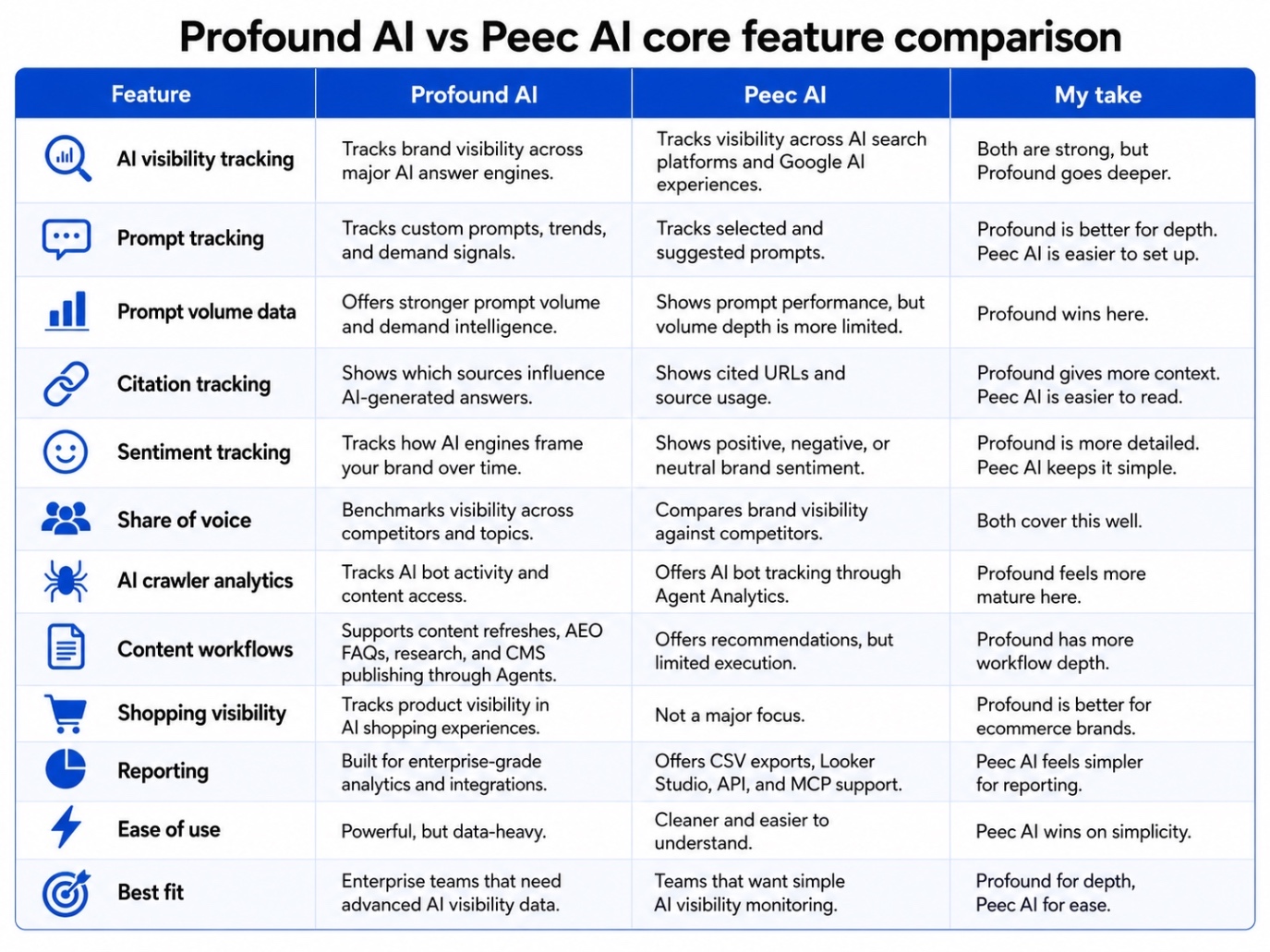
- Profound is better for enterprise teams that need deeper AI visibility data, prompt volume insights, AI crawler analytics, citation tracking, and advanced reporting.
- Peec AI is better for teams that want simpler AI visibility tracking with cleaner dashboards, easier reporting, prompt monitoring, source tracking, and sentiment scores.
- Profound gives more depth, but it can feel heavy if your team does not have the time, budget, or workflow to act on the data.
- Peec AI is easier to use, but lighter on execution because content planning, writing, optimization, and publishing still happen outside the platform.
- Neither platform removes the need for a broader SEO and GEO workflow covering strategy, editorial review, technical optimization, internal linking, and off-site authority. This leaves room for alternatives that connect visibility tracking with more complete execution.
At first glance, Profound vs Peec AI for GEO looks like a simple $99 vs $95 decision. But that small price difference hides two very different platforms.
Profound goes deeper with prompt intelligence, crawler analytics, citation data, and content Agents. Peec AI keeps things simpler with three-model tracking, unlimited users, cleaner reporting, and more affordable scaling.
Profound scores 4.6 from 323 reviews on G2, while Peec AI scores 4.9 from just 11. So, which one gives your team better value? Let’s compare their data, coverage, usability, execution, and limitations in detail.
Profound AI vs Peec AI AEO comparison: Which tool is better?
Profound overview
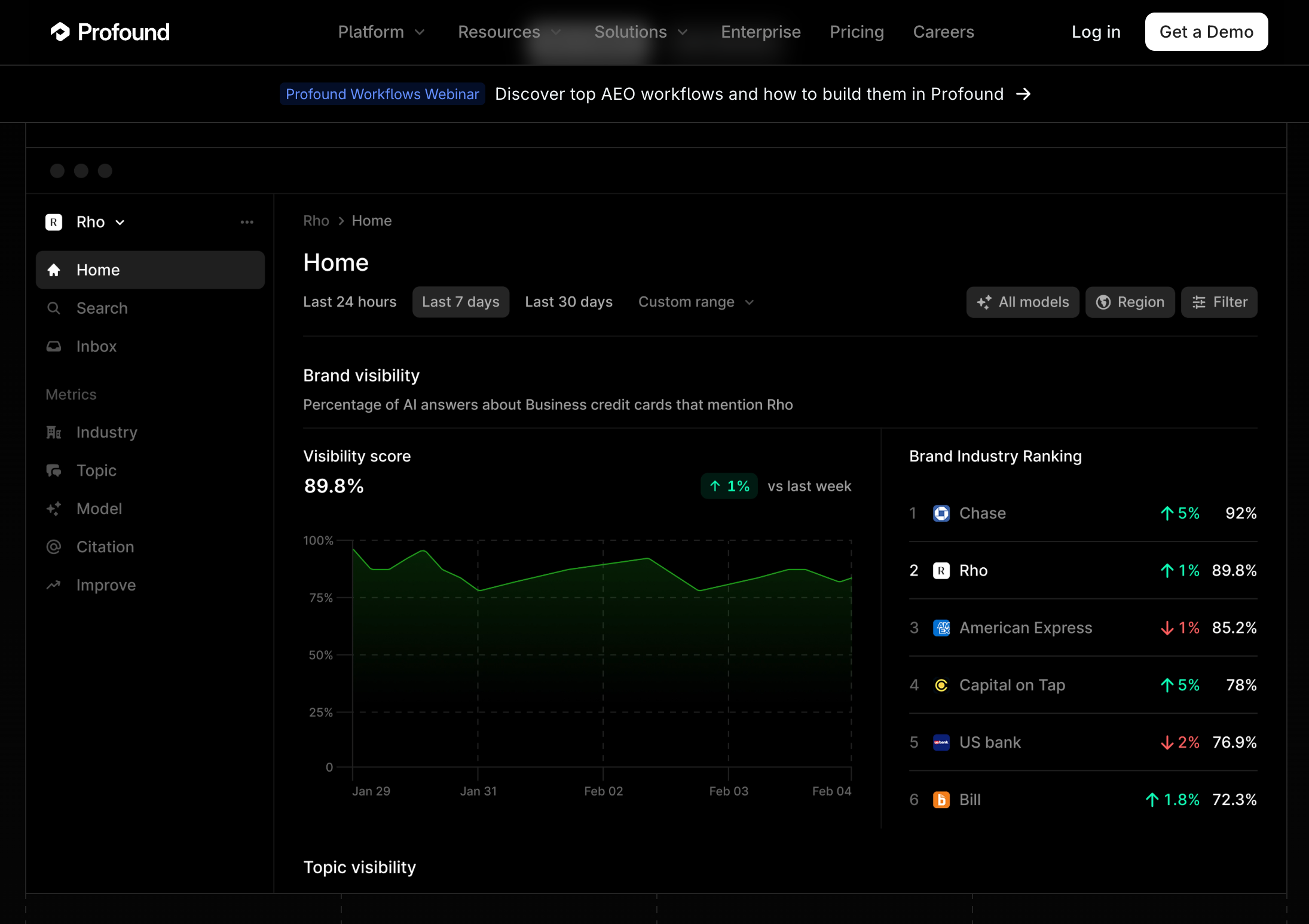
Profound is built for teams that want more than basic AI mention tracking. Depending on your plan, it can monitor brand visibility across ChatGPT, Perplexity, Google AI Overviews, AI Mode, Gemini, Claude, Copilot, Grok, DeepSeek, and Meta AI.
Its biggest advantage is depth. Profound helps teams analyze mentions, citations, sentiment, real-user prompt demand, AI crawler behavior, competitive visibility, and shopping performance. Its Agents can then turn some of those insights into content research, optimization, and publishing workflows.
The tradeoff is that Profound can feel complex and enterprise-heavy. Several of its most valuable research, reporting, security, and model-coverage capabilities are available only on higher plans.
What are the core features of Profound?
- Answer Engine Insights: Tracks how frequently and prominently your brand appears in AI-generated answers across supported platforms.
- Citation tracking: Shows which domains and URLs AI engines cite when answering questions about your brand, competitors, or category.
- Prompt Volumes and Prompt Research: Analyzes more than 1.5 billion real-user prompts to identify demand, intent, trends, related questions, and visibility gaps. Availability depends on the plan.
- Agent Analytics and AI traffic attribution: Uses server-log data to show which AI crawlers visit your website, which pages they access, how often they return, and whether AI discovery contributes to human traffic and conversions.
- Profound Agents: Provides no-code workflows for competitive research, content refreshes, AEO FAQs, new article creation, optimization, and CMS publishing, with human approval built into the process.
- Content and competitive insights: Helps identify pages earning AI citations, compare visibility against competitors, and uncover topics where your brand is underrepresented.
- Shopping analytics: Tracks product and SKU visibility in ChatGPT Shopping, including placement, attributes, shopper sentiment, prices, merchants, and checkout ownership.
- Enterprise security and integrations: Supports capabilities such as SSO, RBAC, SOC 2 controls, and connections with platforms including Cloudflare, Fastly, AWS, Google Cloud, Vercel, WordPress, and Akamai.
Want the deeper breakdown before choosing Profound? Read our full Profound AI review to see where it stands out and where it still feels limited.
Peec AI overview
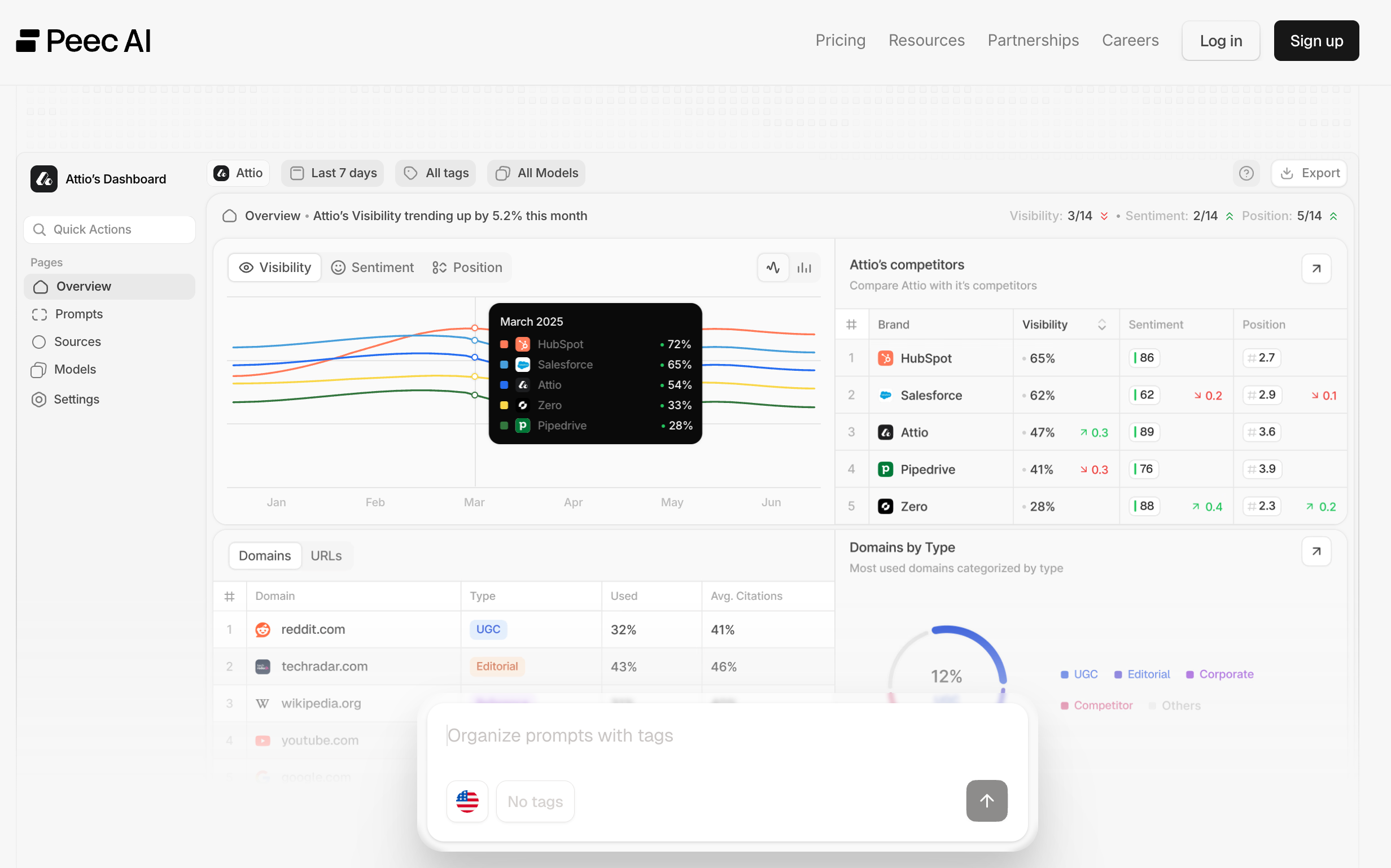
Peec AI feels simpler and easier to navigate than Profound, but it has grown beyond a basic AI visibility dashboard. Depending on the plan, it can track ChatGPT, Perplexity, Gemini, Google AI Mode, AI Overviews, Microsoft Copilot, and additional models.
You can monitor prompts, competitors, mentions, citations, sentiment, positions, source usage, and share of voice without feeling buried in data. Peec AI now also offers prompt-volume signals, query fanouts, AI crawler insights, optimization recommendations, and product visibility tracking.
Profound still goes deeper into real-user prompt research, automated content workflows, and enterprise controls. Peec AI, however, offers a more accessible experience for teams that prioritize monitoring, collaboration, reporting, and straightforward recommendations.
What are the core Peec AI features?
- Prompt tracking: Monitors selected prompts across supported AI platforms, with daily tracking available on standard plans.
- Suggested prompts: Recommends relevant prompts based on your brand and domain, making the initial setup easier.
- Prompt Volume and Query Fanouts: Estimates relative prompt demand and shows the supporting searches AI engines may perform before generating an answer.
- Visibility and share of voice: Measures how frequently your brand appears and compares that visibility with selected competitors.
- Position and sentiment tracking: Shows where your brand appears within AI responses and whether it is described positively, negatively, or neutrally.
- Mentions and source tracking: Separates brand mentions from citations and shows which websites and URLs influence AI-generated responses.
- Actions: Highlights content gaps, sources to target, and optimization opportunities. These recommendations help teams decide what to work on, although execution still happens outside the platform.
- Crawlability and Crawl Insights: Checks whether AI bots can access your website and uses server-log data to show which crawlers visit, what pages they access, and where errors occur.
- AI Shopping: Tracks product-level visibility, appearances, positions, prices, competitors, and shopping queries. Current coverage is primarily focused on ChatGPT Shopping.
- Reporting and integrations: Supports CSV exports and, depending on the plan, Looker Studio, API, MCP, SSO, and other data connections.
Still considering Peec AI? Check our detailed Peec AI review to understand its features, pricing, pros, cons, and best-fit use cases.
Which tool has the best prompt intelligence?
Profound’s prompt intelligence
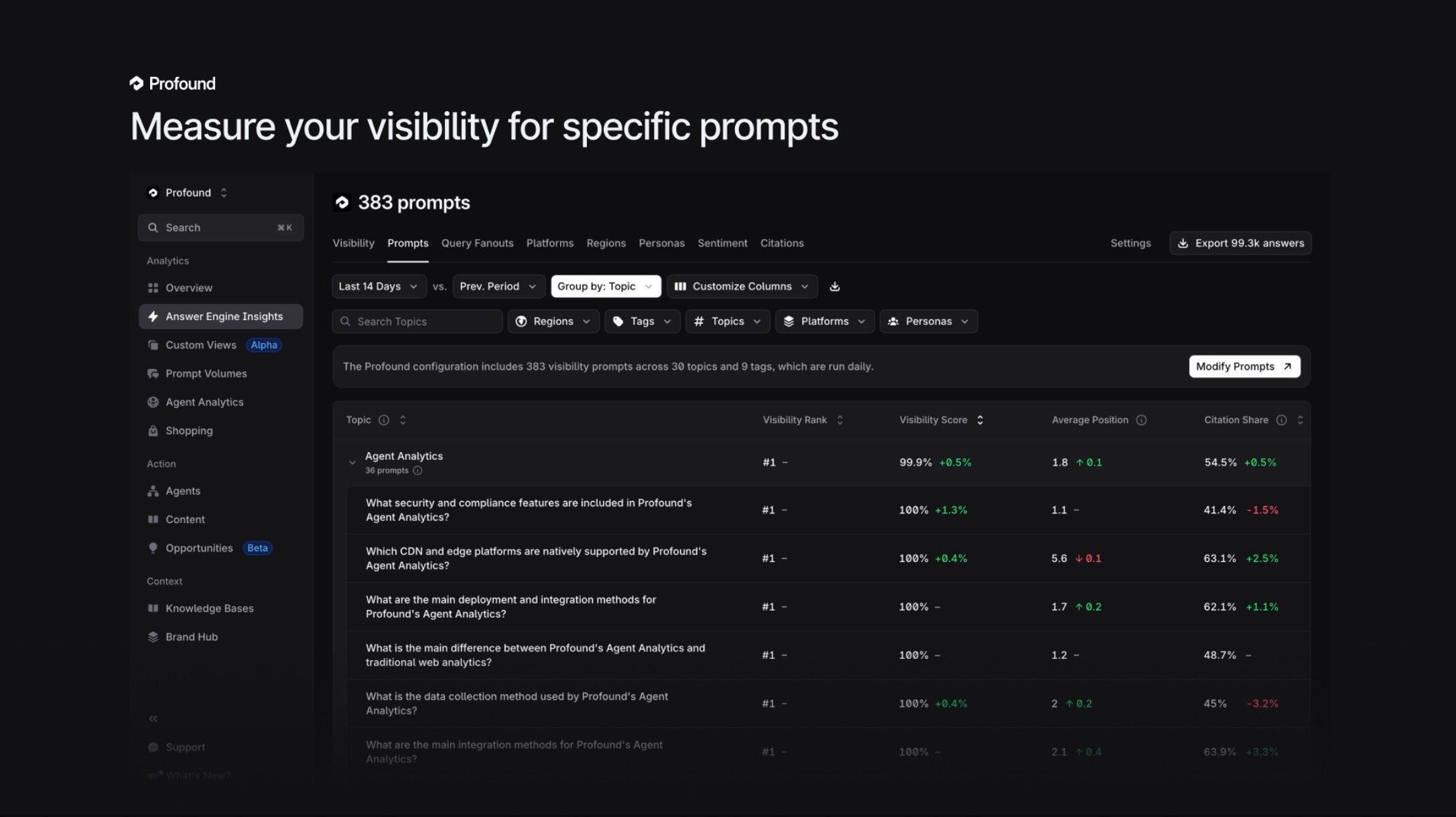
Profound is stronger if you want to understand what people are actually asking AI tools, not just track a fixed list of prompts.
Pros of Profound’s prompt intelligence
- Shows prompt demand and uses Prompt Research Reports to analyze and group 1.5 billion+ real-user prompts by topic, intent, volume share, and coverage.
- Finds high-value prompts where your brand is missing.
- Connects prompt trends with sentiment and keyword signals.
- Helps prioritize prompts based on demand, not guesswork.
- Useful for teams building a demand-led GEO strategy.
Cons of Profound’s prompt intelligence
- Can feel data-heavy for basic prompt tracking.
- Needs an experienced team to interpret the insights.
- Full Prompt Research Reports are currently available only to Enterprise customers.
- Profound Agents can turn prompt insights into briefs, drafts, content refreshes, and published content, but teams still need to review and approve the output.
Peec AI’s prompt intelligence
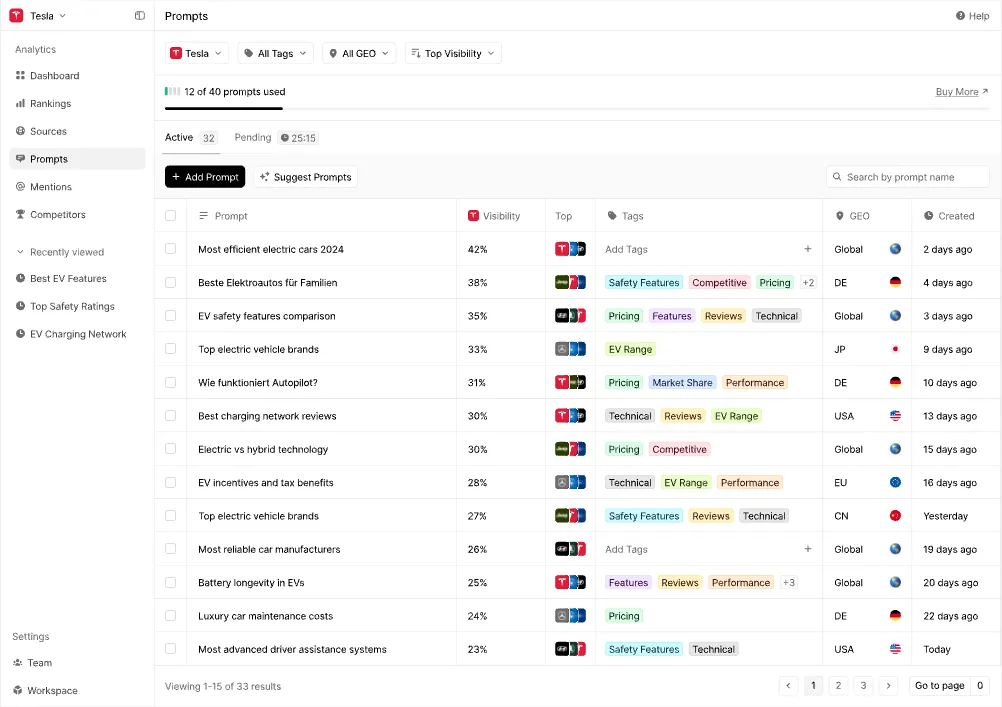
Peec AI is easier to use if you want a cleaner monitoring setup, but it now also offers suggested prompts, relative Prompt Volume scores, and Query Fanouts.
Pros of Peec AI’s prompt intelligence
- Tracks selected AI search prompts across platforms.
- Suggested prompts and relative Prompt Volume scores make setup and prioritization faster.
- Helps organize prompts by topics and tags.
- Shows visibility, sentiment, mentions, position, and share of voice.
- Easier to understand without a steep learning curve.
- Query Fanouts show the related searches ChatGPT, Perplexity, and Copilot perform while generating answers.
Cons of Peec AI’s prompt intelligence
- Prompt Volume is still in beta and provides relative demand levels rather than detailed numerical estimates.
- Not as deep as Profound for prompt volume intelligence.
- Recommendations are useful, but limited for full execution.
- Better suited to monitoring and prioritization than Profound-style large-scale prompt discovery.
My verdict
Profound wins on prompt intelligence because it provides deeper demand-level insights, prompt clustering, intent analysis, and coverage data.
Peec AI is still useful if you want simpler monitoring with suggested prompts, relative demand scores, and Query Fanouts, but Profound has the edge for deeper prompt discovery and prioritization.
Still exploring Peec AI replacements? Check our Peec AI alternatives guide to find tools that offer stronger AI visibility tracking, SEO workflows, and content execution.
Which tool has the best source and citation insights?
Profound’s source and citation insights
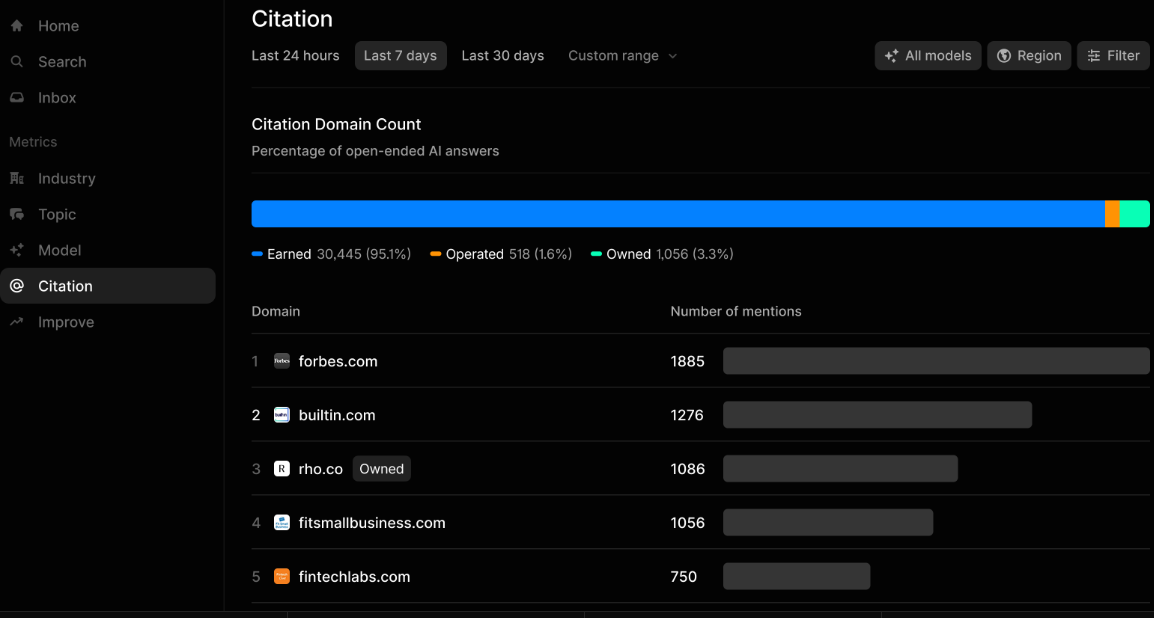
Profound is stronger if you want to understand not just who cites you, but how AI systems crawl, reference, and respond to your content.
Pros of Profound’s source and citation insights
- Tracks citation sources and their authority.
- Shows which pages are referenced in AI-generated answers.
- Tracks AI bot activity and content access through Agent Analytics.
- Connects AI crawler behavior with traffic and attribution insights.
- Benchmarks your citation performance against more than 2 million pages.
Cons of Profound’s source and citation insights
- Can feel technical if you only want simple citation tracking.
- Best suited for teams with mature SEO or GEO workflows.
- Profound Agents can turn citation gaps into content workflows, but technical fixes and external outreach still require action from your team.
- Smaller teams may not need this level of crawler and attribution detail.
Peec AI’s source and citation insights
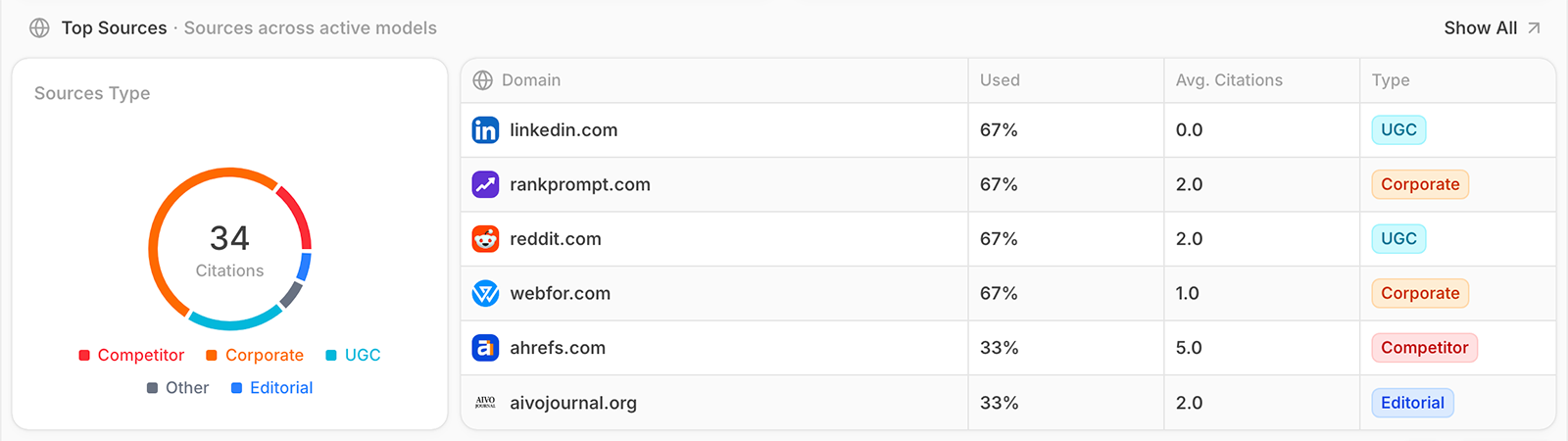
Peec AI keeps source tracking easier to understand. It is useful if you want to see which URLs and domains are shaping AI answers for your tracked prompts. Peec AI now also offers Crawlability and Crawl Insights, which show which AI bots can access your site, what pages they visit, and where crawl errors occur.
Pros of Peec AI’s source and citation insights
- Shows the domains and URLs AI models use for tracked prompts.
- Separates source retrievals from citation rates, showing when a page influenced an answer even if it was not explicitly cited.
- Helps identify source gaps where competitors appear but your brand does not.
- Useful for finding PR, partnership, community, and content opportunities.
- Easier to use for basic citation analysis and reporting.
- Adds Crawlability and server-log-based Crawl Insights for tracking bot visits, accessed URLs, status codes, and failure rates.
Cons of Peec AI’s source and citation insights
- Its crawler analytics are useful, but Profound goes further on AI-driven human traffic and conversion attribution.
- Its technical diagnostics focus on crawlability, bot visits, and server errors rather than advanced traffic attribution.
- Recommendations help, but execution still happens outside the platform.
- Better for visibility and outreach planning than advanced attribution.
My verdict
Profound wins if you want deeper source, citation, crawler, and attribution insights. Its main advantage is connecting crawler activity and citations with human traffic, conversions, and large-scale benchmarking.
Peec AI remains easier to work with for understanding which sources influence AI answers and where your brand is missing. It now also provides useful crawlability and server-log diagnostics, but Profound still offers more depth on attribution.
Want to see where your brand appears in ChatGPT answers? Read our blog on the best tools for tracking brand visibility in ChatGPT.
Which tool has the best sentiment monitoring?
Profound’s sentiment monitoring
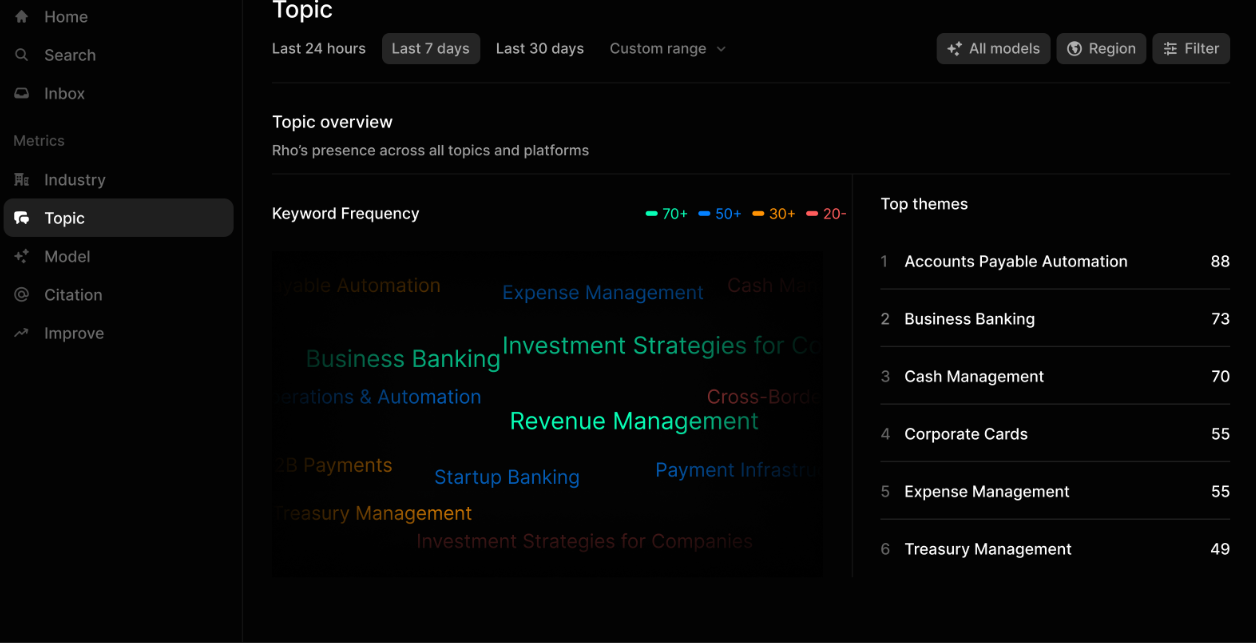
Profound gives you a deeper read on how AI engines describe your brand, including sentiment, themes, and recurring narratives.
Pros of Profound’s sentiment monitoring
- Shows whether AI responses frame your brand positively or negatively.
- Groups individual claims into distinct sentiment themes and connects them to the citations and source passages shaping the narrative.
- Tracks sentiment changes over time.
- Lets you review positive, negative, and trending sentiment themes.
- Compares sentiment themes across your brand and competitors through a competitive sentiment matrix.
Cons of Profound’s sentiment monitoring
- Can feel heavy if you only need a simple sentiment score.
- Insights still need interpretation before you can act on them.
- Fixing negative sentiment usually requires content, PR, or source-level work.
- Better for analysis than direct optimization.
Peec AI’s sentiment monitoring
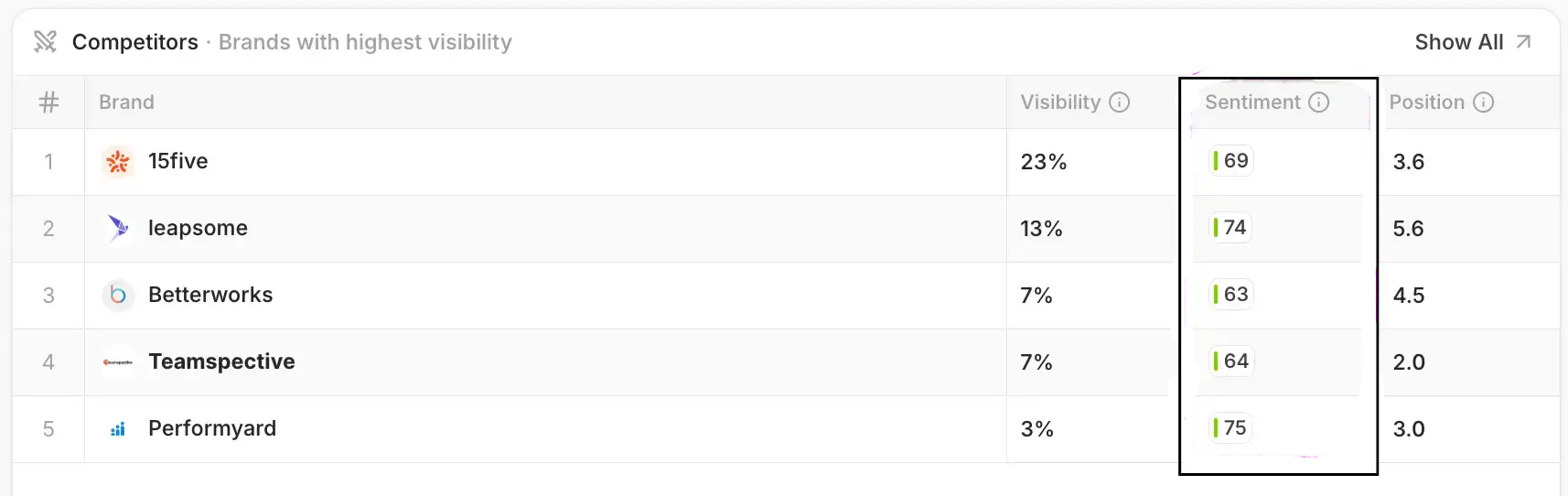
Peec AI keeps sentiment easier to read with a clear 0 to 100 score across your tracked prompts.
Pros of Peec AI’s sentiment monitoring
- Shows how positively AI models describe your brand.
- Makes sentiment easier to track with a simple score.
- Helps compare brand perception against competitors.
- Useful for spotting drops or shifts over time.
- Works well for quick reporting and high-level monitoring.
Cons of Peec AI’s sentiment monitoring
- Less detailed than Profound’s theme-based sentiment analysis.
- A single score can miss the nuance behind why sentiment changed.
- You still need to check the actual responses to understand the cause.
- Limited execution support for fixing negative framing.
My verdict
Profound wins if you want deeper sentiment analysis with themes, narratives, and trend context. It gives you more to work with when you need to understand why AI engines describe your brand a certain way.
Peec AI is better if you want a simpler sentiment score that is easy to monitor and report. It is cleaner, but Profound gives you more depth.
Want to know how AI tools describe your brand? Read our blog on the best GEO tools for sentiment analysis in 2026.
Which platform gives better value for money?
Pricing is where the difference becomes clearer. Profound is built for teams that want deeper AI visibility intelligence, while Peec AI feels more accessible for teams that want clean tracking, reporting, and easier scaling.
How Profound AI pricing works
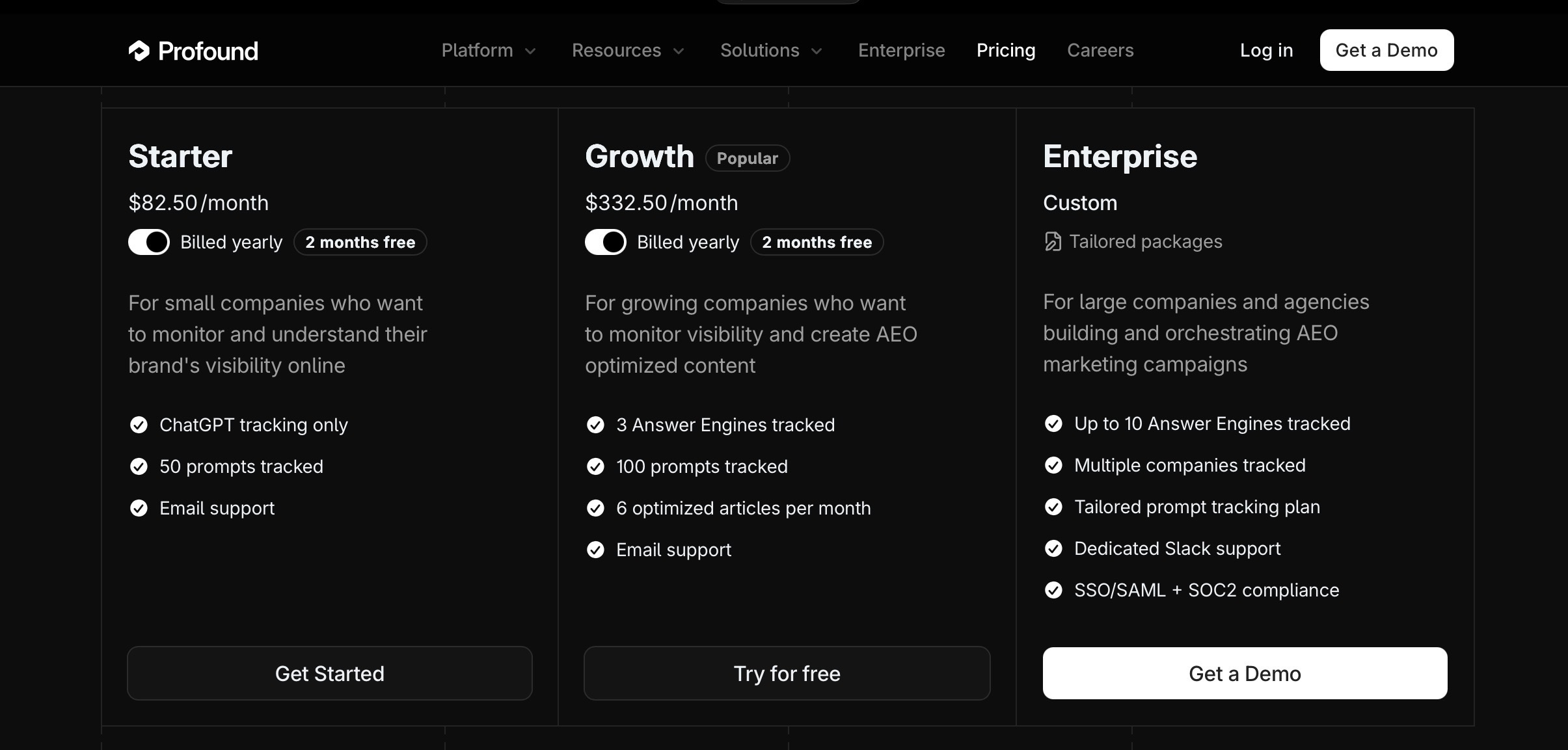
Profound’s pricing model is structured around platform coverage, prompt limits, content capabilities, and enterprise readiness.
- Starter costs $82.50 per month, billed yearly: It includes 50 tracked prompts and ChatGPT tracking only. It is best for smaller teams testing AI visibility monitoring for the first time, but the limited platform coverage may become restrictive.
- Growth costs $332.50 per month, billed yearly: It includes 100 tracked prompts, three answer engines, and six optimized articles per month. It is better for teams that need broader AEO tracking and want to connect visibility data with content improvement.
- Enterprise has custom pricing: It supports up to 10 answer engines, multiple companies, tailored prompt tracking, dedicated Slack support, and enterprise controls such as SSO, SAML, and SOC 2 compliance. It is built for larger brands and agencies that need custom tracking, stronger security, and multi-brand workflows.
- Profound free trial: Profound offers a free trial for its Growth plan
Profound’s real value starts showing up in the higher tiers. The Starter plan works for testing, but teams that need multi-platform tracking and content execution will likely need Growth or Enterprise.
How Peec AI pricing works
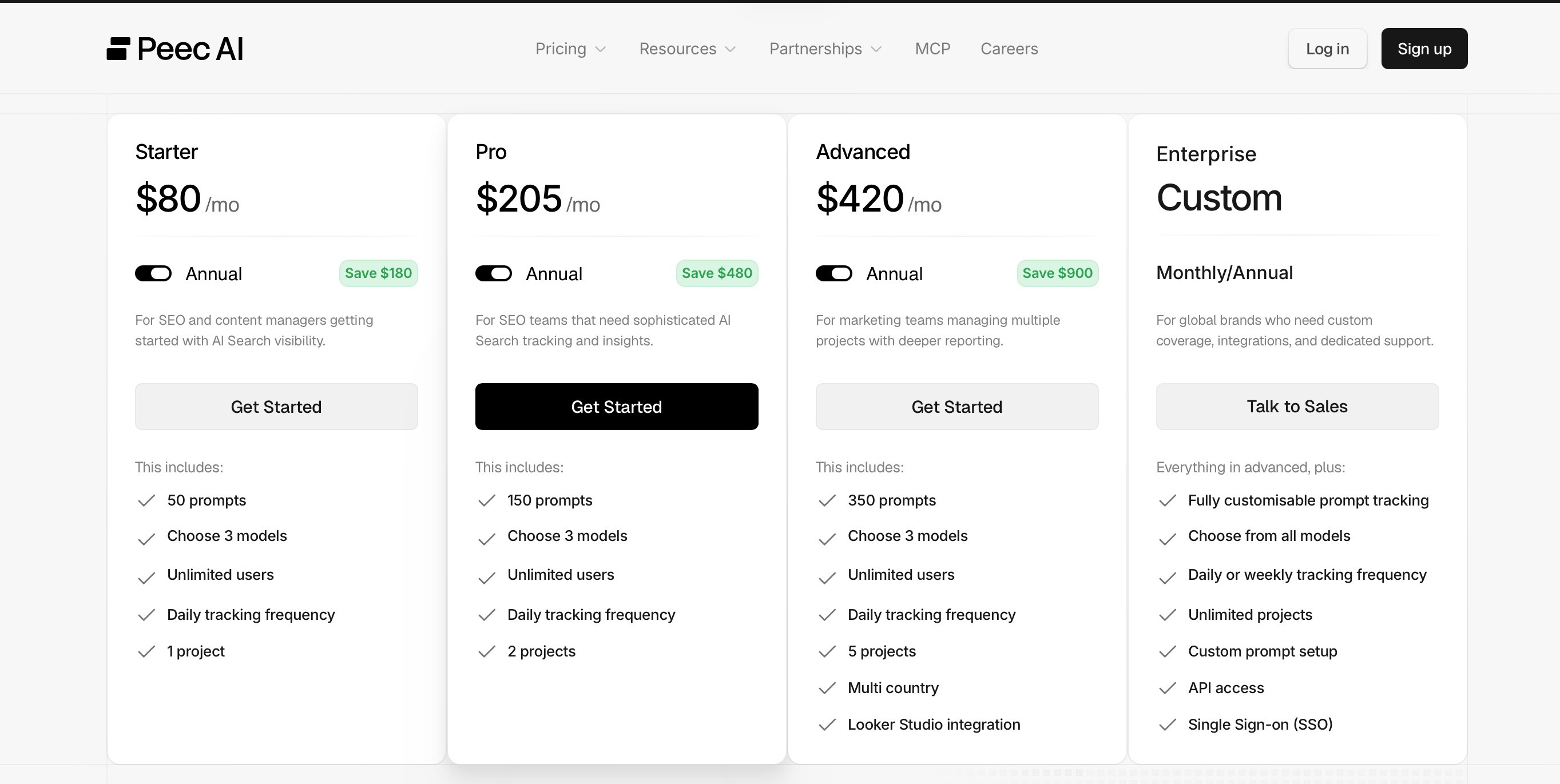
Peec AI’s pricing feels easier to understand because its plans scale more clearly by prompt volume, projects, models, markets, and reporting depth.
- Starter costs $80 per month, billed yearly: It includes 50 prompts, three models, unlimited users, daily tracking, and one project. It is best for SEO and content teams that want simple AI visibility tracking without a heavy setup.
- Pro costs $205 per month, billed yearly: It includes 150 prompts, three models, unlimited users, daily tracking, and two projects. It is better for growing teams that need more prompt coverage and regular visibility reporting.
- Advanced costs $420 per month, billed yearly: It includes 350 prompts, three models, unlimited users, daily tracking, five projects, multi-country tracking, and Looker Studio integration. It is best for teams managing multiple projects, markets, or reporting workflows.
- Enterprise has custom pricing: It includes customizable prompt tracking, access to all available models, unlimited projects, API access, SSO, and custom prompt setup. It is built for larger teams that need broader coverage, integrations, and more control over their AI visibility data.
- Peec AI free trial: Peec AI offers a seven-day free trial with no credit card required.
What I like about Peec AI’s pricing is that it feels more approachable. You can start small and scale without immediately moving into an enterprise-heavy setup.
My pricing verdict
Peec AI offers better entry-level value. Its Starter plan costs $80 per month compared with Profound’s $82.50, but Peec AI includes three models and unlimited users, while Profound Starter is limited to ChatGPT.
Peec AI Pro also costs considerably less than Profound Growth at $205 versus $332.50 per month. However, Profound Growth includes six optimized articles per month, so its higher price may make sense for teams that will use the content workflows.
If I were choosing for affordable multi-platform monitoring and reporting, I would lean toward Peec AI. If I needed deeper intelligence combined with content execution and enterprise controls, Profound would make more sense.
What are users saying about Profound vs Peec AI for AI visibility?
What are users saying about Profound?
Profound has a much larger public review base, so the feedback feels easier to judge at scale. Users generally praise its strong AI visibility insights, detailed analytics, intuitive interface, and customer support. That matches what I noticed too. Profound feels powerful if your team knows how to read the data and turn it into strategy.
The tradeoff is that it can feel heavy. Some users mention a learning curve, setup complexity, pricing concerns, and limited actionability in certain areas. I think that is fair. Profound gives you a lot of data, but smaller teams may still need time and a clear workflow to turn those insights into actual content or GEO improvements.
“What I dislike about Profound is that it can be complex to navigate at first, some metrics aren't always straightforward to translate into actions, and the cost and feature set may be more than smaller teams need.”, says Davide R on G2.
What are users saying about Peec AI?
Peec AI has fewer public reviews, so I would treat the feedback as promising but still early. It is currently rated 4.9 on G2 by 11 users, and most users seem to like its clean UI, helpful support, quick setup, and easy-to-understand AI visibility data.
That also lines up with my experience. Peec AI feels easier to use than Profound, especially if you want to track prompts, citations, mentions, sentiment, and competitors without getting buried in too much data. But users also point out a few gaps, like limited content workflow support, the need for Google Analytics integration, broader model coverage, easier source extraction, and more clarity on how LLMs choose sources.
“Peec AI could improve by adding connections to Google Analytics, which would allow me to check AI referral traffic in a unified view.”, says Niklas B on G2.
My verdict
Profound has stronger review depth, with a 4.6 rating on G2 from 323 reviews. Peec AI has a higher rating at 4.9, but it is based on only 11 reviews, so I would treat it as positive early feedback rather than a fully proven signal.
If you want deeper analytics and enterprise-grade AI visibility tracking, Profound feels stronger. If you want a cleaner interface and easier reporting, Peec AI feels more approachable.
That said, both tools can feel expensive for small businesses, solo creators, and lean content teams that want execution along with tracking.
What are the missing features in Profound and Peec AI?
Both Profound and Peec AI are strong AI visibility platforms, but neither feels perfect if you want tracking, strategy, and execution to sit inside one simple workflow.
Where Profound still feels limited
- Can feel heavy for smaller teams: Profound gives you a lot of data, but it works best when you have a mature SEO, GEO, or analytics team that knows how to use it.
- Entry-level use can feel restricted: The lower tiers are useful for testing, but teams that need broader coverage, deeper insights, and stronger workflows will likely need higher plans.
- Not always beginner-friendly: Features like Prompt Volumes, Agent Analytics, citation insights, and content workflows are powerful, but they can take time to understand and use well.
- Execution still needs strategy: Profound has AI Agents and content workflows now, but you still need a clear content strategy, editorial process, and optimization workflow to get real results.
Want to compare more options before choosing? Read our full guide on the top Profound AI competitor tools to see which platforms are actually worth considering.
Where Peec AI still feels limited
- Less depth in prompt demand intelligence: Peec AI helps with suggested prompts and search volume signals, but Profound still feels stronger for deeper prompt volume and demand analysis.
- Limited technical diagnostics: Peec AI is useful for visibility, citations, sentiment, and reporting, but it does not go as deep as Profound on AI crawler behavior and attribution.
- Content execution is still light: Peec AI gives recommendations, but it does not feel like a full workflow for planning, writing, optimizing, and updating content.
- Source analysis can still require manual work: The source and citation data is useful, but teams may still need exports, filtering, and manual interpretation to turn it into action.
Bottom line
Profound is stronger on depth, data, and enterprise workflows, but it can feel heavy. Peec AI is cleaner and easier to use, but it is still lighter on technical analysis and content execution.
Is there a better alternative to both Profound and Peec AI?
Scalenut is the best alternative to both Profound and Peec AI if you do not want AI visibility tracking to sit in a separate workflow from content execution.
Profound is stronger for deep enterprise analytics, and Peec AI is cleaner for visibility monitoring. But Scalenut brings AI visibility tracking, SEO research, content creation, optimization, audits, internal linking, and off-page signals into one workflow.
That matters because knowing where your brand is missing in AI answers is only half the job. You also need to know what to create, what to update, what to optimize, and which pages need more authority.
Scalenut overview: What is Scalenut?
Scalenut is an SEO and GEO platform built for teams that want to improve visibility across both traditional search and AI search. Instead of stopping at dashboards, it helps you track how your brand appears in AI answers and then use those insights to plan, write, optimize, audit, and improve content from the same workspace.
What are Scalenut’s key features?
- AI Visibility Tracking: Tracks brand mentions, prompt coverage, and visibility trends across AI search experiences.
- Prompt and topic intelligence: Helps identify missing prompts, topic gaps, and opportunity areas where your brand is not showing up strongly enough.
- Competitive visibility: Compares how AI engines represent your brand against competitors, including share of visibility, competitor mentions, and relative positioning.
- AI bot traffic: Tracks how AI crawlers interact with your website, including bot activity, source engines, and page coverage.
- Prompt-level insights: Shows visibility score, average position, response data, platform-level performance, and brand placement for individual prompts.
- GEO content creation: Helps create ready-to-rank GEO articles based on search intent, AI visibility signals, and topic opportunities.
- Content Optimizer: Gives on-page recommendations to improve existing content for SEO and GEO performance.
- Content Audit: Identifies pages that need updates, optimization, consolidation, or technical cleanup.
- Keyword Planner: Builds keyword clusters so teams can plan content around search intent and topical authority.
- On-Page Pro: Helps improve titles, meta descriptions, and SERP-facing elements.
- Link Manager: Detects, fixes, and deploys internal links across your domain to strengthen site structure and authority.
- Social UpReach: Tracks Reddit conversations, brand mentions, competitor mentions, and trending community discussions.
- Backlinks Marketplace: Gives teams a way to support off-page authority building from the same broader workflow.
What does Scalenut's user ratings look like?
- Product Hunt: 5/5
- G2: 4.7/5
- Capterra: 4.8/5
What do the real users say about Scalenut?
"This is an exceptionally useful tool! I've tried others but am most happy with Scalenut. Their team has been very active, continuously working on and regularly releasing new features and improvements," says Allyson Capreol
From what users say, Scalenut seems to be improving fast. Many reviewers like that it is easy to use, produces solid first drafts, and keeps adding features that help with SEO research, content optimization, and ranking opportunities. What stands out most is that users do not just see it as a writing tool, but as a platform that keeps getting better for SEO-led content workflows.
Why choose Scalenut over Profound and Peec AI?
Scalenut makes the most sense if your goal is not just to report on AI visibility, but to improve it through content and SEO execution. Here are some reasons why Scalenut stands out:
- Connects AI visibility tracking with keyword research, content creation, optimization, audits, and internal linking.
- Gives content teams clearer next steps instead of leaving insights stuck inside dashboards.
- More approachable for SEO teams, content marketers, agencies, and growing businesses that need practical execution.
- Helps you improve existing pages, create new content, and strengthen internal links from one platform.
- More cost-effective for teams that want both GEO tracking and content workflows, with plans starting at $59/month.
My honest take is this: Profound is better if you need deep enterprise AI visibility intelligence. Peec AI is better if you want simple and clean AI monitoring. But Scalenut is the more practical option if you want AI visibility insights and the tools to actually act on them.
Ready to turn AI visibility insights into better content performance? Book a Scalenut demo today.
Conclusion: Profound, Peec AI or Scalenut?
Choose Profound for deeper prompt intelligence, crawler attribution, content Agents, and enterprise reporting. Choose Peec AI for simpler tracking, cleaner reports, unlimited users, and easier monitoring across major AI platforms.
Before buying, test both with the same 20–30 buyer-intent prompts. Compare AI search results, citation gaps, reporting effort, and actionable insights. Pick the platform that strengthens your AI search presence while fitting your search engine strategy, and not simply the one with more data.
Choose Scalenut when you want to connect visibility tracking directly with content research, creation, optimization, audits, and internal linking.
Frequently asked questions
What features should I look for when choosing alternatives to Profound AI?
Look for AI visibility tracking, prompt intelligence, citation insights, competitor benchmarking, sentiment monitoring, AI traffic data, and content execution features. Scalenut is worth considering because it connects GEO insights with SEO research, content creation, optimization, audits, and internal linking in one workflow.
Is Profound AI more accurate than Peec AI for GEO analysis?
Profound feels stronger for deep GEO analysis, especially around prompt volumes, citations, sentiment, AI crawler activity, and attribution. Peec AI is easier for visibility tracking, while Scalenut is better if you want insights connected with content execution.
Which tool has better integrations, Profound or Peec AI?
Profound has stronger enterprise integrations, including GA4, CDN, CMS, and cloud-based connections for AI traffic and agent analytics. Peec AI also supports practical workflows through CSV exports, Looker Studio, API access, MCP, and Crawl Insights.
How does the user interface of Profound compare to Peec AI?
Profound feels more data-heavy because it is built for deeper analytics and enterprise teams. Peec AI feels cleaner and easier to understand. Scalenut sits closer to the execution side, where teams can move from insights to content actions faster.
Is Profound the best Peec AI alternative?
Profound is a strong Peec AI alternative if you need deeper AI visibility intelligence, prompt volume data, crawler analytics, better engine coverage, and enterprise reporting. But if you want SEO, GEO tracking, and content execution together, Scalenut may be the more practical option.
Is Peec AI still good to use in 2026?
Yes, Peec AI is still useful in 2026 for marketing teams that need prompt monitoring, citation insights, sentiment tracking, and competitor reporting. Its main limitation is that content planning, writing, optimization, and publishing still need to happen outside the platform.
Why consider Profound AI alternatives?
Teams usually look for Profound AI alternatives because of pricing, complexity, custom enterprise pricing, or the need for a more execution-friendly workflow. Profound is powerful, but smaller teams may prefer tools like Scalenut for AI visibility tracking and content optimization.
Why is Scalenut a better alternative to Peec AI for execution?
Scalenut is a better fit if you want more than AI visibility monitoring. It supports content operations by helping teams track AI visibility, research keywords, create content, optimize existing pages, audit performance, and improve internal linking from one workflow.
How does Profound compare to Peec AI for AI traffic monitoring?
Profound is stronger for advanced AI traffic monitoring through Agent Analytics, GA4, and CDN-based integrations. Peec AI has also improved with Crawl Insights, which uses Cloudflare or server log data to show AI bot activity on your site.
Which tool is better for small teams, Profound or Peec AI?
Peec AI is usually easier for small teams because the interface is cleaner and the setup feels lighter. Profound makes more sense for large enterprises with bigger budgets, deeper analytics needs, and the resources to act on complex AI visibility data.
Which tool is more affordable for AI visibility and execution?
Peec AI offers a lower-cost entry into AI visibility than Profound, but Scalenut is the more affordable entry point if you want tracking plus content execution. It is not a free plan tool, but its pricing is easier for smaller teams to justify.
Does Profound offer an agent experience platform?
Profound has moved closer to an agent experience platform with Agents, Agent Analytics, Prompt Volumes, and enterprise workflows. That makes it powerful for advanced features, but teams that mainly need SEO and GEO execution may still find Scalenut simpler.
What are the best alternatives to Profound AI for 2026?
The best Profound AI alternatives for 2026 include Scalenut, Peec AI, SE Ranking, Ahrefs Brand Radar, Semrush AI Visibility Toolkit, and Rankscale. Scalenut is especially useful if you want AI visibility tracking connected with SEO research, content creation, optimization, audits, and internal linking.
Can you recommend reliable Profound AI competitors for SEO tasks?
Yes. For SEO tasks, reliable Profound AI competitors include Scalenut, SE Ranking, Semrush, Ahrefs, and Rankability. Scalenut is a strong option because it combines GEO tracking with practical SEO workflows like keyword planning, content optimization, content audits, and internal linking.
Do Profound and Peec AI offer free trials?
Yes. Profound offers a seven-day free trial of its Growth plan. Peec AI also offers a seven-day free trial with no credit card required.


.svg)


.webp)