.jpg)
Quick Summary
To choose a generative AI optimization tool, first decide whether you need an AI visibility tracker or a complete GEO and SEO platform, then evaluate your shortlist against seven core capabilities using a weighted scorecard and a hands-on test before committing.
- Start with category, not features. Trackers measure your AI visibility. Complete platforms measure it and help you fix it. Picking the wrong category wastes the rest of the evaluation.
- Seven capabilities separate serious tools from dashboards: content research, AI-assisted writing, search and answer engine optimization, competitive insight, reporting, collaboration, and multi-model coverage.
- A weighted scorecard beats a feature checklist. It forces you to rank what matters to your team instead of comparing vendors on whoever lists the most features.
- A tracker alone will not fix your visibility. It tells you where you are missing from AI answers. Someone still has to do the content work that changes that.
- Expect initial traction in 60 to 90 days, with results compounding from month three onward. No credible tool produces overnight AI citations.
Search stopped being a list of blue links a while ago. More of your buyers now get their answer straight from ChatGPT, Google's AI Overviews, or Perplexity, and never click through to a website at all. If your brand isn't part of that answer, you don't lose a ranking. You disappear from the conversation entirely.
That's the problem generative AI optimization tools exist to solve. But the category is young, crowded, and confusing: vendors use "GEO," "AI visibility," and "AEO" almost interchangeably, and the tools themselves range from $29-a-month tracking dashboards to full content platforms that cost ten times as much. Picking the wrong one wastes budget and, worse, months of the runway you need to build AI citations before competitors do.
This guide gives you a repeatable framework for that decision: what to evaluate, how to score it, and how the leading tools actually stack up.
What is Generative AI Optimization?
Generative AI optimization (GEO) is the practice of improving how often your content or brand appears, is cited, or is referenced in AI-generated answers from platforms such as ChatGPT, Gemini, Perplexity, and Google AI.
It builds on SEO fundamentals like crawlability, helpful content, authority, and clear structure, while focusing more specifically on visibility inside generated responses rather than only traditional search rankings.
Want to understand the strategy in more depth? Learn what Generative Engine Optimization is and how it works
What are the two types of generative AI optimization tools?
Generative AI optimization tools generally fall into two groups: AI visibility platforms that focus on measuring performance in AI answers, and full-stack GEO platforms that combine visibility data with tools to improve it.
1. AI visibility platforms
These tools primarily show where and how your brand appears across AI engines. They track metrics such as brand mentions, citations, Share of Voice, prompt performance, competitor visibility, and changes over time.
They are useful when you already have an SEO or content workflow and mainly need a reliable way to measure AI visibility at scale.
2. Full-stack GEO platforms
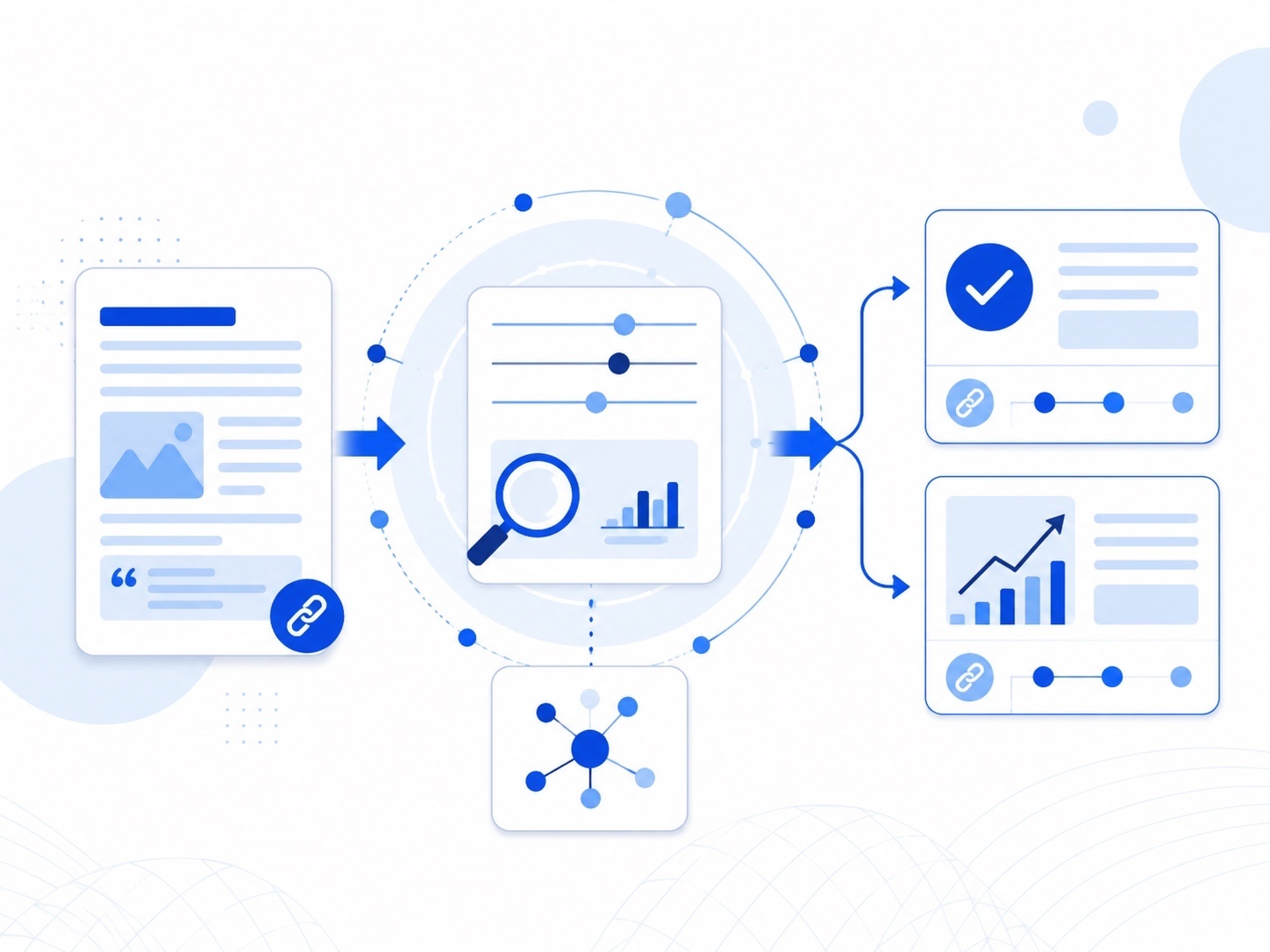
These platforms connect visibility measurement with optimization and execution. Along with identifying missing mentions, citation gaps, or weak-performing prompts, they can help teams create or refresh content, uncover citation opportunities, improve technical AI accessibility, and track the impact of those changes.
The difference is simple: visibility-first tools tell you what is happening, while full-stack GEO platforms also help you act on those insights. Which type you need depends on whether you already have the tools and processes to handle execution.
Want to explore the measurement side further? Compare the best AI visibility platforms for tracking brand performance in AI search.
What's the Step-by-Step Process for Choosing the Best Generative Engine Optimization Tool?
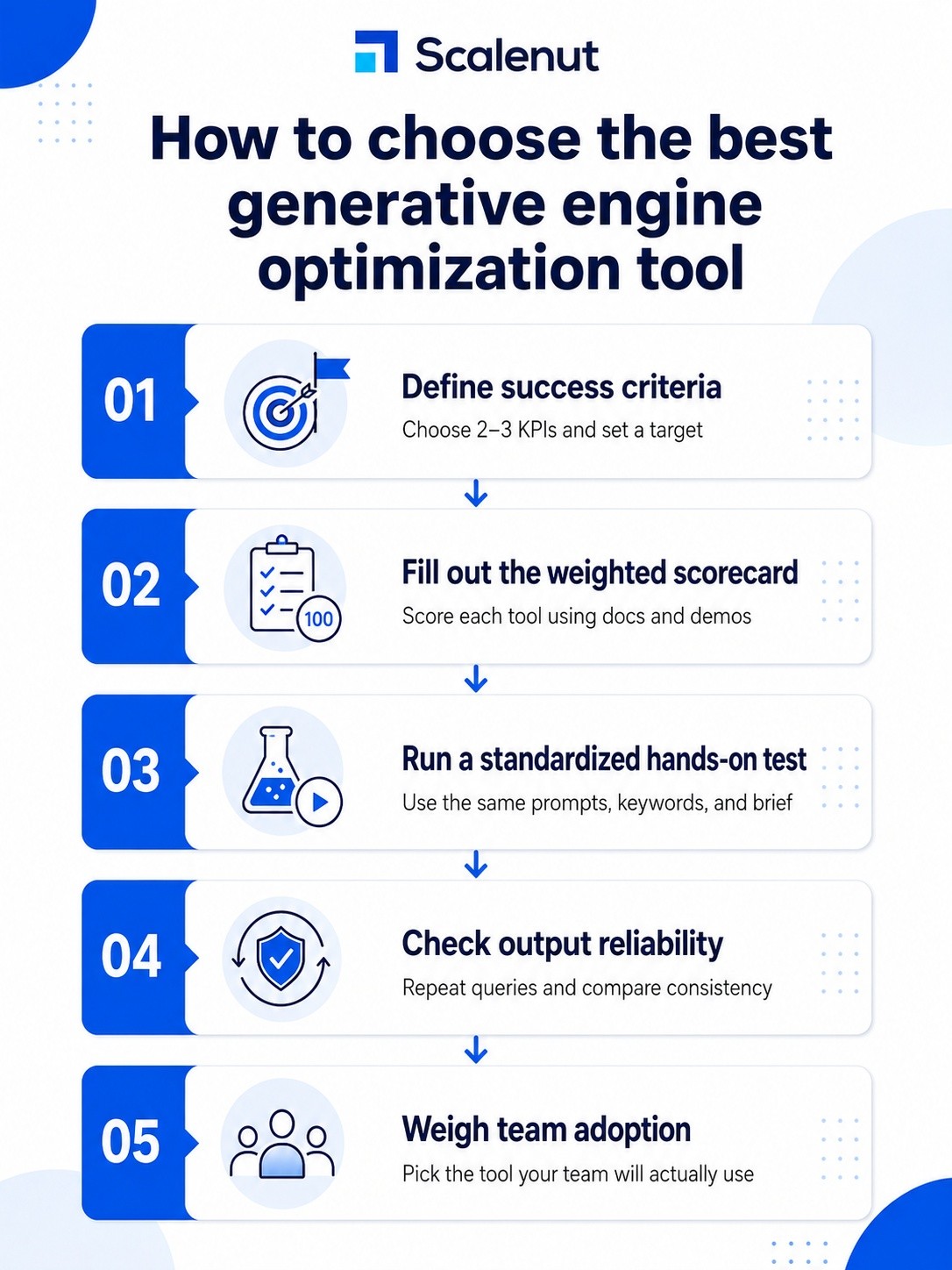
Making the final call on a generative AI optimization tool involves defining success criteria, scoring your shortlist, running a shared hands-on test, checking output reliability, and weighing team adoption alongside the score.
1. Define your success criteria first
Pick two or three metrics that matter, such as visibility score, citation frequency, or share of voice, and set a real target, for example a 20 percent visibility increase in six months. Without this step, every tool on your shortlist looks like a reasonable choice.
2. Fill out the weighted scorecard
Use the template below, adjusted to your priorities, and score each shortlisted tool using vendor documentation and live demos.
3. Run a standardized hands-on test
Give every tool on your shortlist the same prompts, the same keywords, and the same brief. Judging tools on different inputs measures marketing polish more than product quality.
4. Check output reliability, not just output quality
Run the same query twice on each tool. If a visibility platform returns meaningfully different numbers on repeated checks, that points to a data integrity problem, not rounding.
5. Weigh team adoption alongside the scorecard
The highest-scoring tool your team avoids opening loses in practice to the second-best tool people actually use every day. Factor real usage into the final decision, not just the numbers on the scorecard.
Before evaluating platforms, learn how to track and improve brand mentions in LLMs.
What Features Separate Serious Tools From Dashboards?
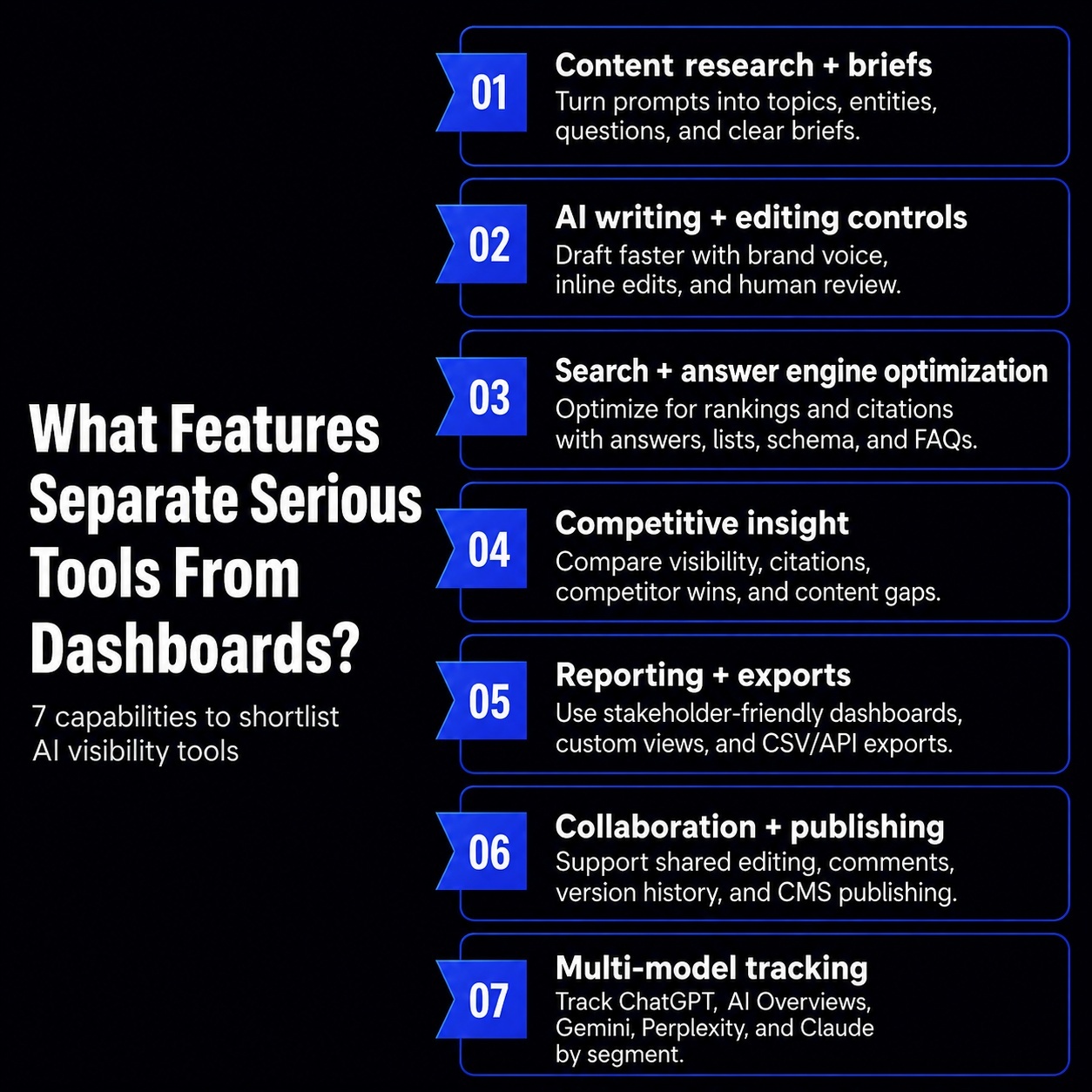
Serious generative AI optimization tools go beyond a visibility score. They combine research, content execution, competitive insight, and reporting in a way that turns a number on a dashboard into a specific action your team can take. Use the seven capabilities below to shortlist within whichever category you picked above.
1. Does it handle content research and brief creation?
The strongest tools start from the actual questions and prompts people type into AI engines, not just keywords. Look for platforms that surface prompt volume and convert it into a brief: structure, entities, and questions to cover, based on what is already earning citations. This is the step that turns "we should probably write about this" into "here is exactly what to write."
2. Does it offer AI-assisted writing with real editing controls?
Fast drafting is table stakes now. What separates tools is what happens after the draft. Can you set brand voice, edit inline, and keep a human reviewing every piece before it publishes? A tool that generates content nobody checks is a liability, since AI-generated inaccuracies get cited just as confidently as accurate ones.
3. Does it optimize for both search and answer engines?
Traditional on-page SEO, meaning headings, keyword placement, and readability, still matters. GEO adds a second layer on top of it: structuring content so a language model can parse and quote it cleanly, through direct-answer paragraphs, clearly labeled lists, schema markup, and FAQ sections phrased the way people actually ask AI systems questions. A tool that only handles one of these layers is optimizing for half the search landscape.
4. Does it show competitive insight, not just your own numbers?
A visibility score in isolation tells you less than the same score next to your competitors. Prioritize tools that show:
- Side-by-side AI visibility against named competitors
- What competitor content is earning citations, and why
- Content gaps where competitors are cited and you are not
This is what turns tracking into strategy. Instead of guessing, you close specific, visible gaps.
5. Can you actually show the reporting to someone?
A dashboard only you understand is not a reporting feature. Check for exportable data through CSV or API, customizable views for executive summaries versus deep analysis, and metrics tied to something a stakeholder recognizes, not just a proprietary score with no context attached.
6. Is it built for how teams actually collaborate?
If more than one person touches content, the tool needs shared editing, comments, and version history, ideally with a direct publish path to WordPress, Shopify, or your CMS. Tools that stop at "download the file and paste it in" quietly add hours of manual handoff every week.
7. Does it cover multiple AI models?
ChatGPT, Google AI Overviews, Gemini, Perplexity, and Claude do not behave identically, and none of them is guaranteed to stay the dominant one your buyers use. Choose a tool that already tracks multiple models and lets you segment by region, language, or persona. This is the difference between a tool you will still trust in 2027 and one you will be replacing within a year.
Want to turn visibility insights into stronger AI presence? See how to improve AI citations across search and answer engines.
How Do You Build a Weighted Scorecard Before Demoing Anything?
Build a weighted scorecard by listing the criteria that matter to your team, assigning each one a weight based on importance, then scoring every shortlisted tool against the same list. A scorecard beats a feature checklist because every vendor can claim every feature; a checklist makes them all look equally good. Weighting forces the comparison to reflect what your team actually needs.
Use this as a starting template.
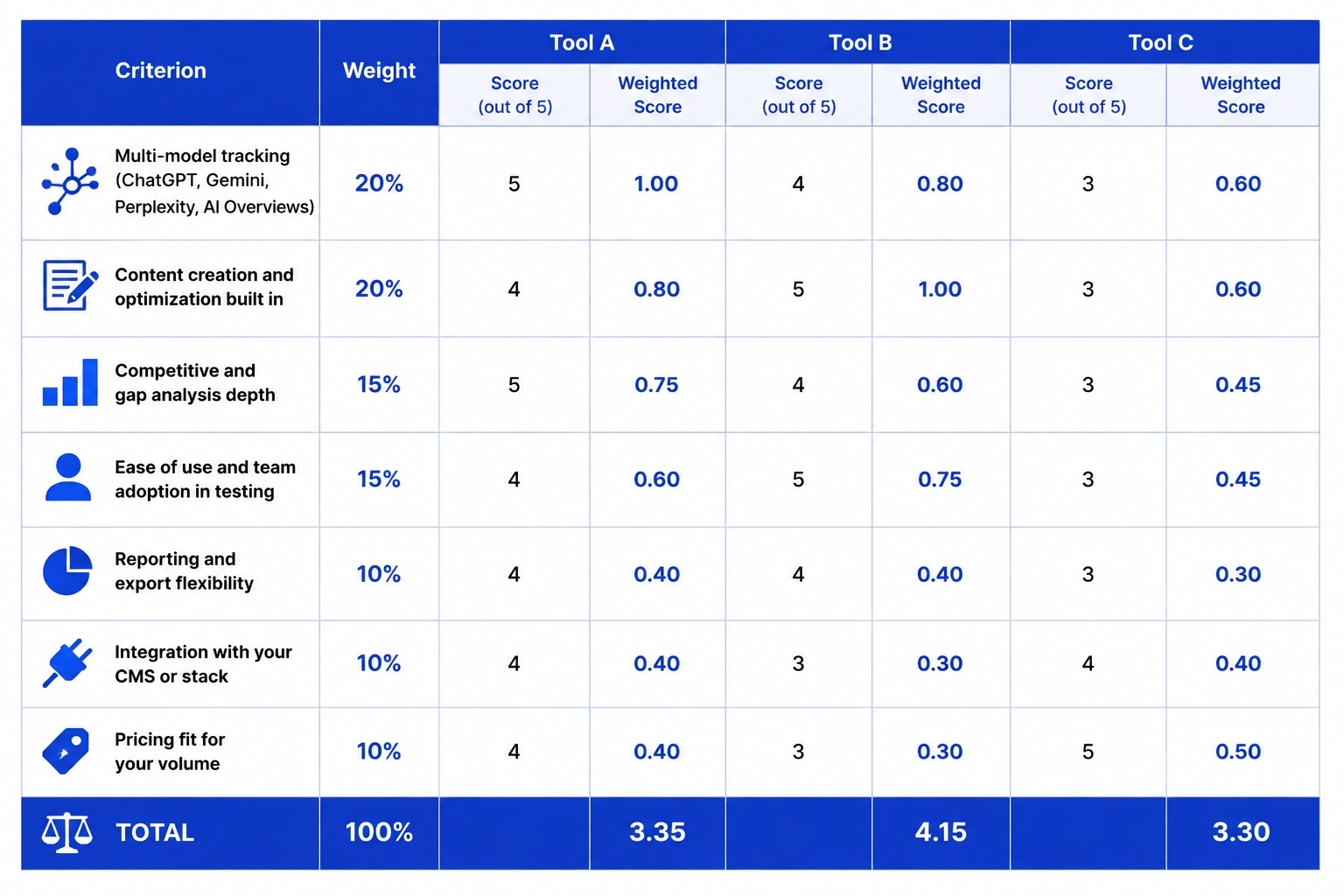
Multiply each score by its weight and total the columns. The tool with the highest weighted total becomes your front-runner, but treat it as provisional until you run the hands-on test described below. A scorecard filled out from a demo alone is still marketing-influenced.
Not sure which metrics deserve the most weight? Explore the key metrics for measuring brand visibility in AI search.
What are the top generative AI optimization tools to explore in 2026?
The top generative AI optimization tools in 2026 include Scalenut, Jasper, Writesonic, Surfer SEO, MarketMuse, Clearscope, and Frase. These platforms cover different parts of the GEO workflow, from AI visibility tracking and citation analysis to content research, creation, and optimization.
1. Scalenut: AI Visibility and GEO Optimization

Scalenut combines AI visibility monitoring with GEO and SEO content execution. It tracks how brands appear across AI platforms such as ChatGPT, Google AI Overviews, Perplexity, and Claude, including visibility, Share of Voice, average position, citations, sentiment, and competitor performance.
Beyond monitoring, Scalenut surfaces content gaps, citation opportunities, and other recommendations that teams can act on through its content creation, optimization, auditing, and publishing workflows. It also includes AI Traffic Monitor for understanding AI crawler activity and AI-driven page performance.
Key capabilities include:
- Multi-platform AI visibility tracking
- Prompt, citation, and sentiment analysis
- Share of Voice and competitor benchmarking
- Query fan-out and content gap insights
- GEO content creation and optimization
- AI crawler and traffic monitoring
Want to see the platform in more detail? Read our complete Scalenut review for GEO and SEO.
2. Jasper AI: Brand-Governed Content and GEO Optimization
Jasper combines AI content creation with SEO, AEO, and GEO optimization. Its GEO capabilities help teams track brand visibility, citations, and competitor gaps across AI search platforms, while Jasper IQ helps keep generated content aligned with brand voice, audiences, and style guidelines.
Its optimization features also help improve existing content for AI readability, answer-first structure, search intent, and structured data.
Key capabilities include:
- AI-assisted content creation
- Brand Voice and brand governance
- AI visibility and citation tracking
- Competitor visibility gap analysis
- SEO, AEO, and GEO content optimization
- Content recommendations based on visibility gaps
Read this Jasper Review to see its key features, biggest pros and cons, and whether it’s the right AI writing tool for your workflow.
3. Writesonic: AI Visibility and GEO Optimization
Writesonic combines AI visibility tracking with GEO optimization. It monitors how brands appear across major AI platforms, including mentions, citations, sentiment, share of voice, and competitor performance.
Its Action Center goes beyond tracking by identifying content gaps, citation opportunities, and technical issues that may affect AI visibility.
Key capabilities include:
- Multi-platform AI visibility tracking
- Citation and competitor analysis
- Sentiment and share-of-voice monitoring
- Prompt-level performance insights
- Content and citation gap recommendations
- Technical GEO optimization actions
4. Surfer SEO: SEO and AI Search Optimization
Surfer combines traditional search optimization with tools for AI search visibility. Its Content Editor provides real-time optimization guidance, while AI Tracker monitors brand mentions, citations, competitors, and prompt-level performance across major AI platforms.
Surfer AI also helps teams create briefs, generate articles, and optimize existing content using SERP and competitor data.
Key capabilities include:
- SEO and AI search content scoring
- AI visibility and citation tracking
- Competitor and prompt analysis
- SERP-based content briefs
- AI-assisted article creation
- Existing-content optimization
5. MarketMuse: AI-Driven Content Strategy
MarketMuse focuses on content strategy, topical authority, and planning. It analyzes existing content and competitors to uncover topic gaps and identify which pages or topics should be created or improved.
Its content plans and briefs provide recommendations around topic clusters, content depth, audience intent, and competitive coverage.
Key capabilities include:
- Content inventory analysis
- Topic and content gap discovery
- Topic cluster planning
- Competitive content analysis
- AI-generated content plans
- Detailed content briefs
6. Clearscope: Content Optimization and AI Visibility
Clearscope combines content optimization with visibility tracking across Google and AI search. Its Tracked Topics feature helps teams monitor AI mentions and citations alongside search performance.
Its Content Editor also recommends relevant terms, concepts, and questions to improve topical coverage and strengthen existing content.
Key capabilities include:
- SEO and AI visibility tracking
- AI mention and citation monitoring
- Topic and content gap research
- AI-related term insights
- Real-time content optimization
- Content refresh recommendations
7. Frase: SEO, GEO, and AI Visibility
Frase combines content research and optimization with AI visibility tracking. It monitors brand mentions, citations, share of voice, competitors, and prompts across major AI platforms.
Its optimization tools also help improve content structure, topical coverage, search relevance, and AI readability while supporting new content creation and existing-page optimization.
Key capabilities include:
- Multi-platform AI visibility tracking
- Citation and competitor monitoring
- SEO and GEO content scoring
- SERP and question research
- AI-assisted writing and optimization
- Existing-content optimization
Want to expand your shortlist? Compare the best LLM optimization tools for improving AI visibility.
How Do These Leading Tools Compare?
So what are the best AI search visibility tools on the market right now? There is no single answer, since "best" depends on whether you need pure tracking or a full content workflow attached to it. Leading generative AI optimization tools split between visibility-only trackers and complete platforms that also create and optimize content, with pricing ranging from roughly $29 a month to $500 or more depending on scope.
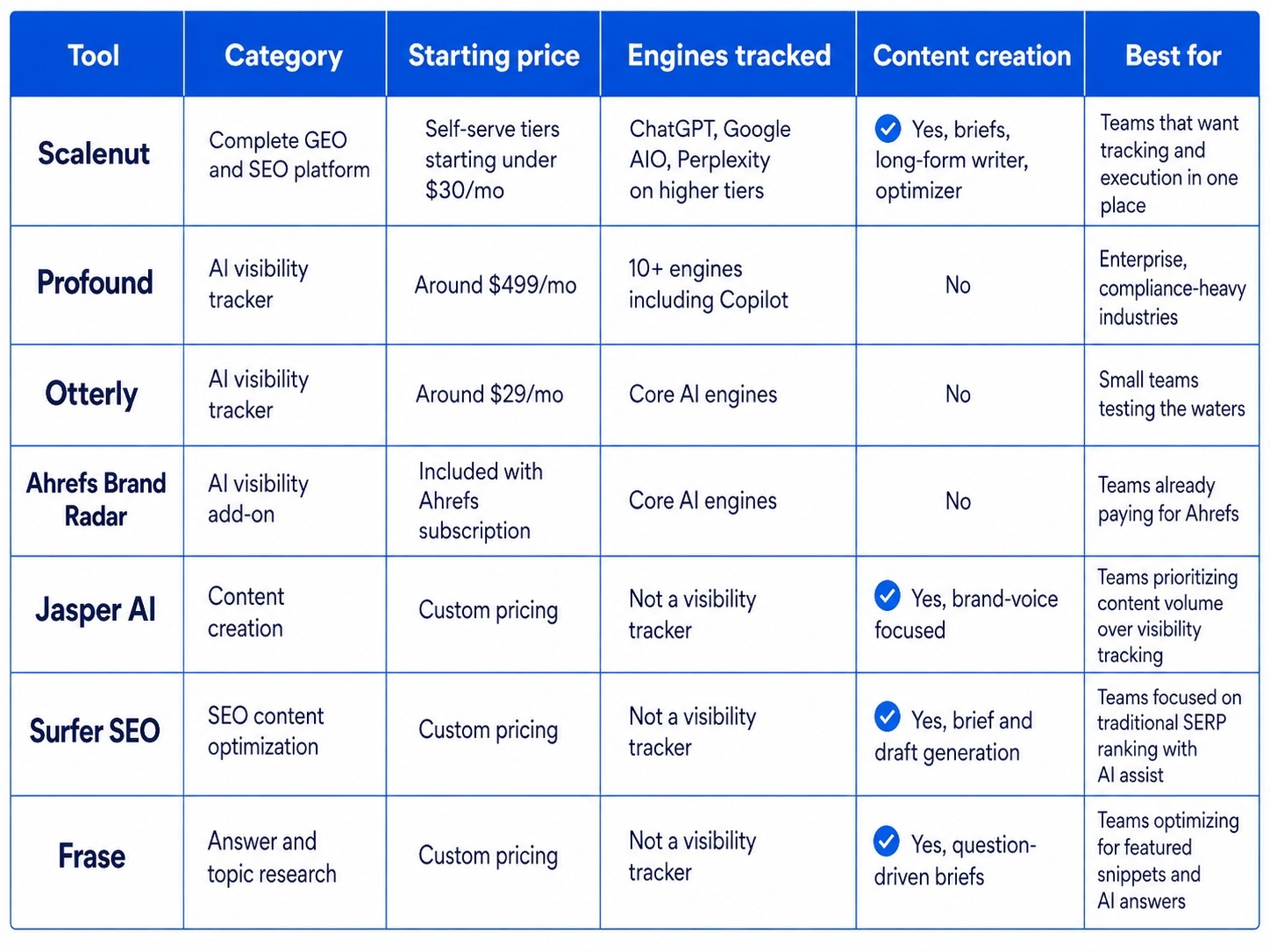
Pricing in this category changes often. Confirm current tiers directly with each vendor before deciding.
The pattern worth noticing: most well-known names in this space are still specialists, either a tracker with no content engine or a content tool with no AI visibility tracking. Complete platforms that do both remain the exception, which matters most if consolidating your tool stack is a priority.
Working with a tighter budget? Explore the best AEO tools under $100 per month.
What Mistakes Do Teams Make When Choosing These Tools?
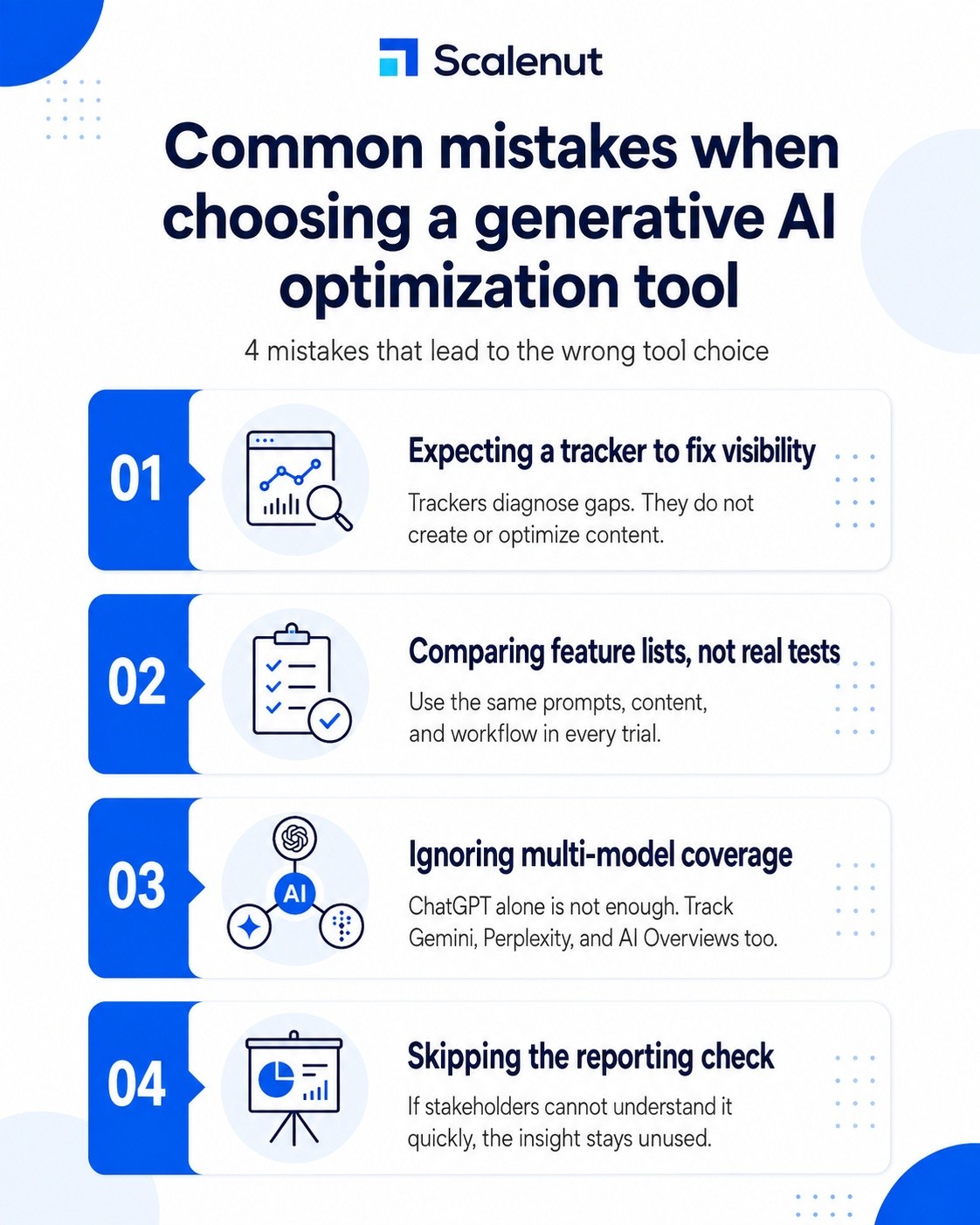
Teams most often choose a tool based on its feature list instead of a hands-on test, assume a tracker alone will fix their visibility, or ignore how many AI models the tool actually covers. Each of these mistakes shows up after the purchase, not during evaluation.
- Buying a tracker and expecting it to fix visibility. Trackers diagnose; they do not treat. If you choose a pure tracker, budget separately for the content work its reports will demand.
- Comparing tools on feature lists instead of hands-on tests. Demos are built to impress. A shared trial using your own prompts and content is the only fair comparison.
- Ignoring multi-model coverage. A tool that only tracks ChatGPT misses a growing share of AI-driven queries on Gemini, Perplexity, and AI Overviews.
- Skipping the reporting check. If you cannot turn a tool's output into something a stakeholder understands in one slide, the insight stays stuck in your dashboard.
Before relying on visibility data, understand how citation tracking in LLMs works and what the data actually tells you.
Why Consider Scalenut?
Working through a scorecard and a hands-on test tells you which tool fits on paper. What it does not solve is the handoff between measuring your AI visibility and actually improving it, which is where most teams lose momentum after a purchase decision. Scalenut is built to close that specific gap.
- AI Visibility Tracking: Monitor how often your brand appears in AI answers across ChatGPT, Google AI Overviews, and Perplexity, alongside brand mentions and visibility trends.
- Prompt and Topic Insights: Identify the prompts and content gaps connected to your brand so your content matches real user questions and AI retrieval patterns, instead of guessing at topics.
- Content Creation and Optimization: Generate briefs, long-form drafts, and real-time GEO scores in the same workspace where you track visibility, so a gap you spot in the morning can become a brief by the afternoon.
- Competitor AI Visibility Analysis: Benchmark your visibility, mentions, and relative position against named competitors, rather than reviewing your numbers in isolation.
- End-to-End Publishing: Plan, create, optimize, and publish directly to WordPress or Shopify from one platform, without exporting data between separate tools.
If your evaluation keeps coming back to "we need both measurement and execution without five tools stitched together," that is the specific use case Scalenut is built for.
Book a demo to see how Scalenut fits into your shortlist.
Conclusion
Somewhere right now, a customer is asking ChatGPT the exact question your best piece of content answers. The AI gives a confident answer. Your brand isn't in it. The customer never knows you existed, and you never know you lost them.
That's the real cost of getting this decision wrong: not a lower ranking, but a version of your business that quietly stops getting found. The framework in this guide won't make that disappear overnight. But it will make sure the tool you choose is actually built to close that gap, instead of just measuring how wide it's getting.
Pick with intention. Test before you trust a demo. Start now, because every month you wait is a month competitors spend building the citations that should have been yours.
Frequently Asked Questions
What are the best AI search visibility monitoring tools?
The best AI search visibility monitoring tools help brands track mentions, citations, rankings, and share of voice across ChatGPT, Google AI Overviews, Perplexity, and Gemini. The benefits of comprehensive tools for AI search visibility include deeper insights, competitor benchmarking, and actionable optimization opportunities.
What are the AI search visibility tools benefits for businesses?
The AI search visibility monitoring tools benefits include tracking brand mentions across AI platforms, identifying optimization opportunities, measuring competitor visibility, and improving your chances of being cited in AI-generated search results.
What are the benefits of using AI search?
AI search delivers faster, context-rich AI responses, improves search optimization, complements traditional search, and helps marketing teams uncover visibility insights, data, and actionable insights that strengthen brand performance across AI search engines.
How can I improve my brand visibility with AI SEO?
Improve visibility through generative engine optimization, AI search optimization, keyword research, citation analysis, source attribution, and content generation. Use seo tools to identify visibility gaps, expand engine coverage, and strengthen LLM visibility across AI platforms.
Can AI visibility tools help track brand presence in search results?
Yes. Platforms like Peec AI provide prompt tracking, sentiment analysis, competitive benchmarking, ai visibility data, Looker Studio reporting, API access, and an action center, helping smaller teams and enterprise teams monitor Microsoft Copilot and other AI results.


.svg)


.webp)