
.jpg)
Quick summary: 7 Best Copy.ai alternatives?
Copy.ai is better suited to companies that need broader GTM automation across marketing, sales, and operations. These alternatives are stronger when your needs are more specific:
- Choose Scalenut for SEO, GEO, content optimization, and AI visibility tracking.
- Choose Jasper for tighter control over brand voice, messaging, audiences, and style.
- Choose Writesonic for SEO execution, site audits, and AI-search visibility monitoring.
- Choose Anyword for performance-focused ads, emails, landing pages, and campaign copy.
- Choose Rytr for affordable, straightforward short-form writing and editing.
- Choose Simplified for combining copy, graphics, video, and social publishing.
- Choose Hypotenuse AI for product data enrichment and ecommerce content at scale.
Stay with Copy.ai when cross-functional GTM automation matters most. Choose an alternative when a specialized platform better matches your team’s core workflow.
Copy.ai works well when a company wants AI workflows across its wider go-to-market process. But many teams only need one part of that system and would rather choose a platform built specifically for SEO, brand control, performance copy, social content, ecommerce, or affordable everyday writing.
This guide compares seven Copy AI alternatives: Scalenut, Jasper, Writesonic, Anyword, Rytr, Simplified, and Hypotenuse AI. You will see their pricing, key strengths, limitations, and the exact situations in which each platform is a better choice than Copy.ai.
What is Copy AI?
Copy.ai is a go-to-market AI platform that helps businesses automate multi-step workflows across marketing, sales, and operations. Beyond generating content, it connects company data, applications, and processes to support tasks such as prospect research, personalized outreach, content creation, CRM enrichment, and workflow execution.
Want to see where Copy.ai fits in the wider market? Compare the best AI writing tools in 2026 by use case, pricing, and workflow.
Why are teams looking for Copy AI alternatives?
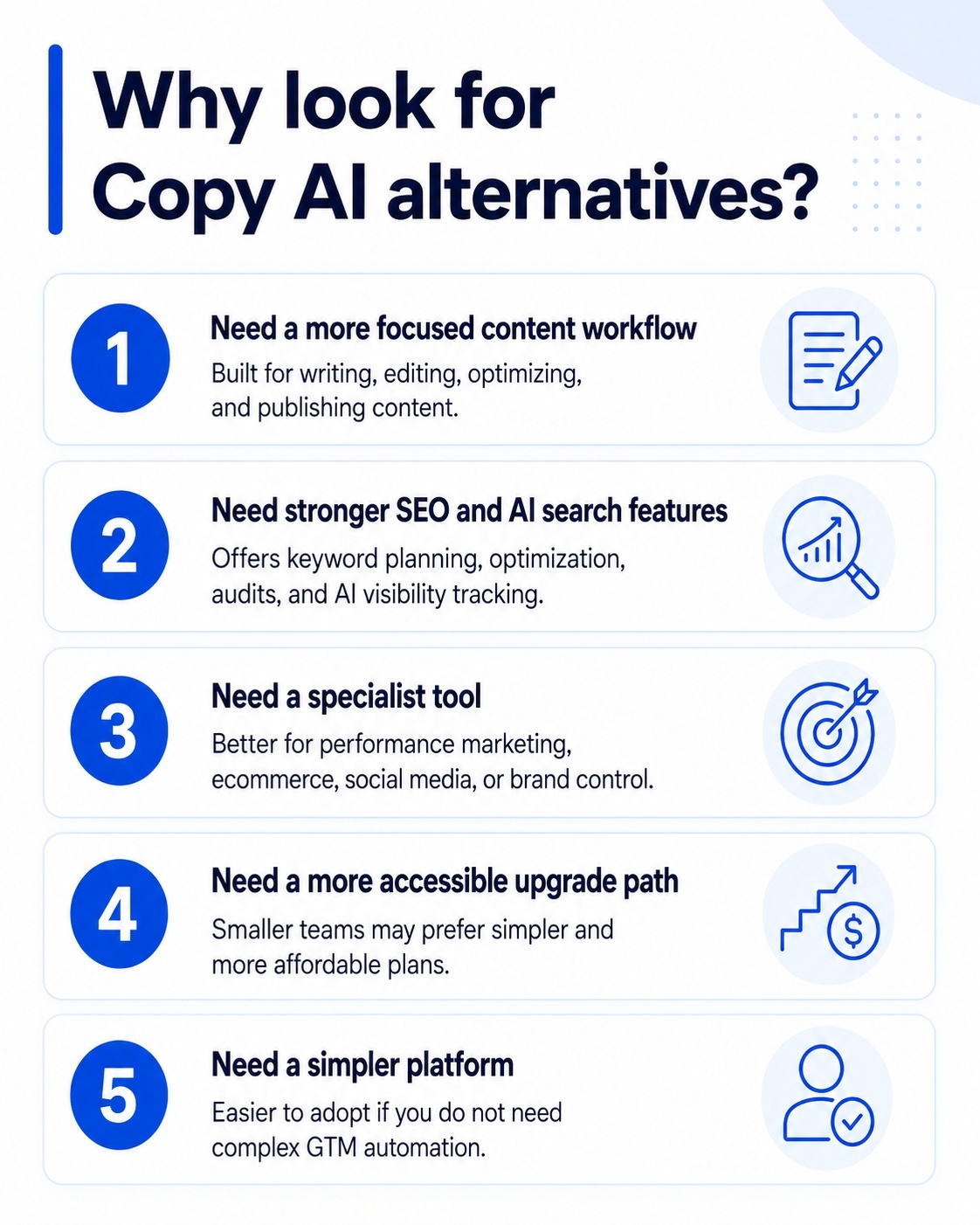
Copy.ai has expanded from an AI writing tool into a broader GTM AI platform with workflows for marketing, sales, and operations. This makes it useful for larger revenue teams, but potentially excessive for users who mainly need content creation.
These are the main reasons why most teams look for Copy.ai alternatives:
1. Need a more focused content workflow
Writers and content teams may prefer a platform built specifically for creating, editing, optimizing, and publishing blogs, emails, landing pages, and social content.
2. Need stronger SEO and AI search features
Some alternatives offer dedicated keyword planning, content scoring, website auditing, on-page optimization, and AI visibility tracking that Copy.ai does not prioritize.
3. Need a specialist tool
A focused platform may be better for performance marketing, ecommerce catalogs, social media production, brand governance, or affordable everyday writing.
4. Need a more accessible upgrade path
Copy.ai’s Chat plan costs $29 per month, while its Growth plan starts at $1,000 per month when billed annually. This may be too large a jump for smaller teams that need more than basic chat but not enterprise-scale workflows.
5. Need a simpler platform
Copy.ai supports multi-step workflows, agents, integrations, research, and content generation. Teams that do not need this level of GTM automation may find a more focused platform easier to adopt and manage.
The best Copy AI alternative depends on whether your priority is SEO, affordability, brand control, campaign performance, ecommerce content, or social production.
Need more than a basic AI writer? Explore the best AI tools for content creation across writing, SEO, design, video, and publishing.
How we selected these Copy AI alternatives?
We reviewed each platform using its current official product pages, pricing pages, and documentation. Our evaluation considered:
- Primary use case and differentiation from Copy.ai
- Feature depth and relevance
- Pricing accessibility and plan restrictions
- Suitability for different teams and workflows
- Ability to solve a distinct content or marketing need
We prioritized tools with clearly different strengths rather than selecting multiple platforms with overlapping capabilities. Features and pricing were checked in July 2026 and may change over time.
Need a deeper evaluation framework? Learn how to choose a generative AI optimization tool for your goals, workflow, and budget.
What are the 7 best Copy AI alternatives in 2026?
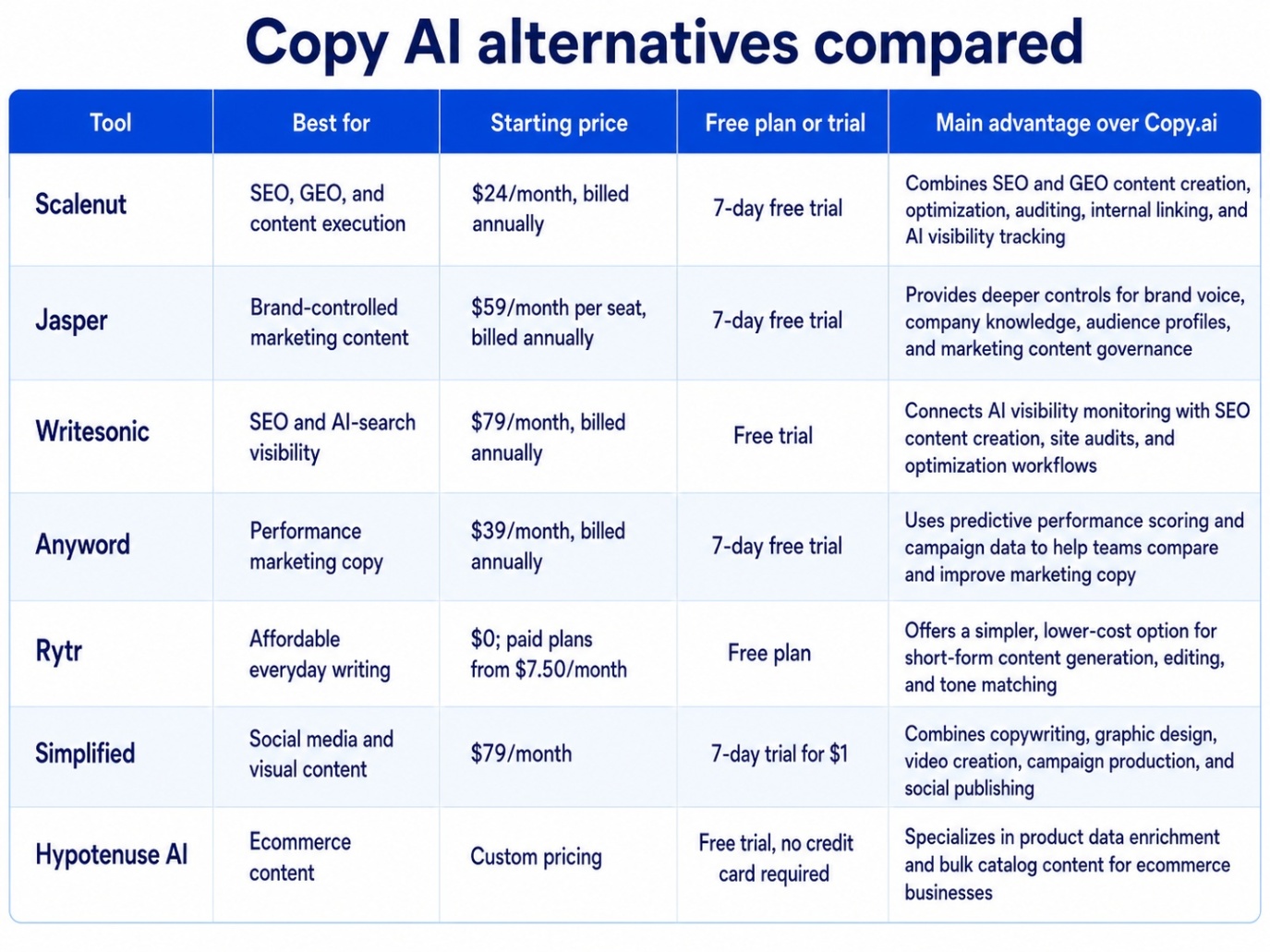
The seven best Copy AI alternatives are Scalenut, Jasper, Writesonic, Anyword, Rytr, Simplified, and Hypotenuse AI. Each platform serves a different need, from SEO and AI visibility to brand control, performance copy, social content, affordability, and ecommerce workflows.
Below, we compare their key features, pricing, pros and cons, and who should choose each tool over Copy.ai:
1. Scalenut: Best for SEO, GEO, and content execution
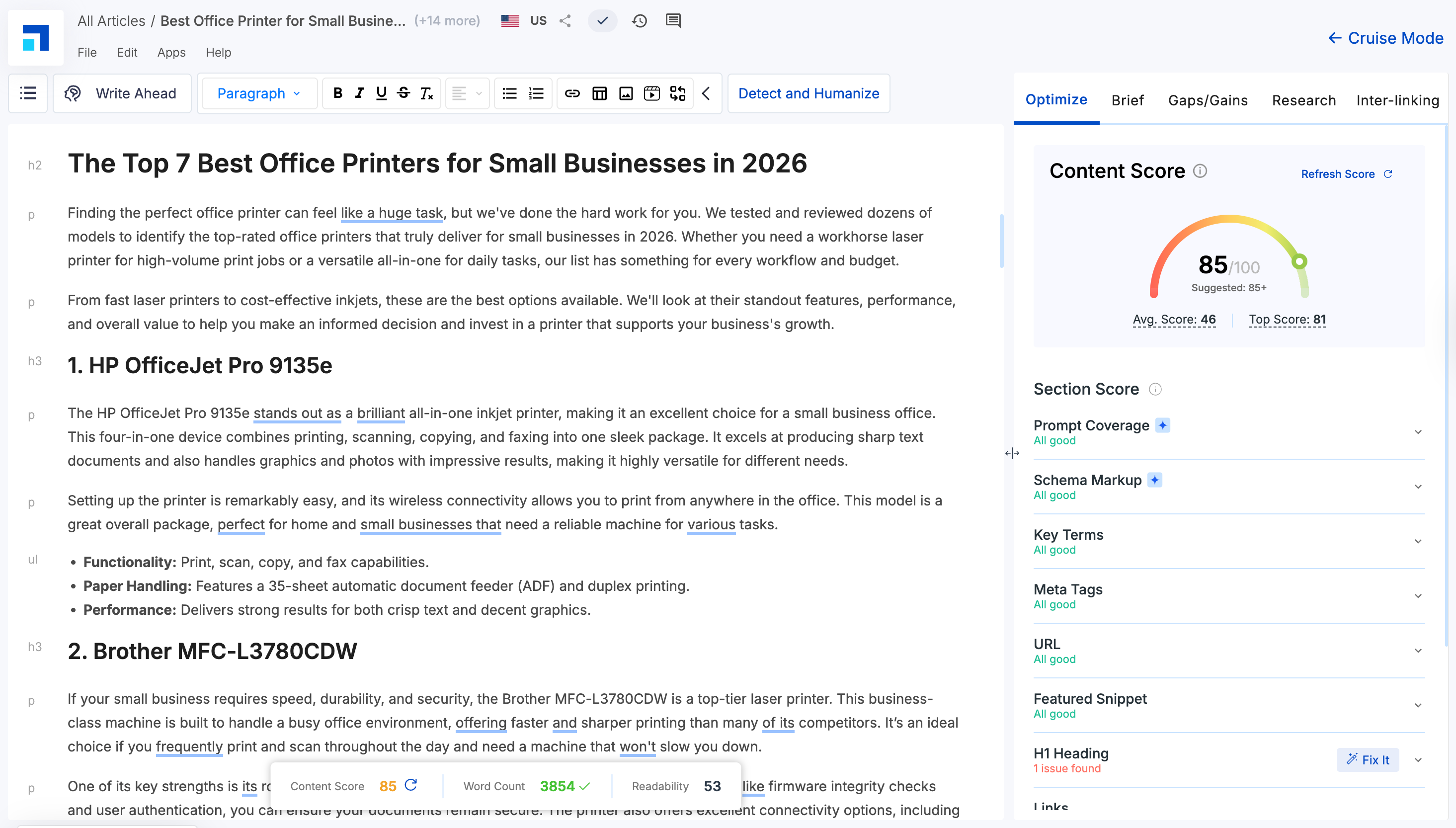
Scalenut is an SEO and GEO platform for teams that want to plan, create, optimize, and monitor content within one workflow. Unlike Copy.ai’s broader focus on go-to-market automation, Scalenut is designed specifically for improving visibility across Google and AI platforms such as ChatGPT, Google AI Overviews, and Perplexity.
Key features
- AI Visibility: Tracks brand mentions, citations, Visibility Score, Share of Voice, sentiment, prompt performance, and competitor visibility across supported AI engines.
- Keyword Planner and Article Writer: Builds keyword clusters and converts them into research-backed content briefs and first drafts using data from top-ranking pages.
- GEO AI Editor and Content Optimizer: Evaluates content using SEO and GEO factors such as key terms, headings, prompt coverage, links, and metadata. Existing URLs can also be compared with top-ranking competitors to identify missing topics and optimization opportunities.
- Content execution tools: Includes content auditing, internal linking, auto-optimization, traffic analysis, WordPress and Shopify publishing, and cannibalization analysis on eligible plans.
How does Scalenut compare with Copy.ai?
Scalenut is more suitable for teams focused on organic search, AI visibility, long-form content, content refreshes, and on-page optimization. It connects visibility insights with tools for creating and improving the pages intended to close those gaps.
Copy.ai is broader across the revenue lifecycle. Its workflows support marketing, sales, customer success, CRM enrichment, prospecting, and other multi-step GTM processes. It may be the stronger choice when cross-functional automation matters more than SEO and GEO execution.
Pros and cons
Pros
- Combines SEO, GEO monitoring, content creation, and optimization
- Supports both new content and existing-page refreshes
- Provides internal linking, auditing, and publishing tools on higher plans
Cons
- The Starter plan tracks only 10 prompts with weekly refreshes
- Perplexity tracking, cannibalization analysis, and several advanced capabilities require higher plans
Scalenut pricing
- Starter: $24 per month when billed annually or $59 monthly
- Plus: $36 per month when billed annually or $89 monthly
- Professional: $80 per month when billed annually or $199 monthly
- VIP Service: Custom pricing
- A seven-day free trial is available.
Who should choose Scalenut over Copy.ai?
Choose Scalenut when your primary goal is to research topics, produce search-focused content, optimize existing pages, and track visibility across traditional and AI search. Copy.ai remains better suited to organizations that need automated workflows across sales, marketing, operations, and customer success.
Want a closer look before deciding? Read our Scalenut review for a full breakdown of its GEO, SEO, and content workflows.
Or, book a demo to see how Scalenut can help your team create, optimize, and scale content while improving visibility across both search engines and AI answer platforms.
2. Jasper: Best for brand-controlled marketing content
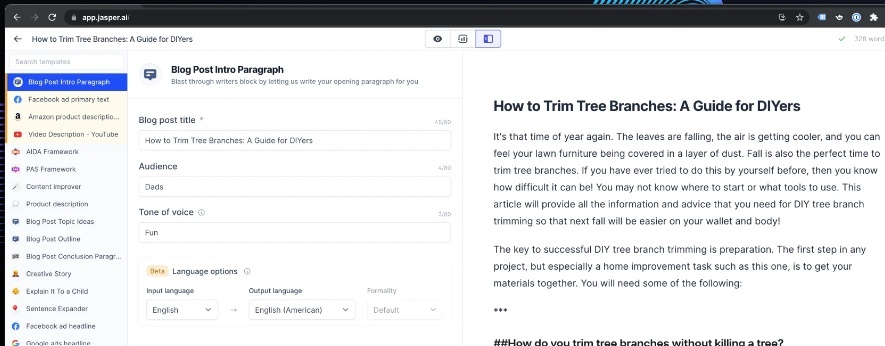
Jasper is an AI marketing platform built for teams creating campaigns, ads, emails, social posts, website copy, and other marketing assets. Its key differentiator is the level of control it provides over brand voice, audience context, company knowledge, terminology, and content standards.
Key features
- Brand Voice: Jasper can analyze existing content to identify its tone, style, and language patterns. The selected voice is then applied to new content to maintain consistency.
- Knowledge and audiences: Teams can provide product information, messaging, FAQs, competitive positioning, and audience profiles. Jasper uses this context to tailor its outputs to the company and intended reader.
- Style Guide: Business-plan users can define rules for punctuation, capitalization, abbreviations, approved terminology, and formatting. These rules are applied automatically while content is generated.
- Marketing agents: Jasper provides agents for core marketing tasks. Its Business plan adds advanced agents, a no-code agent builder, Jasper Grid, and workflows for scaled content production.
How does Jasper compare with Copy.ai?
Jasper AI is more focused on helping marketing teams produce content that follows defined brand, audience, and style requirements. Its brand controls make it particularly relevant for companies managing multiple products, campaigns, or customer segments.
Copy.ai has a broader go-to-market focus. Its workflows extend beyond marketing content into prospecting, lead processing, CRM enrichment, account-based marketing, and sales operations. It is therefore better suited to companies seeking automation across their wider revenue process.
Pros and cons
Pros
- Strong controls for brand voice, audience context, and company knowledge
- Purpose-built agents for common marketing workflows
- Supports multiple brands and audiences within one workspace
Cons
- The Pro plan includes only one seat
- Style Guides, API access, Jasper Grid, and advanced governance require the Business plan
Jasper pricing
- Pro: Costs $69 per month or $59 per month when billed annually. It includes one seat, two Brand Voices, five Knowledge assets, three Audiences, Canvas, and essential marketing agents.
- Business: Uses custom pricing. It adds unlimited Brand Voices, Knowledge assets and Audiences, advanced agents, Jasper Grid, API access, governance controls, and dedicated support.
- Jasper offers a seven-day free trial of the Pro plan.
Who should choose Jasper over Copy.ai?
Choose Jasper when maintaining a consistent brand voice across marketing campaigns is more important than automating the entire go-to-market process.
It is better suited to marketing teams managing multiple audiences, products, or brand identities. Copy.ai remains stronger for companies that need workflows spanning marketing, sales, and revenue operations.
Considering Jasper for brand-led marketing? Read our Jasper AI review for a closer look at its features, strengths, and limitations.
3. Writesonic: Best for SEO and AI-search visibility
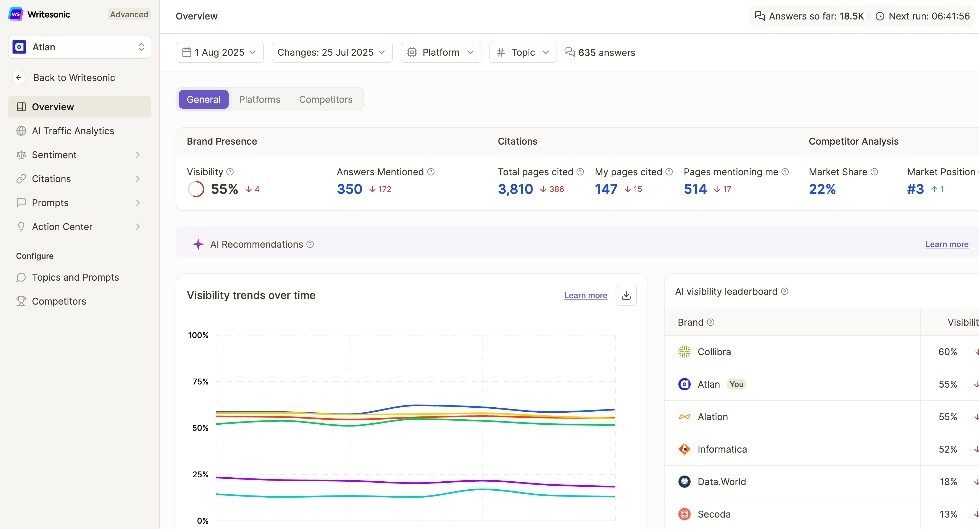
Writesonic is an AI search platform that combines brand visibility tracking, SEO auditing, content creation, and optimization. It is better suited to search-focused marketing teams than Copy.ai because it connects AI-search insights with tools for creating content and addressing website issues.
Key features
- AI visibility tracking: Self-serve plans monitor brand visibility, citations, prompts, and answers across ChatGPT, Gemini, and Google AI Overviews. Enterprise customers can track ten AI platforms, including Perplexity, Claude, Microsoft Copilot, AI Mode, and DeepSeek.
- SEO AI Agent: The agent runs technical website audits and can address issues involving meta tags, schema markup, and other SEO elements without requiring users to edit code manually.
- AI Article Writer: Writesonic creates long-form articles as part of its SEO and content workflow. Article limits range from 15 per month on Starter to 50 per month on Growth.
- Site audits: The platform audits website pages to identify technical and content issues. Audit volume and page limits increase across the Starter, Basic, Growth, and Enterprise plans.
How does Writesonic compare with Copy.ai?
Writesonic is stronger for teams that need to monitor AI-search visibility, audit websites, produce SEO content, and improve pages within the same platform.
Copy.ai is designed for wider go-to-market automation. Its workflows cover content creation, prospecting, inbound lead processing, account-based marketing, CRM enrichment, translation, and sales operations. It is therefore better suited to businesses prioritizing cross-functional GTM processes over dedicated SEO and AI-search execution.
Pros and cons
Pros
- Combines SEO, content creation, site auditing, and AI visibility tracking
- Tracks prompts and answers daily on self-serve plans
- Supports both content production and technical SEO improvements
Cons
- Starter, Basic, and Growth track only ChatGPT, Gemini, and Google AI Overviews
- Full ten-platform tracking, Action Center access, and advanced agentic workflows require Enterprise
Writesonic pricing
- Starter: $79 per month, billed annually
- Basic: $199 per month, billed annually
- Growth: $399 per month, billed annually
- Enterprise: Custom pricing
Who should choose Writesonic over Copy.ai?
Choose Writesonic when your priorities are SEO content, technical website improvements, and tracking how your brand appears in AI-generated answers. Copy.ai remains the stronger option for organizations that need broader automation across marketing, sales, revenue operations, and customer-facing GTM workflows.
Need a deeper product breakdown? Read our Writesonic review to assess its SEO, AI visibility, and content workflows.
4. Anyword: Best for performance marketing copy
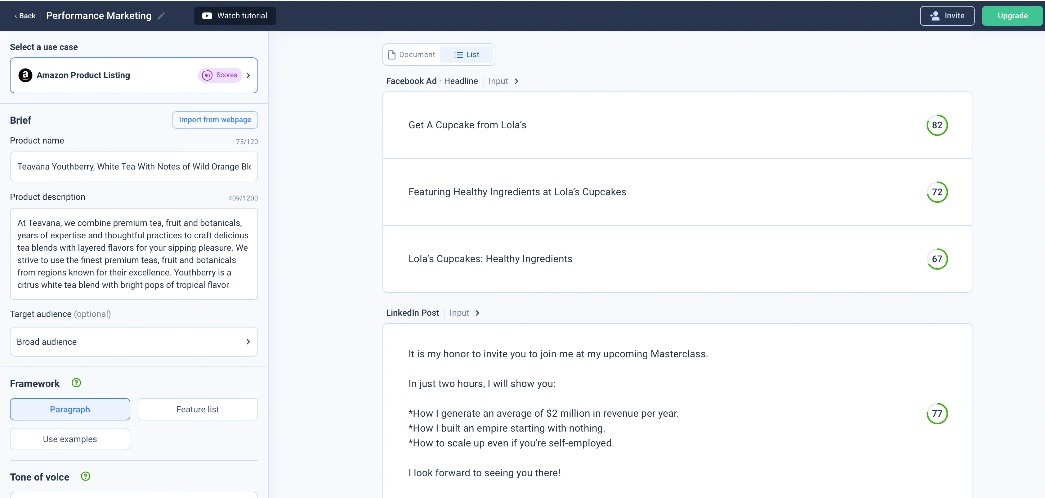
Anyword is an AI writing platform built for marketers creating ads, emails, landing pages, social posts, and other campaign assets. Its main differentiator is predictive scoring, which helps teams compare copy variations based on their estimated performance and audience fit before publishing.
Key features
- Predictive Performance Score: Anyword scores copy variations based on their predicted performance and conversion potential, helping marketers choose between different messages before launching a campaign.
- Audience targeting: Teams can define audiences using details such as demographics, roles, and pain points. Anyword then adapts messaging and recommended talking points to those audience profiles.
- Brand Voice: Users can centralize messaging, tone, audience profiles, and brand guidelines to maintain greater consistency across channels and teams.
- Performance data: Business customers can connect past campaign data so Anyword can identify high-performing messaging and apply those insights to new content.
How does Anyword compare with Copy.ai?
Anyword is more focused on improving the effectiveness of individual marketing assets. Its predictive scoring, audience controls, and performance data make it particularly relevant for paid media, demand generation, email, and landing-page teams.
Copy.ai supports a much broader range of go-to-market processes, including content creation, prospecting, lead processing, account-based marketing, CRM enrichment, translation, and sales workflows. It is the stronger option when a company needs connected automation across multiple revenue teams.
Pros and cons
Pros
- Predictive scoring for comparing copy variations
- Strong audience and brand-message controls
- Can use past campaign data to inform future content
Cons
- Performance predictions are limited by plan
- Advanced data connections and custom models require custom-priced plans
Anyword pricing
- Starter: $49 per month or $39 per month when billed annually
- Data-Driven: $99 per month or $79 per month when billed annually
- Business: Custom pricing
- Enterprise: Custom pricing
- A seven-day free trial is available.
Who should choose Anyword over Copy.ai?
Choose Anyword when your main priority is selecting and improving copy for ads, emails, landing pages, and other measurable campaigns. Copy.ai remains better suited to companies that need broader workflow automation across marketing, sales, operations, and the wider go-to-market process.
Want to know where predictive scoring adds value? Read our Anyword review for its strengths, limitations, and best-fit use cases.
5. Rytr: Best affordable Copy.ai alternative
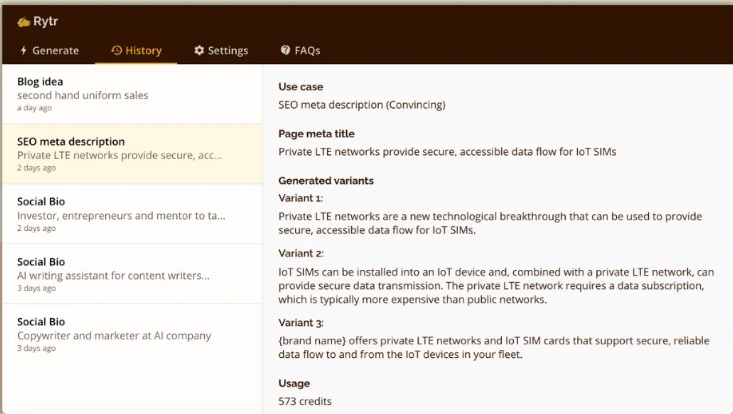
Rytr is a lightweight AI writing assistant for freelancers, small businesses, and individuals who need help creating or editing everyday content. It offers a free plan and low-cost unlimited generation, making it more accessible than Copy.ai for users who do not need advanced GTM automation.
Key features
- 40+ writing use cases: Rytr provides templates for emails, social posts, calls to action, website copy, SEO titles, product descriptions, and other short-form content.
- Tone matching: The MyVoice feature analyzes a writing sample and applies a similar tone to generated content. The Unlimited plan supports one personalized voice, while Premium supports multiple voices.
- Editing tools: Users can continue, expand, shorten, rephrase, and improve existing text within Rytr’s editor.
- Chrome extension: Rytr can generate and improve emails, social comments, meta descriptions, reviews, and other content directly within supported websites and applications.
How does Rytr compare with Copy.ai?
Rytr is the more affordable and straightforward option for users who primarily need short-form content generation and basic editing. Its free plan and inexpensive unlimited plan make it suitable for freelancers, creators, and small businesses with modest content requirements.
Copy.ai is built for broader GTM automation. It supports connected workflows for content creation, prospecting, lead processing, account-based marketing, CRM enrichment, sales, and operations. It is better suited to larger teams automating multi-step revenue processes.
Pros and cons
Pros
- Free plan with access to more than 40 writing use cases
- Unlimited content generation on both paid plans
- Browser extension for writing across different websites
Cons
- The free plan is limited to 10,000 characters per month
- Free and Unlimited users can access only one language at a time
Rytr pricing
- Free: $0 per month
- Unlimited: $7.50 per month, billed annually
- Premium: $24.16 per month, billed annually
Who should choose Rytr over Copy.ai?
Choose Rytr when you need an inexpensive tool for emails, social posts, website copy, product descriptions, and everyday editing. It is better suited to freelancers and small businesses that value simplicity and unlimited generation. Copy.ai remains the stronger option for teams needing advanced workflows, integrations, and cross-functional GTM automation.
Need affordable options with deeper capabilities? Compare the best Rytr alternatives for SEO, long-form content, and everyday writing.
6. Simplified: Best for social media and visual content
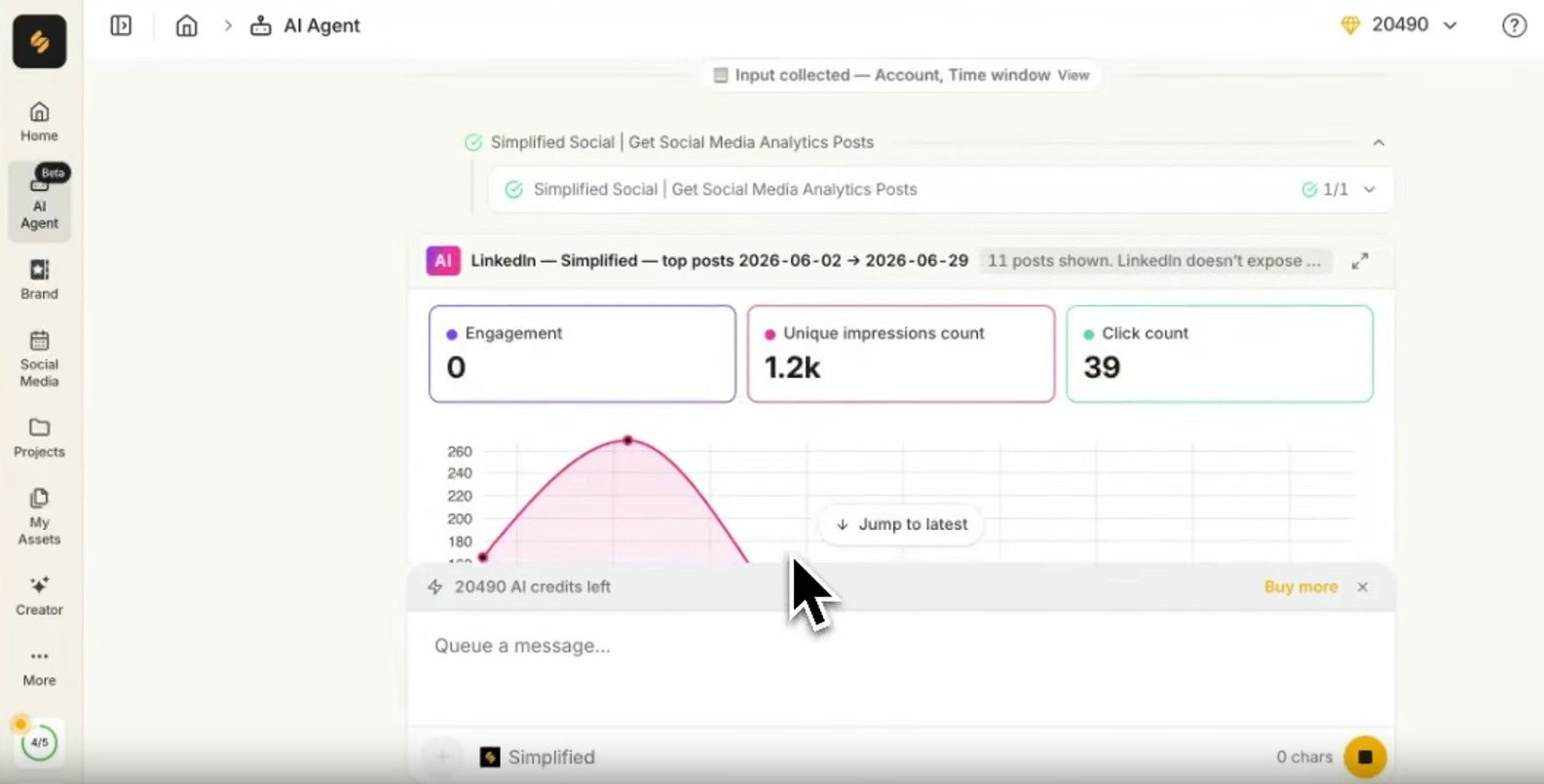
Simplified combines AI writing, graphic design, video creation, campaign production, and social publishing in one platform. It is particularly relevant for social media teams that want to create captions, carousels, ads, short videos, and other visual assets without moving between separate writing, design, and scheduling tools.
Key features
- AI design tools: Simplified can generate presentations, social carousels, ad banners, thumbnails, and images. Its Brand Book stores logos, fonts, colors, and other visual guidelines for reuse across assets.
- AI video creation: Users can turn a topic into a scripted and voiced video, add subtitles, generate voiceovers, and repurpose longer videos into short clips.
- Social media management: Simplified supports content planning, post scheduling, analytics, inbox management, client approvals, and publishing across multiple social platforms.
- Campaign agents: Teams can provide a campaign brief and generate social post batches, email sequences, or ad creative sets for review before publishing.
How does Simplified compare with Copy.ai?
Simplified is stronger for teams that need to create the written and visual parts of a campaign and publish social content from the same workspace. Its design, video, brand kit, scheduling, and approval tools make it more suitable for visual-first marketing workflows.
Copy.ai focuses more heavily on automating wider go-to-market processes across sales, marketing, and operations. It is better suited to businesses that need connected workflows involving CRM data, prospecting, lead processing, and revenue operations.
Pros and cons
Pros
- Combines copy, design, video, and social publishing
- Supports branded visual content across multiple formats
- Includes scheduling, approvals, analytics, and social inbox tools
Cons
- Its $79 starting price may be excessive for users who only need AI copywriting
- Unused campaign credits do not roll over to the next billing period
Simplified pricing
- Starter: $79 per month
- Additional campaigns: $10 each
- A trial of the Starter plan is available.
Who should choose Simplified over Copy.ai?
Choose Simplified when your workflow involves producing captions, graphics, carousels, videos, and scheduled social posts within one platform. Copy.ai remains more suitable for companies that want to automate broader processes across their marketing, sales, and revenue teams.
Looking beyond all-in-one creative suites? Explore the best Simplified alternatives by pricing, features, and workflow fit.
7. Hypotenuse AI: Best for ecommerce content
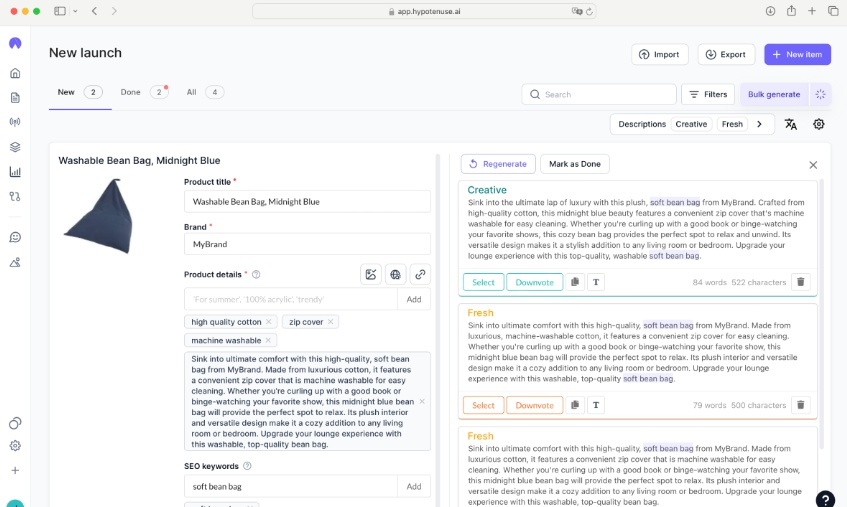
Hypotenuse AI is built for ecommerce teams managing product data, descriptions, metadata, images, and large catalogs. Its main advantage over Copy.ai is its ability to enrich incomplete product information and generate channel-ready content in bulk while maintaining brand and formatting requirements.
Key features
- Product data enrichment: Hypotenuse AI can fill missing attributes using product images, webpages, specific URLs, barcodes, and data sheets.
- Bulk content generation: Teams can import thousands of products and generate descriptions, metadata, category copy, and other product content in bulk.
- Brand and formatting controls: Content can follow defined brand voices, required formats, and rules specifying which words to include or exclude.
- Ecommerce integrations: Hypotenuse AI connects with platforms and product systems such as Shopify, Salsify, Salesforce Commerce Cloud, PIMs, and ERPs.
How does Hypotenuse AI compare with Copy.ai?
Hypotenuse AI is more specialized for ecommerce catalog operations. It can enrich, clean, standardize, and structure product data before using it to generate product descriptions and other content across large inventories.
Copy.ai can also produce product descriptions, but its broader focus is automating workflows across marketing, sales, and customer success. It is better suited to companies seeking cross-functional GTM automation rather than dedicated catalog enrichment and product content management.
Pros and cons
Pros
- Purpose-built tools for ecommerce product data and content
- Supports large catalogs and bulk workflows
- Can enrich incomplete supplier or manufacturer data
Cons
- Pricing is not publicly disclosed
- Direct PIM integrations and advanced capabilities require custom plans
Hypotenuse AI pricing
- Basic: Custom pricing
- Ecommerce Enterprise: Custom pricing
- A free trial is available without a credit card.
Who should choose Hypotenuse AI over Copy.ai?
Choose Hypotenuse AI when you need to enrich product data and create consistent descriptions, metadata, and other catalog content at scale. Copy.ai remains more suitable for teams that need AI workflows connecting marketing content with sales, lead processing, CRM data, and wider GTM operations.
Want to improve product discovery beyond content generation? Compare the best GEO tools for ecommerce for traditional and AI search visibility.
How to choose the right Copy AI alternative for your team?
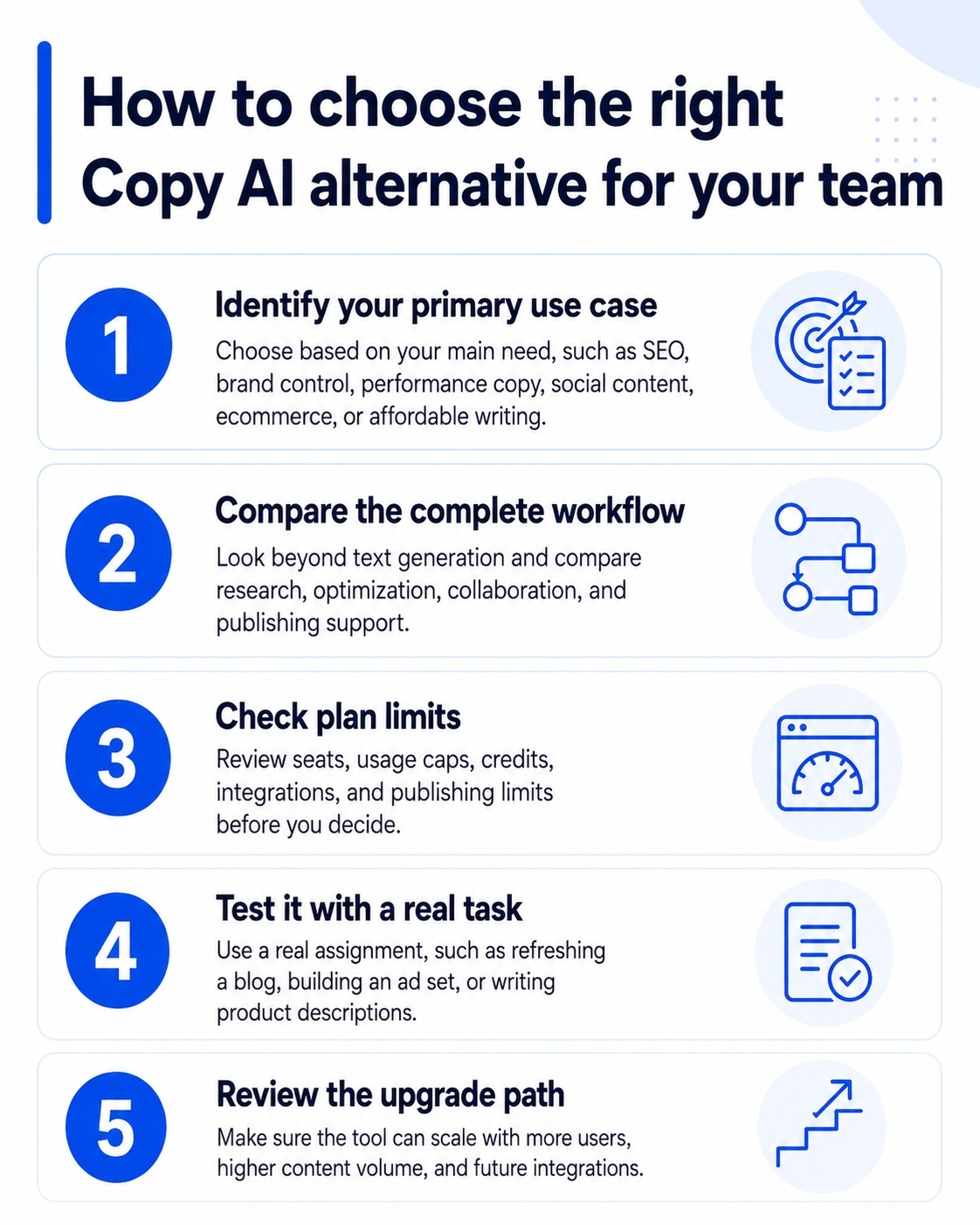
The right choice depends on the work you want to improve, not which platform has the longest feature list. Compare each tool against the same criteria before committing to a plan.
Here are the main things to consider while choosing a Copy AI alternative:
1. Identify your primary use case
Start with the task your team performs most often. You may need SEO and AI search optimization, brand-controlled marketing content, performance copy, social campaigns, ecommerce content, or an affordable everyday writing tool.
A specialist platform is often more practical than a broader tool when most of your work follows one workflow.
2. Compare the complete workflow
Look beyond basic text generation. Depending on your needs, compare research, optimization, brand controls, performance scoring, visual creation, product data enrichment, collaboration, and publishing.
The best option should support the full process your team follows, not just generate a first draft.
3. Check the limits of the plan you can afford
Compare seats, workspaces, usage caps, tracked prompts, campaign credits, brand voices, integrations, and publishing limits.
These restrictions can affect the value of a plan more than its headline price, especially as your content output grows.
4. Test the tool with a real task
Use the free trial or demo to complete a typical assignment, such as refreshing an article, producing an ad campaign, or generating product descriptions.
Compare the editing time, factual accuracy, brand fit, workflow steps, and final output rather than judging the tool from a generic prompt.
5. Review the upgrade path
Consider whether the platform can support additional users, brands, languages, content volume, and integrations as your needs grow.
Also check how the pricing scales. Some tools charge by seats, while others use prompts, articles, projects, campaign credits, or workflow usage.
The best Copy AI alternative should improve the part of your workflow that matters most without making your team pay for complexity it does not need.
Need a more search-focused shortlist? Compare the best AI tools for SEO and AEO by capabilities, pricing, and team fit.
Which Copy AI alternative is best for your use case?
The best Copy AI alternative depends on the workflow you want to improve. Among the seven tools reviewed, these are the strongest options for each use case:
- Best for SEO and GEO: Scalenut. It combines content planning, creation, optimization, and visibility tracking across traditional and AI search.
- Best for brand-controlled marketing: Jasper. Its brand voice, company knowledge, audience profiles, and style controls help teams maintain consistency across campaigns.
- Best for SEO and AI-search visibility: Writesonic. It brings SEO research, content optimization, site auditing, and AI visibility monitoring into one platform.
- Best for performance marketing: Anyword. Its predictive scoring helps marketers compare copy for ads, emails, landing pages, and other campaigns.
- Best affordable option: Rytr. Its free plan and low-cost paid plans suit freelancers and small teams with straightforward writing needs.
- Best for social and visual content: Simplified. It combines AI writing with design, video production, social publishing, and scheduling.
- Best for ecommerce: Hypotenuse AI. It specializes in product data enrichment, catalog management, and bulk ecommerce content creation.
Use this shortlist to narrow the field, then compare pricing, plan limits, and workflow fit before making the final choice.
Still comparing execution-first platforms? Explore the best AI SEO tools in 2026 to refine your shortlist.
Final thoughts
Copy.ai remains useful for broad GTM automation, but the right AI tool depends on the work you need to improve. Content marketers and business owners should prioritize output quality, SEO optimization, performance copy, ecommerce, or social production based on their content strategy. The best fit should support SERP research, SEO articles, content pipelines, and quality content for search engines without adding unnecessary complexity.
Shortlist two options and run the same real task through each AI writer. Compare the AI output for accuracy, editing time, brand fit, SEO features, collaboration, and advanced features. Then choose the single platform that strengthens your content marketing workflow and delivers the clearest long-term value.
Frequently Asked Questions
What AI writing tools are copywriters actually paying for instead of Copy.ai?
Copywriters often choose tools like Jasper, Scalenut, Writesonic, Rytr, and Anyword instead of Copy.ai. The right choice usually depends on budget, preferred workflow, content goals, and whether they need SEO support, performance insights, or simple day-to-day writing help.
What features should I look for when choosing a Copy.ai alternative?
Look for features that match your actual workflow, such as brand voice controls, long-form writing support, SEO tools, ease of use, collaboration options, and pricing. It also helps to choose a platform that supports your main content formats without adding unnecessary complexity.
Which Copy.ai alternatives are best for SEO-focused content teams?
Scalenut, Frase, Surfer AI, and Writesonic are among the strongest options for SEO-focused content teams. These tools go beyond basic text generation by supporting research, optimization, content planning, and workflows that help improve rankings, visibility, and overall content performance.
Which Copy.ai alternatives work best for generating long-form content?
Scalenut, Jasper, Writesonic, Frase, and ContentShake AI are strong options for long-form content generation. They are better suited for creating blog posts, guides, and in-depth articles because they offer more structure, research support, and optimization features than basic copy tools.
What is the free alternative to Copy AI?
Rytr is one of the better-known free alternatives to Copy.ai because it offers a free plan for lighter writing needs. Simplified also has a free tier, making both tools useful for freelancers, beginners, or small teams looking to keep costs low.
Which Copy.ai alternatives offer automated publishing features?
Scalenut can publish content directly to WordPress and Shopify, while Writesonic supports WordPress and other CMS publishing workflows. Simplified schedules and publishes social posts, and Hypotenuse AI can push ecommerce or blog content to platforms such as Shopify, WordPress, and Webflow.
Is Copy.ai still worth using in 2026?
Copy.ai remains worth considering for larger teams that need connected workflow automation across marketing, sales, customer success, and operations. A specialist alternative may offer better value when your priority is SEO, ecommerce content, performance copy, or affordable everyday writing.
What is the closest alternative to Copy.ai for marketing teams?
Among these seven tools, Jasper is the closest fit for marketing teams primarily using Copy.ai to create campaigns and maintain brand consistency. It offers strong brand voice, audience, style, and company knowledge controls, but not Copy.ai’s wider GTM automation scope.
Which Copy.ai alternative is best for small businesses and freelancers?
Rytr is usually the most accessible option for freelancers and small businesses that need straightforward writing and editing at a low cost. Teams requiring SEO planning, optimization, and publishing should compare Scalenut before choosing solely on price.
Which Copy.ai alternative is best for ecommerce product content?
Among the shortlisted tools, Hypotenuse AI is the strongest fit for ecommerce teams managing large product catalogs. It can enrich, clean, standardize, and generate product data and descriptions in bulk while supporting brand and channel requirements.
Can any Copy.ai alternative fully replace its GTM automation workflows?
No single alternative fully mirrors Copy.ai’s broader GTM automation across marketing, sales, customer success, and operations. Jasper is closer for marketing workflows, while the other tools specialize in SEO, performance copy, social production, affordable writing, or ecommerce content.


.svg)


.webp)