7 Best LLM SEO Analysis Tools Compared in 2026
Quick verdict: Which tool is best for LLM SEO analysis?
The best LLM SEO tool depends on whether you need broad market research, focused prompt tracking, technical crawler analysis, or a platform that also helps execute the recommendations.
- Scalenut: Best overall for connecting AI visibility analysis with content creation, optimization, internal linking, backlinks, and publishing.
- Profound: Best for enterprise teams that need daily tracking, prompt-demand data, regional analysis, and crawler intelligence.
- Peec AI: Best for focused custom-prompt monitoring, competitor benchmarking, and citation analysis.
- Scrunch: Best for connecting AI visibility with crawler behavior, technical page health, referrals, and conversions.
- Ahrefs Brand Radar: Best for researching brand visibility, competitors, citations, and topics across a large search-backed prompt database.
- Semrush AI Visibility Toolkit: Best for teams that want AI visibility analysis alongside established SEO and competitor data.
- AIclicks: Best for identifying citation gaps, influential sources, and outreach or content opportunities.
You can buy a platform that reports a clean AI visibility score and still have no idea why competitors keep winning the answer. The real difference is not how many dashboards a tool offers. It is whether it can connect prompts, citations, source gaps, competitor positioning, and traffic signals to a clear next step.
I compared seven platforms to find the best LLM SEO analysis tool for different workflows, from enterprise monitoring and crawler analysis to content execution. This guide shows what each platform actually analyzes, where its data is most useful, what it costs, and which team it suits best.
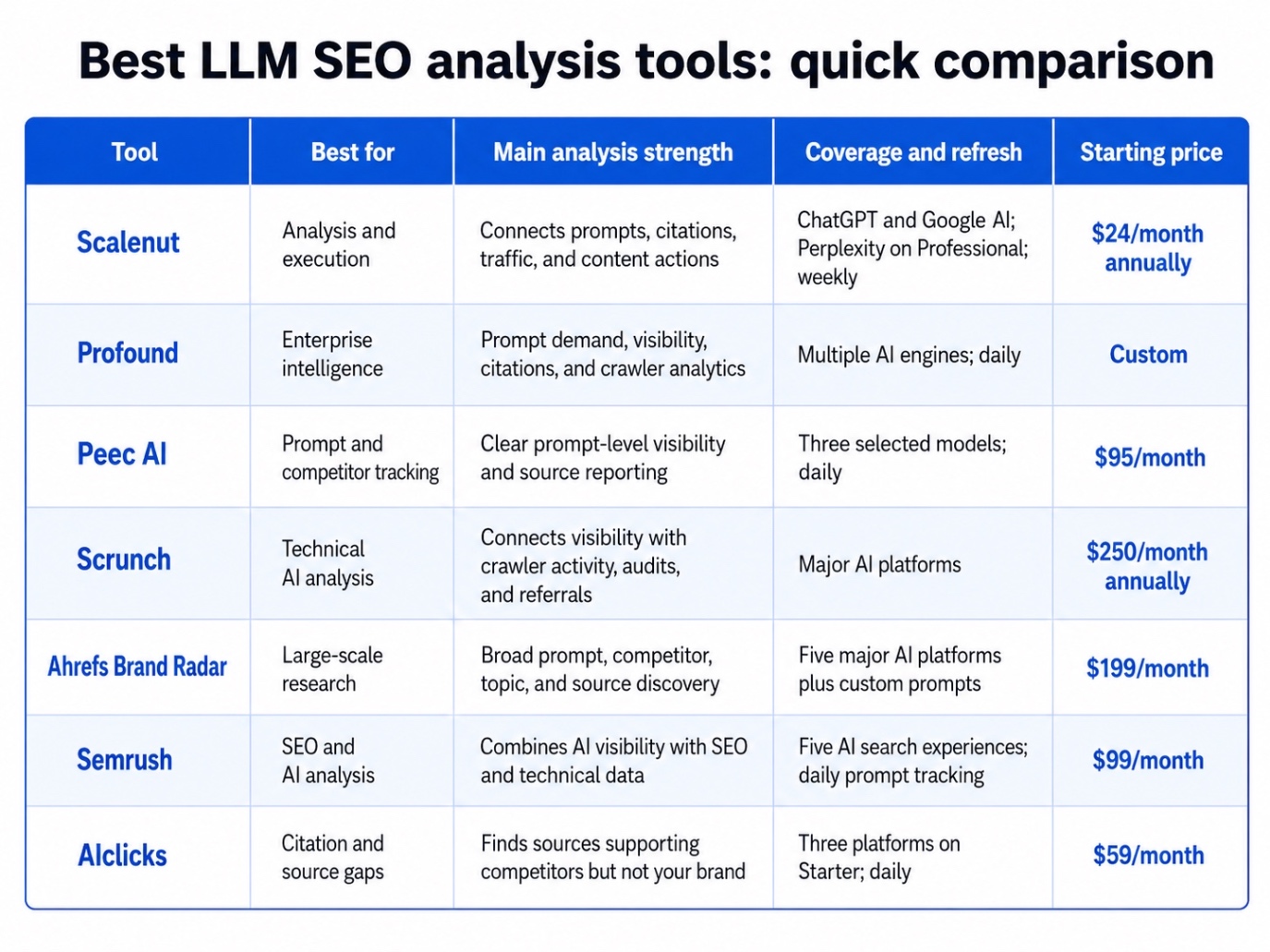
What are the best LLM SEO analysis tools in 2026?
The leading options are Scalenut, Profound, Peec AI, Scrunch, Ahrefs Brand Radar, Semrush AI Visibility Toolkit, and AIclicks. They differ in analysis depth, prompt tracking, citation intelligence, crawler data, and execution capabilities.
Let’s look at what each platform analyzes, where it stands out, and which teams it suits best.
1. Scalenut: Best overall for LLM SEO analysis and execution
Scalenut combines AI visibility analysis with content creation, optimization, internal linking, authority building, and publishing workflows. Teams can identify a weak prompt, citation gap, or competitor advantage and act on it without moving to a separate platform.
What does Scalenut analyze?
1. Brand Monitor
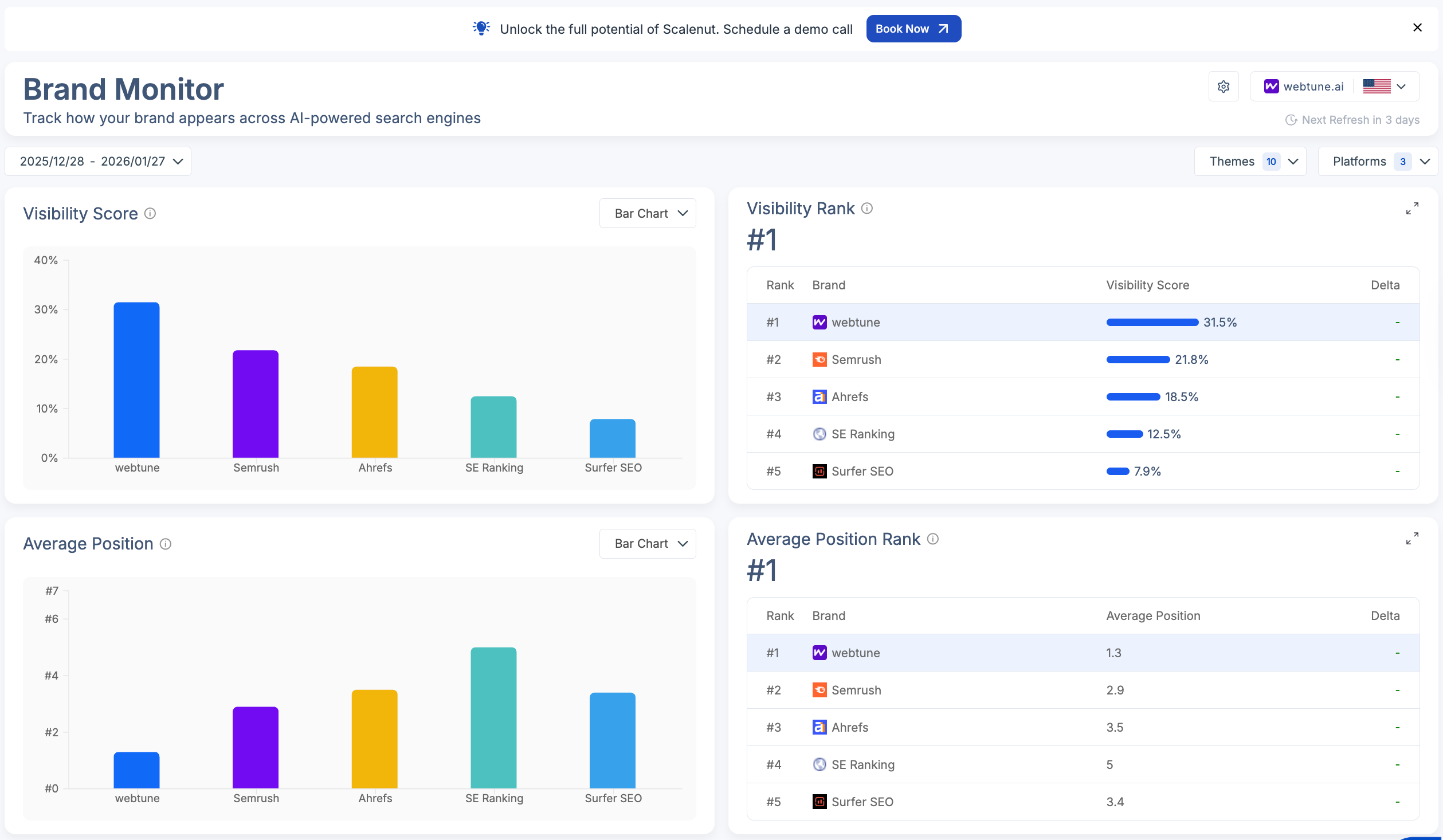
Brand Monitor shows how frequently and prominently a brand appears across supported AI platforms. Its main metrics include:
- Visibility Score
- Visibility Rank
- Average Position
- Share of Voice
- Visibility Heatmap
Historical charts show how visibility, position, and share of voice change over time, helping teams distinguish temporary fluctuations from sustained gains or declines.
2. Prompt Insights

Users can add custom prompts and organize them into themes. Each prompt shows visibility, position, mentions, citations, competitors, executions, and the latest refresh date.
Opening a prompt reveals the complete AI response, region, brand position, competing brands, cited sources, and query fan-outs. This helps teams understand what caused a visibility change instead of relying only on an aggregate score.
3. Citation analysis
Scalenut reports Citation Share, Citation Rank, leading citation domains, frequently cited pages, and source types.
This helps teams identify which owned pages influence AI answers, which third-party sources support competitors, and where additional content or authority-building work may be needed.
4. Competitor and sentiment analysis
Scalenut compares brands across visibility, position, share of voice, prompt coverage, citations, and mentions.
It also classifies sentiment as positive, neutral, or negative for each prompt execution. Users can review the complete response to understand how their brand is described and positioned against competitors.
5. AI Traffic Monitor
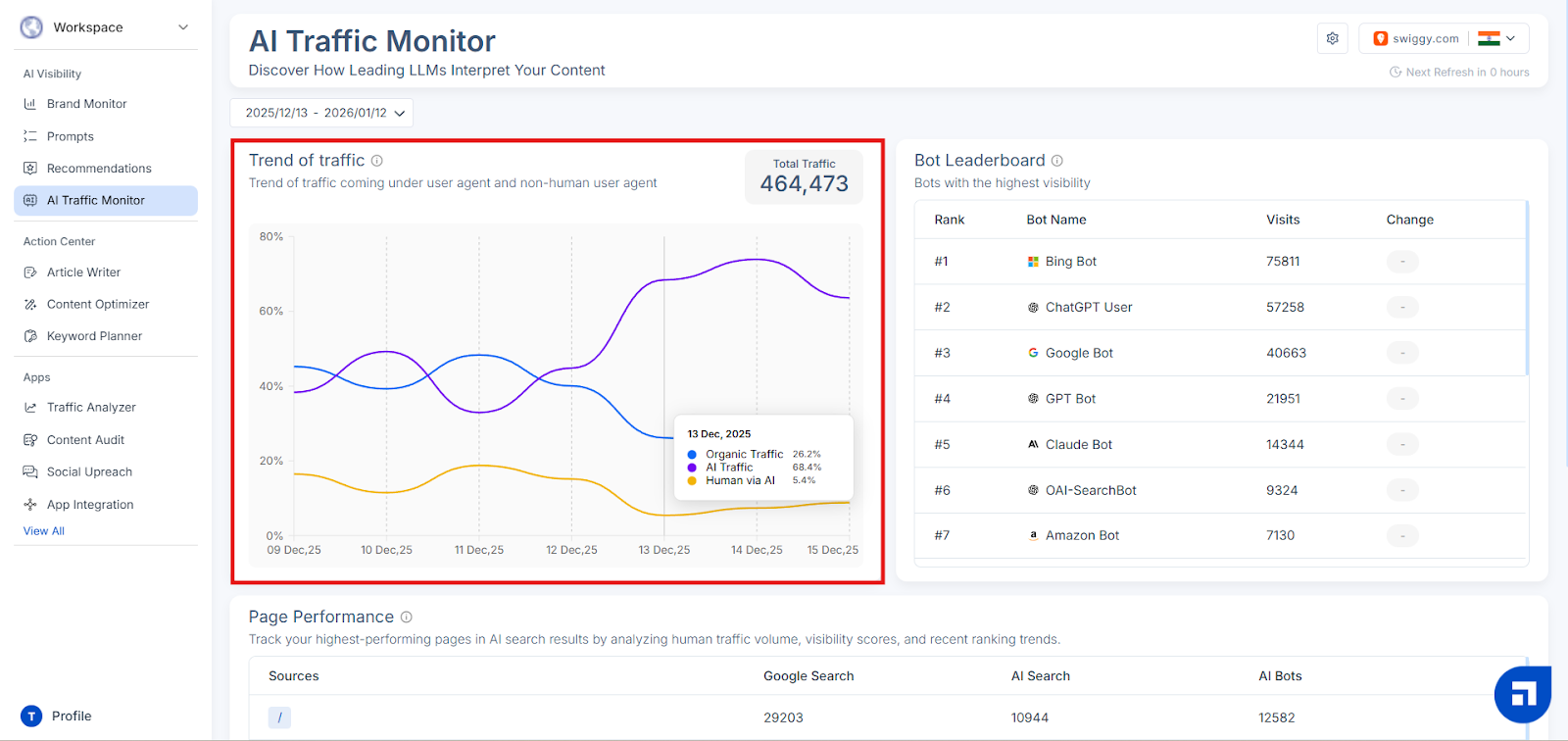
AI Traffic Monitor separates AI crawler visits, organic traffic, and human referrals from AI platforms. It also identifies which AI bots access the website and which pages receive the most crawler and referral activity.
The feature uses server-side data and requires a Cloudflare connection.
What are Scalenut’s key strengths?
- Shows complete AI responses, citations, competitors, sentiment, and query fan-outs.
- Connects AI visibility with Google Search Console data and existing content performance.
- Identifies new content, backlink, and community engagement opportunities.
- Supports content optimization, internal linking, audits, and publishing within one workflow.
What should you consider before choosing Scalenut?
Scalenut may feel more extensive than necessary if you only need basic AI visibility tracking and do not plan to use its content creation, optimization, or execution workflows.
Who should choose Scalenut?
Scalenut is best suited to SEO, content, and GEO teams that want to:
- Track prompts, citations, competitors, and sentiment
- Inspect complete AI-generated responses
- Connect AI visibility with existing content performance
- Monitor AI crawler and referral activity
- Create or optimize content based on identified gaps
- Manage analysis and execution within one platform
Scalenut pricing
- Starter: $24 per month when billed annually
- Plus: $36 per month when billed annually
- Professional: $80 per month when billed annually
- VIP Service: Custom pricing
2. Profound: Best for enterprise AI search intelligence
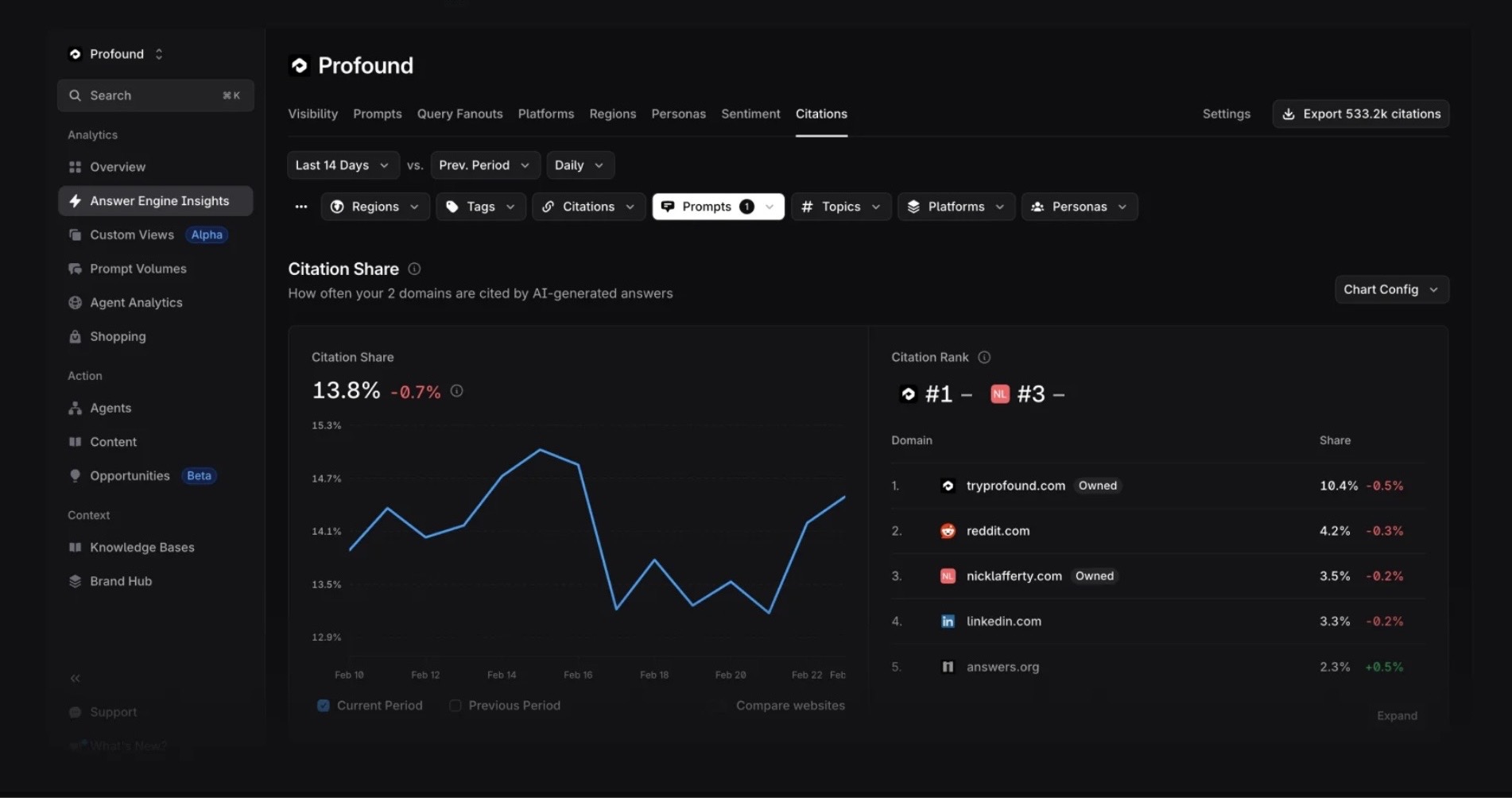
Profound is an enterprise-focused LLM SEO analysis tool that combines daily AI visibility tracking with prompt-demand data, citation intelligence, competitor benchmarking, and AI crawler analysis.
What are Profound’s key features?
- Tracks visibility, share of voice, brand position, sentiment, citations, and competitors across major AI platforms.
- Captures daily responses from consumer-facing AI interfaces rather than relying only on API outputs.
- Uses Prompt Volumes to show real-user prompt demand, intent, audience patterns, and emerging topics.
- Identifies the domains and pages influencing AI answers.
- Tracks verified AI crawlers, referral traffic, conversions, and crawlability issues.
- Supports exports, APIs, multi-region tracking, and enterprise access controls.
How does Profound help with LLM SEO analysis?
Profound connects three important data layers: what audiences ask, how AI platforms respond, and which sources influence those answers.
Teams can compare brand visibility against competitors, inspect citation gaps, identify high-demand prompts, and track performance by platform, topic, region, and language. Agent Analytics also helps connect AI visibility with crawler activity, referral traffic, and conversions.
What should you consider before choosing Profound?
Profound is built primarily for enterprise teams. Its depth, integrations, and custom pricing may be more than smaller teams need for monitoring a limited prompt set.
Who should choose Profound?
Profound is best suited to enterprise brands, large agencies, and international teams that need daily tracking, broad platform coverage, multi-market analysis, advanced reporting, and AI crawler intelligence.
Profound pricing
Profound uses custom enterprise pricing. Teams need to contact sales for current platform coverage, prompt limits, user allowances, and implementation costs.
Compare Profound’s enterprise reporting with Scalenut’s execution-focused workflow in our detailed Scalenut vs Profound AI guide.
3. Peec AI: Best for custom prompt and competitor tracking
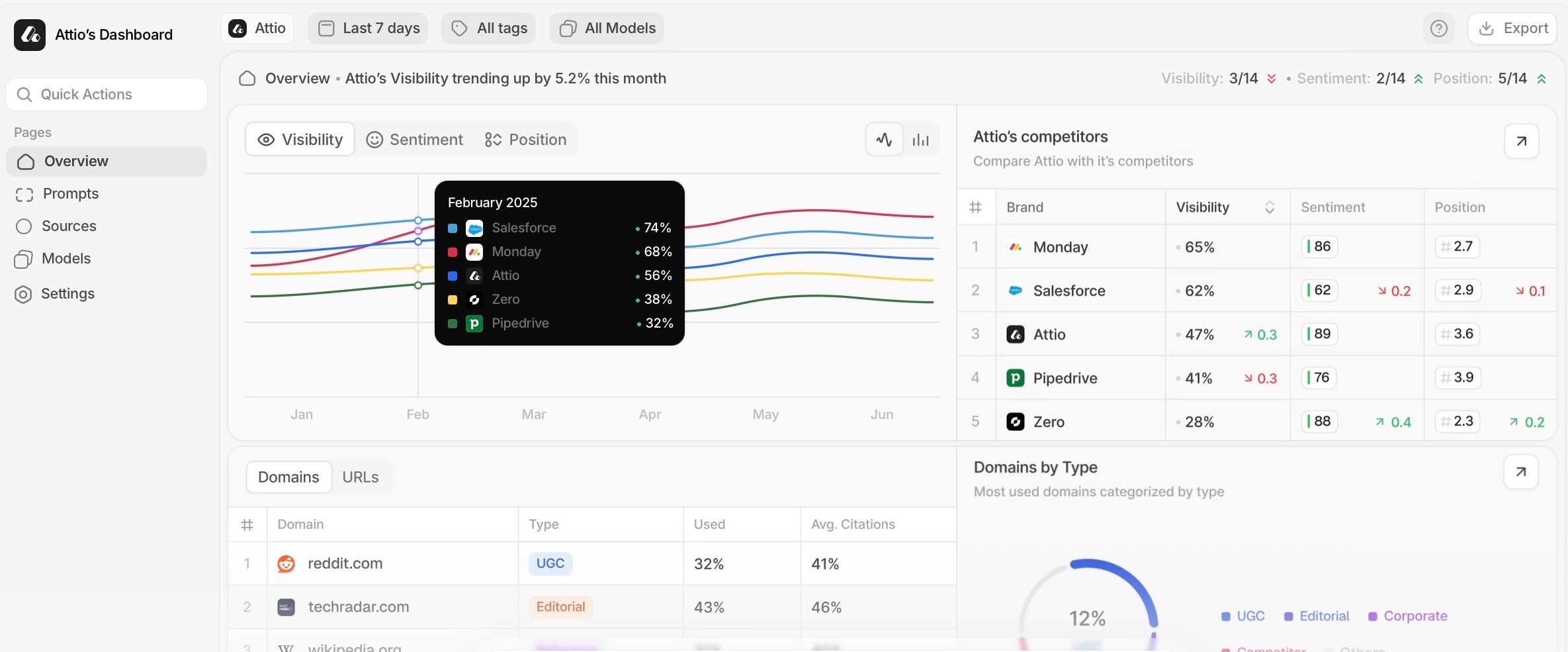
Peec AI is a focused LLM SEO rank tracking tool for monitoring brand visibility across AI-generated answers. It is built around daily prompt tracking, competitor benchmarking, citation analysis, and clear reporting rather than content creation.
What are Peec AI’s key features?
- Tracks Visibility, Position, Sentiment, and Share of Voice across selected AI platforms.
- Runs custom prompts daily through consumer-facing AI interfaces.
- Compares brand performance by prompt, topic, model, country, and competitor.
- Identifies cited domains, pages, and sources that support competing brands.
- Prioritizes owned-content, editorial, and community opportunities through Actions.
- Supports exports, Looker Studio, MCP connections, API access, and AI crawler analysis on eligible plans.
How does Peec AI help with LLM SEO analysis?
Peec AI shows where a brand appears, how prominently it is positioned, which competitors outrank it, and which sources influence the answer.
Its prompt-level reports help teams identify visibility gaps, citation opportunities, sentiment changes, and topics where competitors consistently perform better.
What should you consider before choosing Peec AI?
Peec AI analyzes and prioritizes opportunities, but teams need separate tools to create or optimize the recommended content.
Who should choose Peec AI?
Peec AI is best for SEO teams and agencies that want daily prompt monitoring, competitor intelligence, citation analysis, and multi-project reporting without a full content-production platform.
Peec AI pricing
- Starter: $95 per month
- Pro: $245 per month
- Advanced: $495 per month
- Enterprise: Custom pricing
- Free trial: Available
Before shortlisting, read our hands-on Peec AI review for a closer look at its dashboards, source insights, pricing, and execution limits.
4. Scrunch: Best for AI crawler and technical analysis
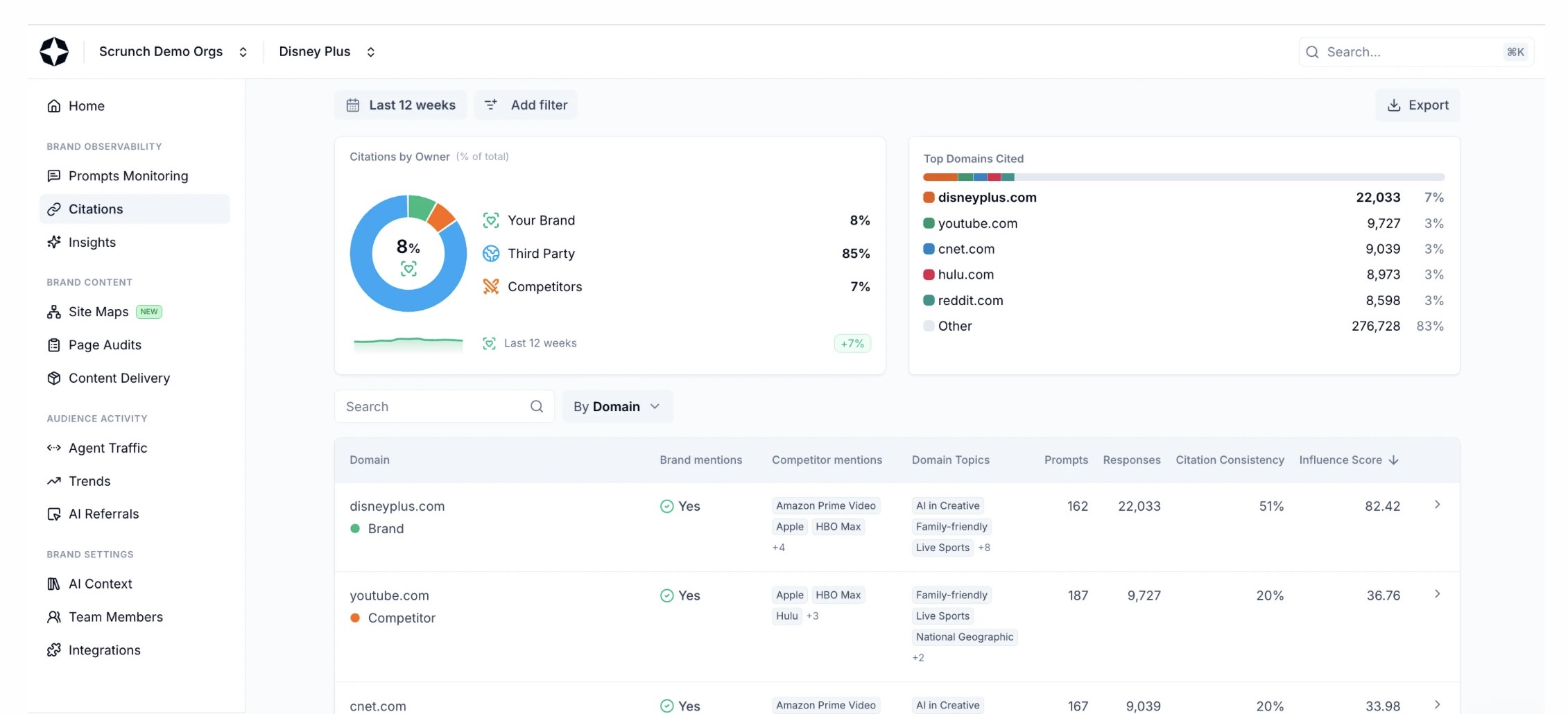
Scrunch is an LLM SEO analysis tool that connects AI visibility data with crawler activity, technical page health, citations, and referral performance. It is particularly useful for teams that want to understand both how AI platforms describe their brand and how AI agents access their website.
What are Scrunch’s key features?
- Tracks brand presence, position, sentiment, citations, and competitor performance across major AI platforms.
- Filters performance by prompt, topic, persona, location, platform, and time period.
- Maps the domains and URLs cited in AI answers and compares citation share against competitors.
- Monitors AI crawler visits, frequently accessed pages, crawl errors, and bot activity.
- Connects with GA4 to report AI referral sessions, landing pages, conversions, and revenue.
- Uses Site Maps and page audits to combine citations, crawler traffic, referrals, technical issues, and content recommendations.
- Offers AXP to serve lightweight, structured versions of website content to AI agents.
How does Scrunch help with LLM SEO analysis?
Scrunch connects three signals that are often measured separately: visibility in AI answers, AI crawler behavior, and human referral traffic.
Teams can identify prompts where competitors outperform them, examine the sources influencing those answers, and find pages that receive high crawler activity but few citations. Page audits then surface technical and content issues that may be limiting AI visibility.
What should you consider before choosing Scrunch?
Scrunch may be more extensive and expensive than necessary if you only need basic prompt tracking without crawler analytics, page audits, referral reporting, or AXP.
Who should choose Scrunch?
Scrunch is best for technical SEO teams, enterprise brands, ecommerce businesses, and agencies that need to connect AI visibility with crawlability, citations, page performance, and referral outcomes.
Scrunch pricing
- Starter: $250 per month when billed annually or $300 monthly
- Growth: $417 per month when billed annually or $500 monthly
- Enterprise: Custom pricing
- Free trial: Seven days with no credit card required
See how Scrunch combines crawler analytics with its Agent Experience Platform in our detailed Scrunch AI review.
5. Ahrefs Brand Radar: Best for large-scale AI visibility research
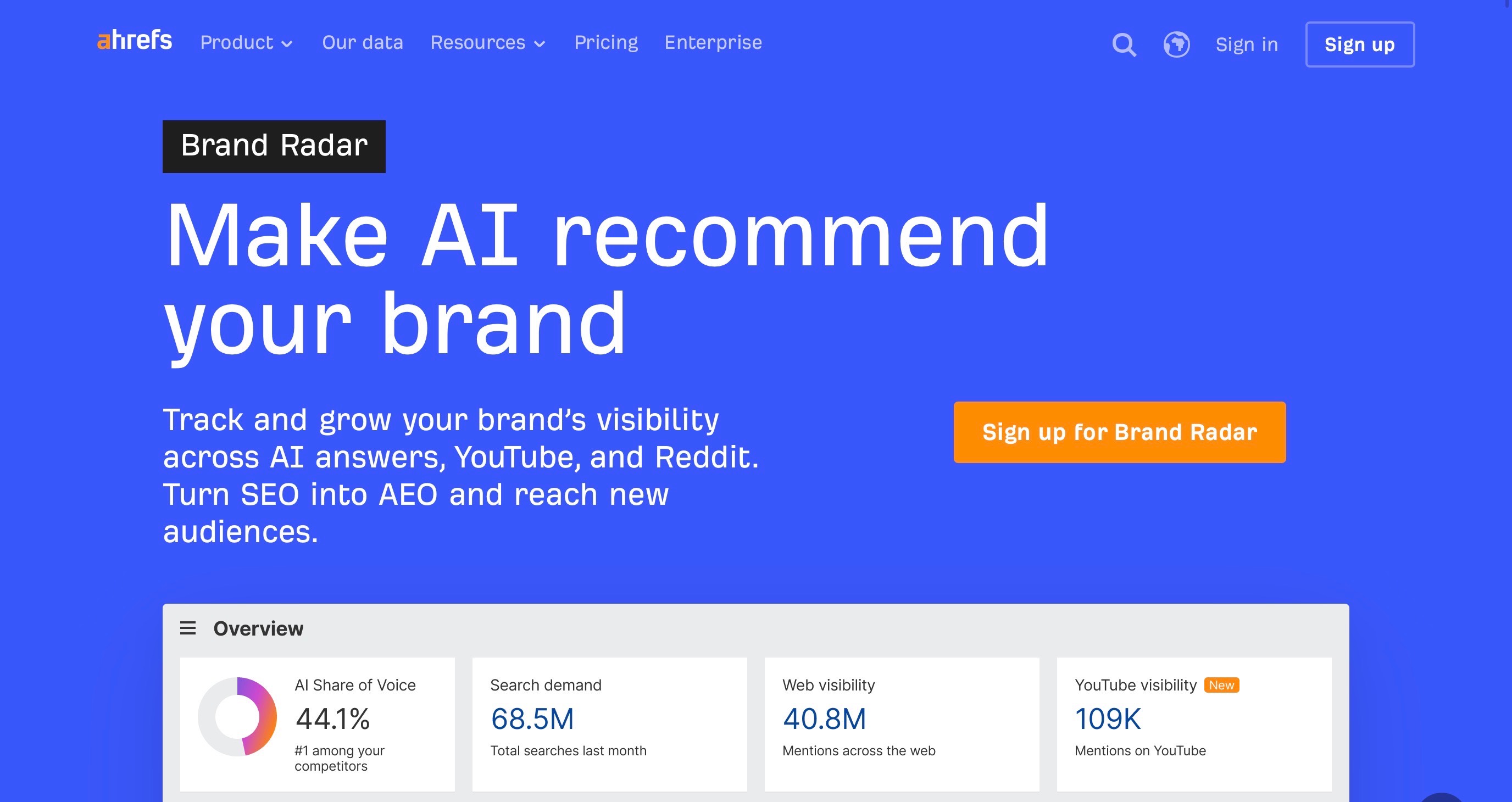
Ahrefs Brand Radar analyzes brand visibility across hundreds of millions of search-backed prompts. It is designed for broad market research, competitor benchmarking, citation discovery, and topic analysis rather than only tracking a small predefined prompt set.
What are Ahrefs Brand Radar’s key features?
- Measures AI Share of Voice, mentions, citations, and estimated impressions.
- Searches more than 350 million prompts modeled from Ahrefs’ keyword database, People Also Ask data, and semantic fan-outs.
- Compares brands, products, competitors, topics, regions, and authors without requiring project setup.
- Identifies the domains and pages cited across ChatGPT, Perplexity, Gemini, Copilot, Google AI Overviews, and AI Mode.
- Adds custom prompt tracking with daily, weekly, or monthly checks across selected locations.
- Connects AI visibility with search demand, web mentions, Reddit, YouTube, and TikTok data.
How does Ahrefs Brand Radar help with LLM SEO analysis?
Brand Radar helps teams understand where their brand appears across a large AI search market rather than only within manually selected prompts.
Its search-backed dataset highlights high-demand topics, competitors with stronger share of voice, frequently cited sources, and pages influencing AI answers. Custom prompts can then be used to monitor the specific commercial questions that matter most to the business.
What should you consider before choosing Ahrefs Brand Radar?
Its large prompt index is better suited to market discovery and directional analysis than precise daily monitoring of a fixed prompt set. Custom checks are available, but usage increases with every prompt, platform, location, and tracking frequency.
Who should choose Ahrefs Brand Radar?
Brand Radar is best for SEO teams, agencies, and existing Ahrefs users that need large-scale competitor, topic, citation, and market research alongside traditional search data.
Ahrefs Brand Radar pricing
- Individual AI platform: Starts at $199 per month
- Selected platforms: $398 per month
- All platforms: $699 per month
- Custom prompts: Start at $50 per month for 2,500 checks
6. Semrush AI Visibility Toolkit: Best for combined SEO and AI visibility analysis
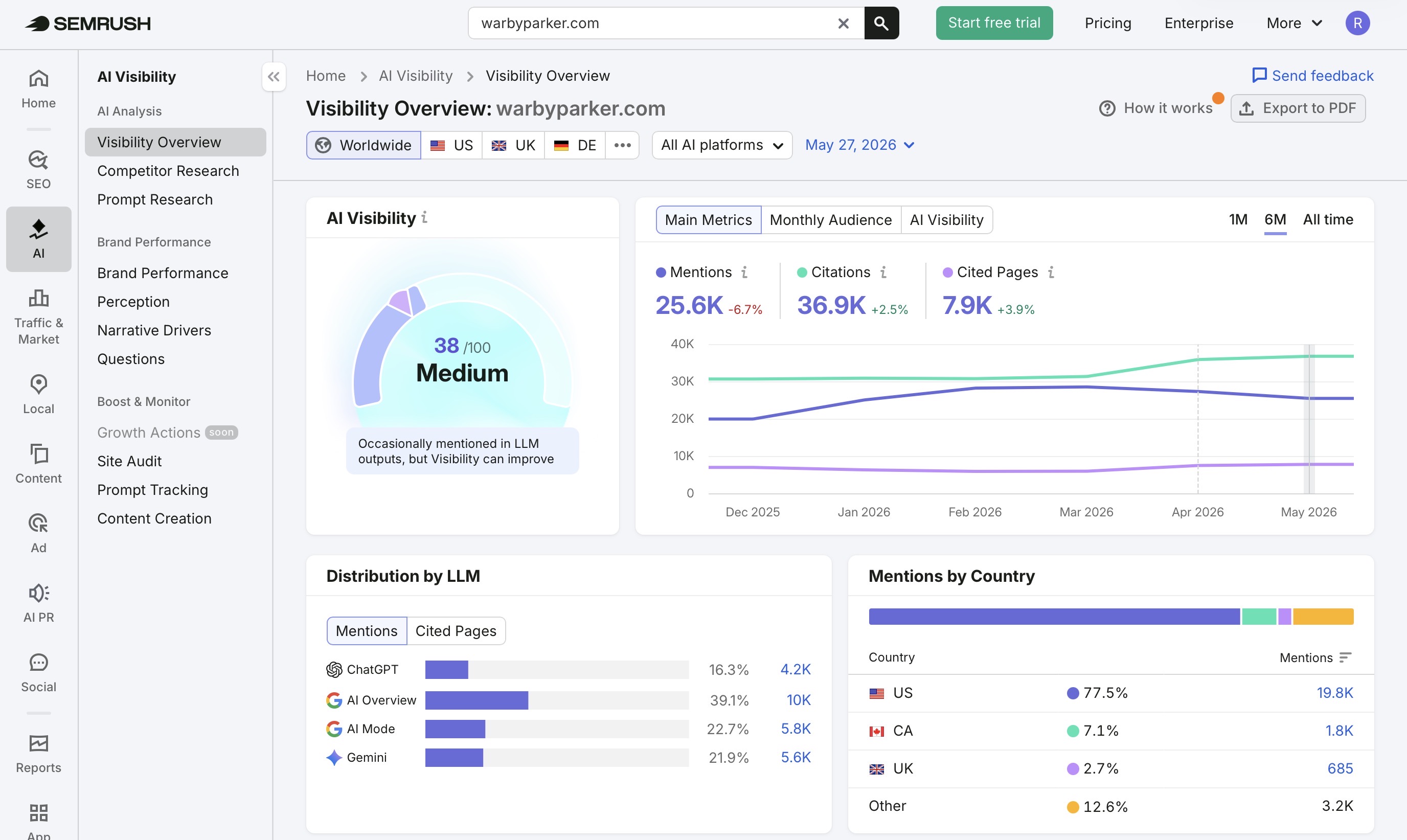
Semrush AI Visibility Toolkit tracks how brands are mentioned, cited, and positioned across ChatGPT, Gemini, Google AI Mode, AI Overviews, and Perplexity. It is particularly useful for teams that want AI visibility insights alongside established SEO research workflows.
What are Semrush AI Visibility Toolkit’s key features?
- Measures AI Visibility Score, mentions, citations, cited pages, share of voice, and sentiment.
- Tracks up to 25 custom prompts daily across supported AI platforms.
- Provides full AI responses with mentioned brands and cited sources.
- Compares mentions, citations, and topic coverage against up to four competitors.
- Uses a database of more than 289 million prompts to uncover topic and source opportunities.
- Checks up to 100 website pages for technical issues that may block AI crawlers.
How does Semrush help with LLM SEO analysis?
Semrush combines broad prompt research with daily tracking for a smaller custom prompt set.
Teams can identify topics where competitors appear but their brand does not, inspect the pages and domains influencing AI answers, and monitor commercially important prompts over time. Its wider SEO tools can add keyword, backlink, and technical context, although these may require a separate Semrush subscription.
What should you consider before choosing Semrush?
The base plan covers one domain and 25 tracked prompts. Additional domains, users, and prompt allowances require paid add-ons, which can increase the cost for agencies or multi-brand teams.
Who should choose Semrush?
Semrush is best for existing Semrush users and marketing teams that want AI visibility tracking, prompt research, competitor analysis, source intelligence, and technical AI-readiness checks within a familiar SEO ecosystem.
Semrush AI Visibility Toolkit pricing
- Base: $99 per month per domain
- Additional 50 prompts: $60 per month
- Additional domain or location: $99 per month
- Free trial: Not available
7. AIclicks: Best for citation and source-gap analysis
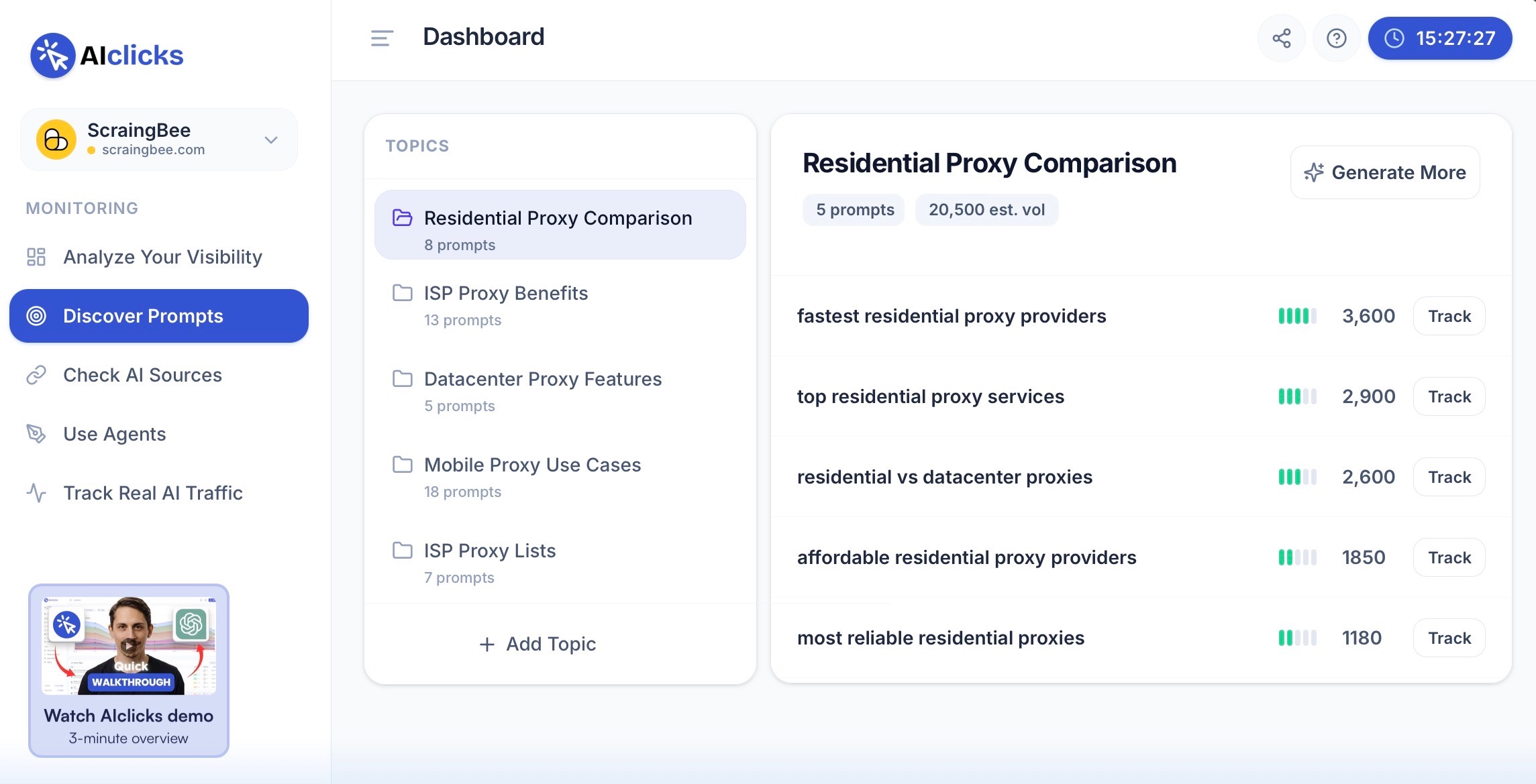
AIclicks is an LLM SEO rank tracking tool focused on daily visibility monitoring, citation intelligence, competitor benchmarking, and prioritized actions. It supports more than 10 AI platforms, although the number available depends on the selected plan.
What are AIclicks’ key features?
- Tracks visibility, position, share of voice, sentiment, and competitor mentions by prompt.
- Shows the complete AI responses and the URLs cited within them.
- Identifies third-party sources that cite competitors but do not mention your brand.
- Organizes prompts by topic and surfaces related prompts and fan-outs.
- Converts visibility gaps into Create Content, Get Mentioned, and Engage recommendations.
- Connects with Google Analytics on Pro and higher plans to relate AI visibility to website traffic.
- Includes an AI content agent for creating articles based on identified gaps.
How does AIclicks help with LLM SEO analysis?
AIclicks is particularly useful for understanding which external sources influence AI recommendations. Teams can compare citation frequency, inspect the pages supporting competitors, and prioritize outreach or content opportunities based on those gaps.
Its recommendations also create a clearer path from analysis to action by separating new content, third-party mentions, and community engagement opportunities.
What should you consider before choosing AIclicks?
The number of AI platforms included varies by plan. Starter covers three selected platforms, Pro covers four, and Business covers six.
Who should choose AIclicks?
AIclicks is best for brands and agencies that want daily prompt tracking, detailed source analysis, competitor benchmarking, and guided content or outreach recommendations.
AIclicks pricing
- Starter: $59 per month
- Pro: $189 per month
- Business: $499 per month
- Enterprise: Custom pricing
- Free trial: Three days on Starter and Pro
Final verdict: Which LLM SEO tool should you choose?
The best LLM SEO tool depends on whether you prioritize enterprise reporting, focused prompt tracking, crawler analysis, or execution. Scalenut is the strongest overall choice for teams that want to connect prompts, citations, competitors, and traffic insights with content creation and optimization.
Before investing, test each platform using the same 15 to 20 commercial prompts and verify whether it explains both the visibility gap and the next action. To identify where your brand is losing ground and what to improve first, book a free strategy call with Scalenut today!
Frequently asked questions
What should an LLM SEO platform measure?
A strong visibility tool should track brand mentions, citations, positions, competitors, sentiment, and complete responses across relevant AI engines. It should also preserve historical data so teams can separate temporary answer changes from sustained improvements in LLM visibility.
How is LLM SEO different from conventional SEO?
Traditional SEO focuses on rankings, clicks, links, and crawlability. Generative engine optimization and answer engine optimization examine how AI platforms interpret, cite, and recommend a brand. Effective search optimization now requires teams to evaluate both channels without treating their metrics as interchangeable.
Which AI platforms should a tool monitor?
Choose coverage based on where your audience actually searches. Prioritize the answer engines relevant to your market, then compare location support, refresh frequency, prompt limits, citation access, and AI features. Broad coverage matters only when it improves meaningful search visibility across AI platforms.
How accurate are AI visibility scores?
Scores are directional because platforms use different prompts, locations, models, and sampling methods. A visibility tracker is most reliable when it shows the underlying responses and supports manual verification. It cannot fully reproduce real user behavior across every private AI conversation.
Which prompts should you track first?
A practical starting point is a balanced set of commercial, comparison, problem-led, and branded prompts. Combine keyword research with sales calls, support tickets, and customer questions so the tracked prompts reflect genuine search intent instead of broad topics with little buying relevance.
How can LLM SEO analysis improve content?
Content teams can use visibility gaps to update weak blog posts, create sharper comparisons, strengthen evidence, and correct inaccurate claims. The findings should shape a wider content strategy while preserving a consistent brand voice across pages, third-party mentions, and community responses.
Do technical audits improve AI visibility?
Site audits can improve crawlability, structure, internal linking, and content clarity, but they cannot guarantee inclusion in generated answers. Visibility also depends on relevance, authority, factual consistency, third-party citations, and credible discussions across publications, communities, and social media.
How should you compare LLM SEO tool pricing?
Compare total cost using prompt allowances, platform coverage, projects, users, refresh frequency, exports, and required add-ons. Entry prices can be misleading when a team needs multiple markets or daily checks, so calculate costs against the exact monitoring scope you plan to maintain.


.svg)


.webp)