Quick summary: Which is the best AEO analysis tool?
- Scalenut: Best for tracking AI visibility, citations, sentiment, competitors, and prompt performance, then turning those insights into content and optimization actions.
- Profound: Best for enterprise prompt demand, citation, sentiment, competitor, and AI traffic intelligence.
- Semrush AI Visibility Toolkit: Best for adding prompt tracking, citation analysis, competitor research, and sentiment insights to existing SEO workflows.
- Ahrefs Brand Radar: Best for large-scale brand, prompt, competitor, and citation research across AI platforms.
- Peec AI: Best for straightforward daily AI visibility tracking across different markets and models.
- Scrunch AI: Best for enterprise monitoring, citation analysis, content-gap detection, and AI agent optimization.
- Otterly AI: Best for affordable daily prompt, brand, competitor, and citation monitoring.
Choose based on platform coverage, prompt limits, citation depth, refresh frequency, reporting needs, and whether you need analysis alone or built-in execution.
Choosing an AEO analysis tool is harder than comparing feature lists. A platform may cover more AI engines but restrict prompts, refresh data less often, or charge separately for additional brands and markets. Another may offer fewer analytics but make it easier to turn visibility gaps into content and technical actions.
This guide narrows the market to seven AEO analysis tools with distinct strengths. It compares their platform coverage, prompt and citation data, competitor analysis, refresh frequency, reporting, pricing, and scalability, then explains which option is best suited to different teams and budgets.
How we selected the best AEO analysis tools?
We compared each platform using publicly available product documentation, pricing pages, help centres, release notes, product demonstrations, and verified customer feedback where relevant. This is a desk-research comparison and does not include hands-on testing.
Each AEO analysis tool was evaluated based on:
- AI platform, country, and language coverage
- Custom prompt tracking and prompt discovery
- Citation and source-level analysis
- Competitor benchmarking and sentiment analysis
- Refresh frequency and historical data
- Prompt, project, brand, and user limits
- Reporting, exports, APIs, and integrations
- Pricing and scalability
- Ability to turn findings into content, authority, or technical actions
These criteria focus on the capabilities that most directly affect a buyer’s decision rather than the total number of AEO features offered.
Still building your evaluation criteria? Learn how to choose an AI brand visibility tool based on coverage, prompt limits, reporting, pricing, and execution needs.
7 best AEO analysis tools for AI search visibility in 2026

The best tool for AEO in 2026 are Scalenut, Profound, Semrush AI Visibility Toolkit, Ahrefs Brand Radar, Peec AI, Scrunch AI, and Otterly AI. These platforms help teams analyze brand mentions, prompt performance, citations, sentiment, and competitor visibility across major AI platforms.
Below, we compare their AEO analysis capabilities, pricing, strengths, limitations, and best-fit use cases.
1. Scalenut: Best for combining AEO analysis with content execution
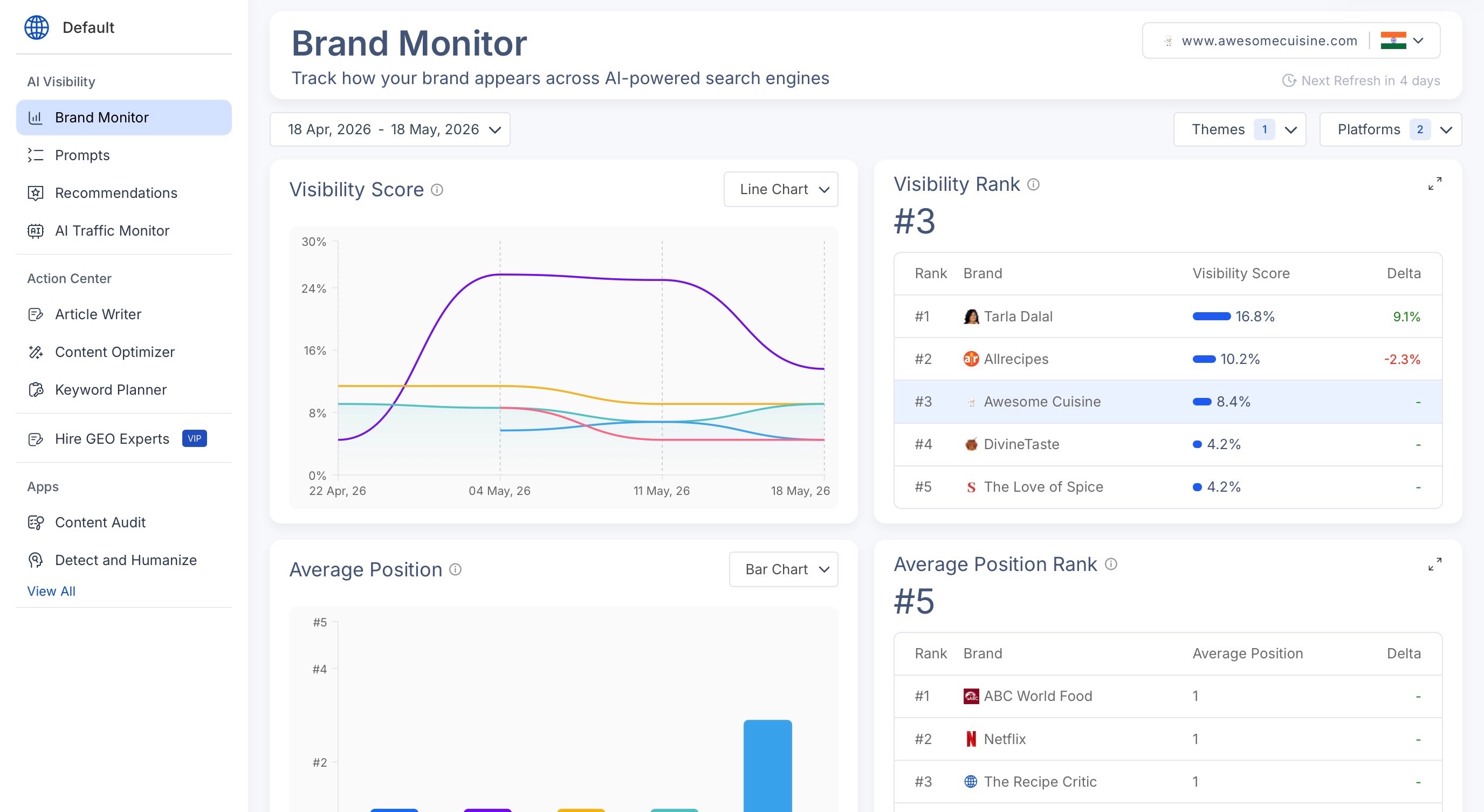
Scalenut is a full-stack GEO platform for teams that want to measure AI visibility and act on the findings within the same workflow, making it the best AEO tool for answer engine optimization. Its AI Visibility module tracks brand presence, citations, competitors, sentiment, and prompt performance, while its Action Center supports content planning, creation, optimization, auditing, internal linking, and publishing.
Key AEO analysis capabilities
- Tracks Visibility Score, Visibility Rank, Average Position, Share of Voice, and performance by AI engine, competitor, theme, and prompt.
- Shows the prompts that mention the brand, its position within each answer, competing brands, AI responses, citations, and source URLs.
- Analyzes citation share, cited domains, top citation pages, sentiment, and query fan-out to explain how AI platforms build their answers.
- Converts visibility gaps into article opportunities, backlink suggestions, and relevant Reddit or Quora engagement opportunities.
- Provides an AI Traffic Monitor that uses a Cloudflare integration to distinguish AI bot activity from human visits referred by AI platforms.
Scalenut currently monitors ChatGPT, Google AI Overviews, Claude and Perplexity. Tracking limits are between 10-100 prompts with weekly refreshes included for all the plans.
Pros
- Connects AI visibility analysis directly with GEO content creation and optimization.
- Covers both high-level competitive metrics and prompt-level citations, mentions, sentiment, and source data.
- Includes content audits, topic-gap recommendations, internal linking, on-page optimization, and WordPress or Shopify publishing on eligible plans.
- Offers a lower entry price than several enterprise-focused AI visibility platforms.
Limitations
- The platform may be broader than necessary for teams seeking only a lightweight mention tracker.
Pricing
- Starter: $59 per month, or $24 per month when billed annually
- Plus: $89 per month, or $36 per month when billed annually
- Professional: $199 per month, or $80 per month when billed annually
- Free trial: 7 days
Best for: SEO, content, SaaS, and agency teams that want to connect AEO analysis with content execution.
Not ideal for: Teams that only need high-volume standalone monitoring or daily enterprise reporting.
Want the complete picture before deciding? Read our Scalenut review for a closer look at its GEO, SEO, content, and AI visibility workflows.
2. Profound: Best for enterprise AEO intelligence and prompt demand analysis
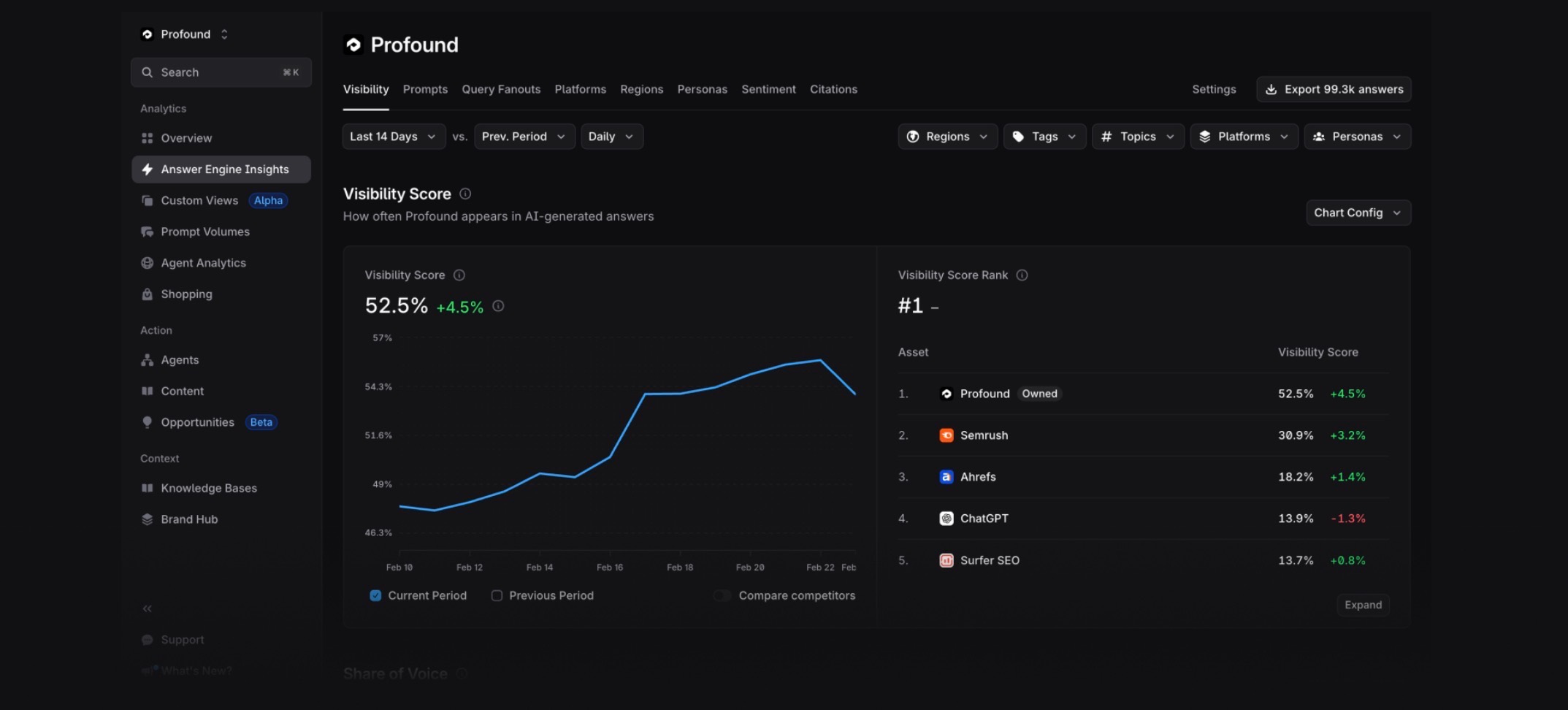
Profound is a purpose-built AEO platform for brands that need detailed visibility into how they appear across AI answer engines. Answer Engine Insights tracks mentions, ranking, share of voice, citations, sentiment, and competitor performance.
Its broader platform also includes Prompt Volumes for demand research, Agent Analytics for AI crawler and referral activity, and content-focused Agents. The depth is useful for larger teams, but meaningful multi-engine coverage starts at the Growth plan.
Key AEO analysis capabilities
- Runs tracked prompts daily and measures visibility score, share of voice, ranking, sentiment, citations, and competitive presence.
- Shows the AI responses and cited sources associated with each prompt, topic, platform, and competitor.
- Categorizes citations as owned, competitor, earned media, PR wire, social, institution, or custom sources.
- Uses FactCheck to identify inaccurate AI-generated claims about a brand and the sources connected to those claims.
- Provides Prompt Volumes to surface prompt demand, intent, trends, demographics, co-citations, and prompts where competitors are cited but the tracked brand is absent.
- Tracks AI crawler activity and AI-sourced traffic through Agent Analytics, with integrations including Cloudflare, Akamai, AWS, Fastly, Google Analytics, Vercel, Netlify, and WordPress.
Pros
- Offers detailed citation classification and source-level analysis.
- Refreshes tracked prompt responses daily and retains historical visibility data.
- Supports custom prompts alongside prompts informed by its real-user conversation dataset.
- Connects visibility and citation findings with content workflows, exports, and Agents.
- Enterprise plans support additional answer engines, regions, languages, API access, SSO, and dedicated support.
Limitations
- The Starter plan tracks only ChatGPT and is limited to 50 prompts.
- The Growth plan supports 3 answer engines but allows only 100 tracked prompts.
- Broader engine coverage, multiple regions and languages, API access, and custom prompt limits require an Enterprise plan.
- At $399 per month when billed annually, Growth may be expensive for smaller teams.
Pricing
- Starter: $99 per month when billed annually
- Growth: $399 per month when billed annually
- Enterprise: Custom pricing
- Free trial: Available for the Growth plan
Best for: Enterprise brands, AEO teams, agencies, and PR teams that need detailed prompt, citation, sentiment, and competitor intelligence.
Not ideal for: Small teams that need affordable multi-engine tracking with high prompt allowances.
Considering Profound for enterprise AEO intelligence? Read our Profound AI review for its strongest capabilities, pricing, and trade-offs.
3. Semrush AI Visibility Toolkit: Best for AEO analysis within an established SEO platform
Quick verdict
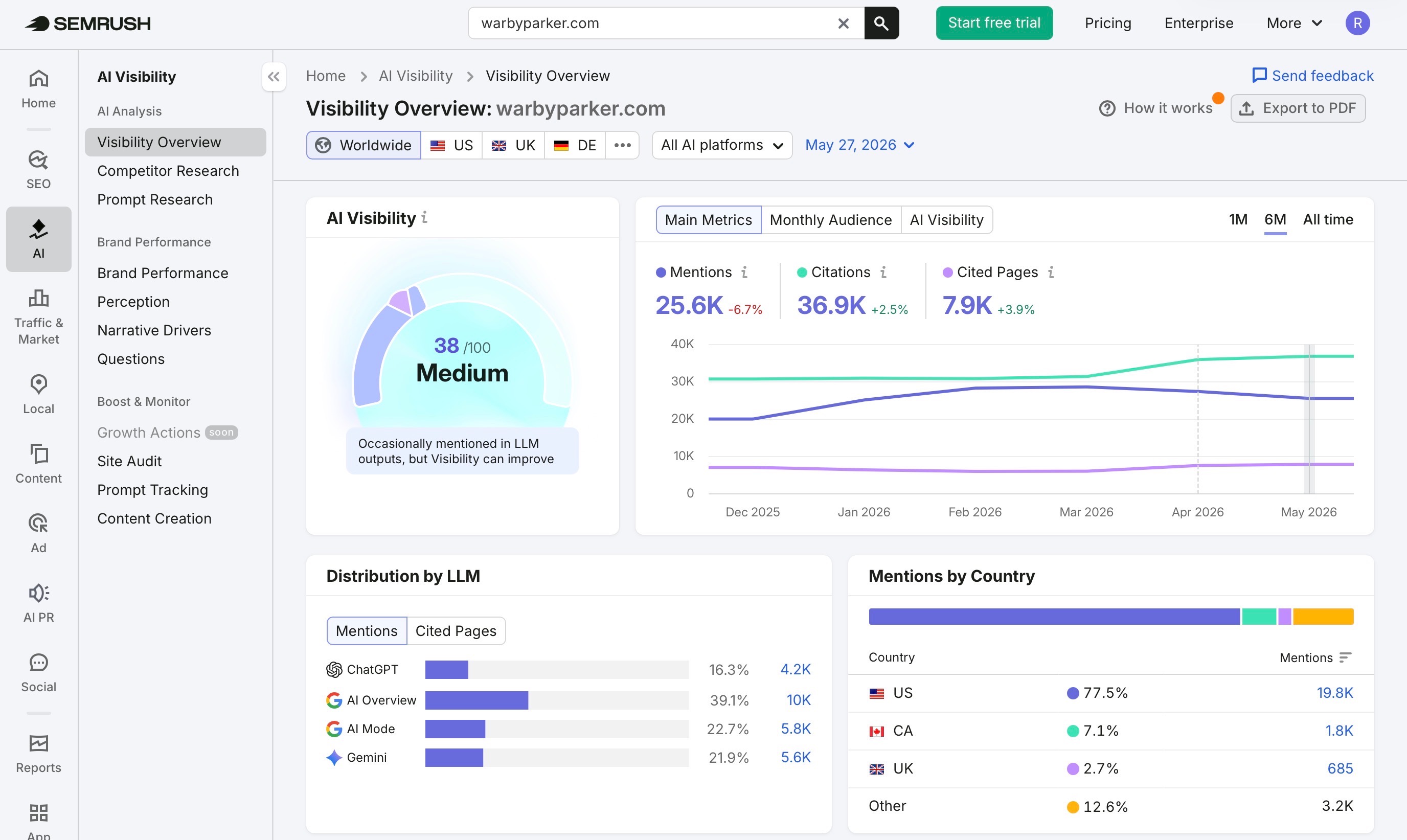
Semrush AI Visibility Toolkit suits teams that want to analyze brand performance in AI search while retaining access to Semrush’s broader SEO ecosystem. It combines large-scale prompt research with custom tracking, competitor benchmarking, citation analysis, sentiment reporting, and AI-readiness checks. However, the Base plan’s single-domain and 25-prompt limits can restrict agencies or brands managing several products.
Key AEO analysis capabilities
- Measures AI Visibility Score, mentions, citations, cited pages, estimated audience, average position, and Share of Voice.
- Analyzes brand mentions from ChatGPT, Google AI, Gemini, and Perplexity, with platform and location breakdowns.
- Uses a database of more than 289 million prompts and responses to surface topic demand, intent, mentioned brands, cited sources, and visibility opportunities.
- Compares a domain with up to four competitors to identify strong, weak, and missing topics, prompts, and citation sources.
- Tracks 25 custom prompts daily and retains trend data for measuring visibility changes.
- Analyzes favorable sentiment, brand strengths, recurring pain points, feature-level perception, and narrative drivers.
- Includes AI Search Site Audit checks for up to 100 pages to flag issues that may block AI crawlers.
Pros
- Combines custom prompt monitoring with a large prompt and response database.
- Identifies content gaps and external sources that cite competitors but not the tracked brand.
- Updates AI analysis reports and prompt tracking daily, while Brand Performance data refreshes weekly.
- Covers research, competitor analysis, sentiment, citations, and technical AI readiness.
- Can be bundled with Semrush One for keyword tracking, site audits, content optimization, and other SEO workflows.
Limitations
- The Base plan includes one Brand Performance domain and 25 tracked prompts.
- Each additional domain or location costs $99 per month.
- An extra 50 tracked prompts costs $60 per month.
- The toolkit does not offer a free trial.
- Full content optimization requires a broader Semrush plan or separate tools.
Pricing
- AI Visibility Toolkit Base: $99 per month per domain when billed annually
- Additional domain or location: $99 per month
- Additional 50 prompts: $60 per month
- Free trial: Not available
Best for: SEO and marketing teams that want AEO analysis alongside Semrush’s keyword, competitor, and technical SEO data.
Not ideal for: Agencies or multi-brand teams that need high prompt limits and several domains at a lower monthly cost.
Is the $99 toolkit right for your workflow? See our Semrush AI Visibility Toolkit review for the complete feature, pricing, and limitations breakdown.
4. Ahrefs Brand Radar: Best for large-scale AI visibility and citation research
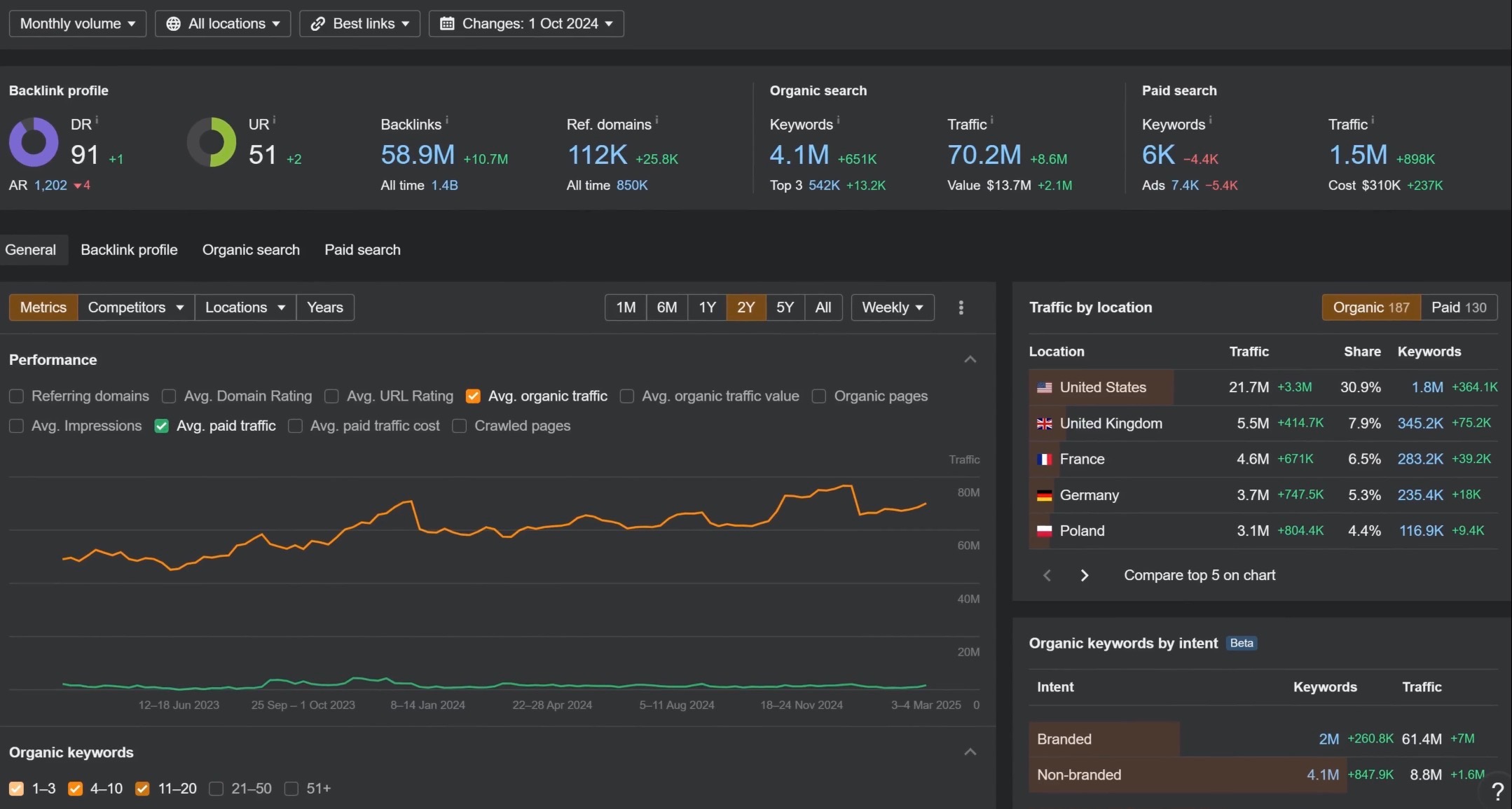
Ahrefs Brand Radar suits brands that need broad AI visibility research rather than tracking only a small prompt set. It combines a large database of search-backed prompts with custom monitoring, competitor comparisons, citation analysis, sentiment, and historical trends.
Its strength is research scale, but full platform access costs considerably more than lightweight AEO trackers.
Key AEO analysis capabilities
- Measures mentions, citations, estimated impressions, AI Share of Voice, sentiment, and competitor visibility.
- Searches more than 450 million monthly prompts across Google AI Overviews and AI Mode, ChatGPT, Perplexity, Gemini, Microsoft Copilot, and Grok.
- Identifies pages and domains cited in AI answers, including sources that mention competitors but not the tracked brand.
- Supports unlimited brand and domain research without requiring a separate project for each competitor.
- Lets users add custom prompts, select locations and platforms, and choose daily, weekly, or monthly checks.
- Shows query fan-out data for ChatGPT and Perplexity to reveal related questions used to build an answer.
- Connects AI visibility with Search Demand, Web Visibility, YouTube, Reddit, and TikTok data.
Pros
- Provides a large search-backed prompt database for market and topic research.
- Separates brand mentions from clickable citations and shows the pages influencing AI responses.
- Allows teams to compare multiple brands, products, people, or markets without domain limits.
- Combines AI analysis with Ahrefs’ backlink, keyword, content, and competitor data.
- Includes API access and Looker Studio reporting on eligible plans.
Limitations
- A single AI platform costs $199 per month, while all-platform access costs $699 per month.
- The main chatbot indexes refresh monthly, although custom prompts can be checked more frequently.
- Grok data collection is paused, and Claude is available only for custom prompts.
- Frequent custom tracking across several platforms and locations can increase usage costs.
Pricing
- Single AI platform: $199 per month per index
- All platforms: $699 per month, including 2,500 custom prompt checks
- Custom Prompts Basic: $50 per month for 2,500 checks
- Custom Prompts Growth: $100 per month for 7,000 checks
- Custom Prompts Scale: $250 per month for 25,000 checks
- Free trial: Not listed; a limited free AI Visibility Checker is available.
Best for: SEO, brand, and competitive intelligence teams that need broad AI visibility and citation research across large prompt datasets.
Not ideal for: Smaller teams that need affordable daily monitoring for a focused prompt list.
Need more options before investing in Brand Radar? Compare the best Ahrefs Brand Radar alternatives by AI coverage, pricing, analysis, and execution capabilities.
5. Peec AI: Best for straightforward multi-market AI visibility tracking
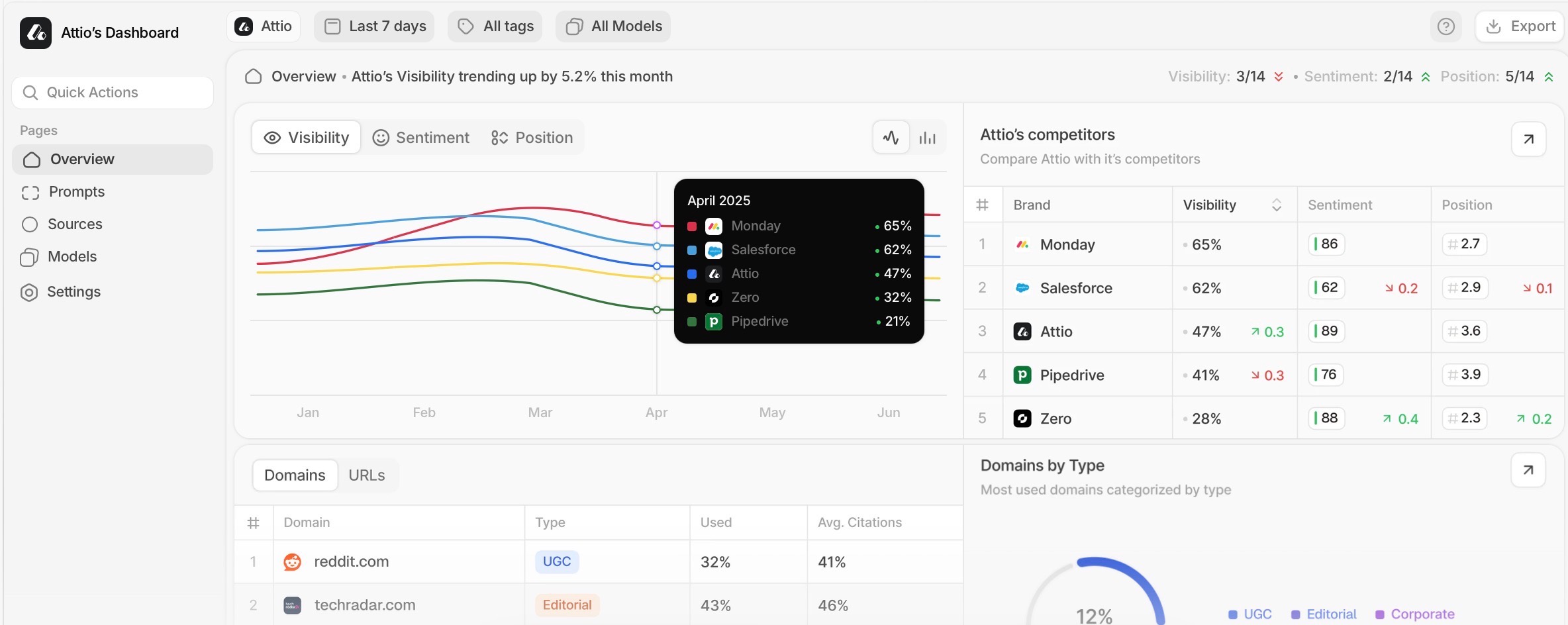
Peec AI is a dedicated AI search analytics platform for teams that need daily visibility tracking without a broader SEO or content-writing suite. It monitors how brands appear across selected AI models, measures competitive position and sentiment, and shows the sources influencing those answers.
Its simple project structure and unlimited users suit in-house teams, although lower plans restrict each project to 3 selected models.
Key AEO analysis capabilities
- Tracks visibility, share of voice, average position, sentiment, and daily changes across monitored prompts and competitors.
- Lets users choose from ChatGPT, Google AI Mode, Google AI Overviews, Microsoft Copilot, Perplexity, and Gemini. Starter, Pro, and Advanced plans include 3 selected models.
- Stores the generated answers behind each metric, including mentioned brands, their positions, sentiment, and cited sources.
- Separates source retrieval from visible citations and reports source performance at both domain and URL level.
- Categorizes sources as editorial, corporate, user-generated content, reference, or the brand’s own website.
- Identifies citation gaps where competitors appear in sources or answers but the tracked brand does not.
- Shows query fan-outs for supported models and provides prioritized Actions for owned content, editorial coverage, reference sites, and community sources.
- Supports prompt organization by topic and tags, competitor comparisons, data exports, and integrations.
Pros
- Runs tracked prompts daily across all standard brand plans.
- Includes unlimited users, which supports collaboration without per-seat charges.
- Provides granular URL-level citation and source analysis rather than only brand mention totals.
- Supports different countries and languages without separate regional pricing.
- Actions is included across plans and turns citation and visibility gaps into prioritized recommendations.
Limitations
- Starter includes only 50 prompts, 1 project, and 1 country per project.
- Standard plans include 3 models, with additional models charged separately.
- Looker Studio integration requires the Advanced plan.
- API access, SSO, unlimited projects, and broader model coverage require Enterprise.
- Peec AI provides recommendations but does not create or publish content.
Pricing
- Starter: $95 per month
- Pro: $245 per month
- Advanced: $495 per month
- Enterprise: Custom pricing
- Annual billing: 15% discount
- Free trial: Available
Best for: In-house SEO, content, and brand teams that need daily, multi-market AI visibility and citation tracking with clear competitor comparisons.
Not ideal for: Teams seeking an all-in-one platform for AI visibility analysis, content creation, optimization, and publishing.
Want a closer look at Peec AI’s prompts, sources, competitors, and plan limits? Read our complete Peec AI review.
6. Scrunch AI: Best for enterprise AI visibility and agent experience optimization
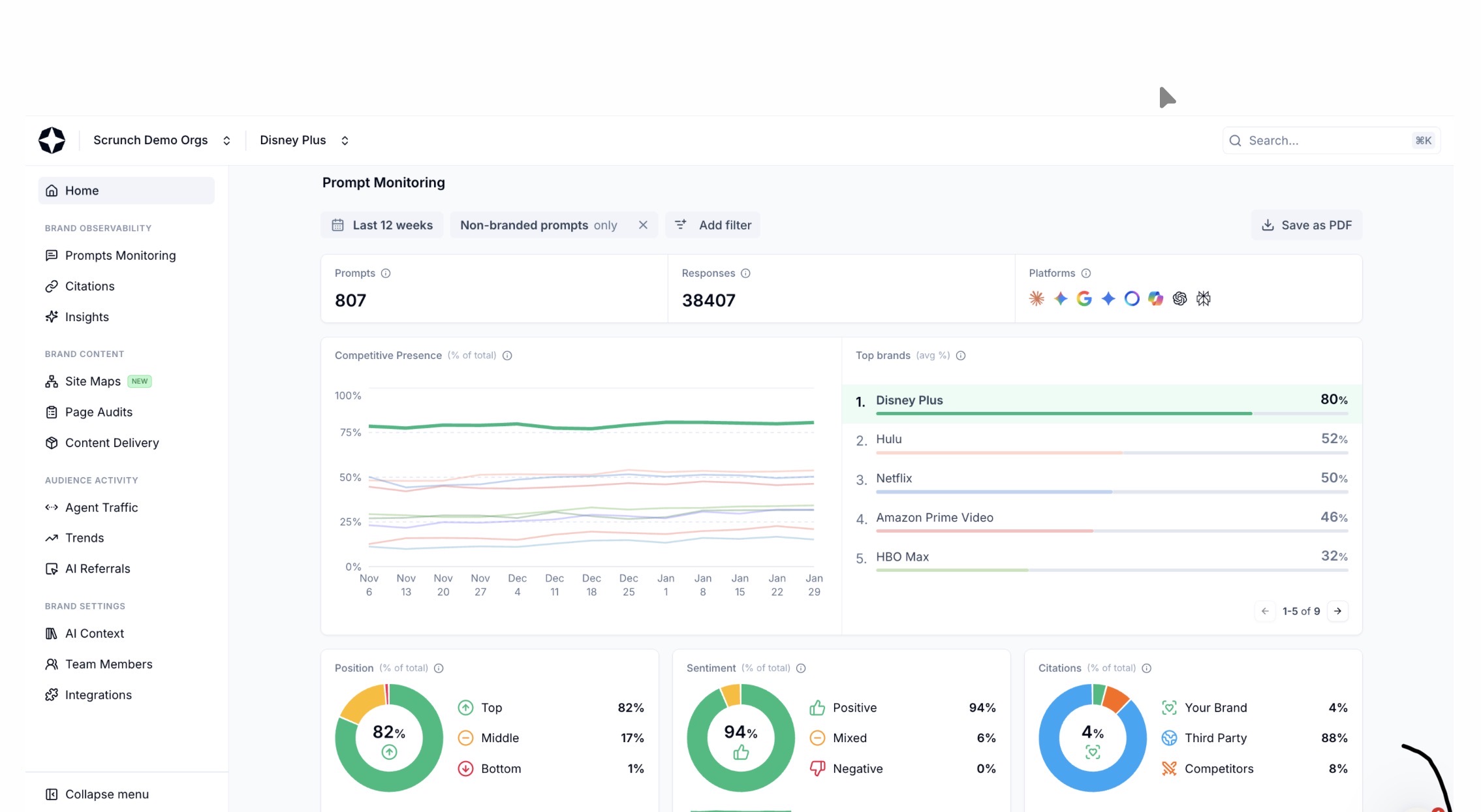
Scrunch AI combines answer engine monitoring with technical auditing and content delivery for AI agents. It tracks how brands appear across major AI platforms, identifies the prompts and sources shaping those answers, and surfaces content or technical gaps.
Its Agent Experience Platform creates a separate, machine-readable version of a website for AI retrieval bots, making Scrunch particularly relevant to enterprise teams that want both analysis and technical optimization.
Key AEO analysis capabilities
- Tracks brand presence, competitive presence, answer share, position, sentiment, citations, and changes over time.
- Provides prompt-level views with daily answer snapshots across ChatGPT, Claude, Gemini, Perplexity, Google AI Mode, Google AI Overviews, and Meta AI.
- Identifies the domains and exact pages cited in AI answers, then categorizes citations as brand-owned, third-party, competitor, or social sources.
- Monitors AI crawler activity and human referral traffic from AI platforms at the page and model level.
- Uses AI Search Trends to estimate topic-level prompt demand, track changes in interest, and compare brand and competitor presence.
- Includes page audits and Insights that flag technical access issues, content gaps, missing citations, and optimization opportunities.
Pros
- Covers monitoring, citation research, AI traffic analysis, page auditing, and technical content delivery in one platform.
- Supports custom prompts, industry prompts, personas, unlimited key topics, and competitor analysis.
- AXP converts pages into server-rendered, structured HTML and serves them to AI retrieval bots through supported CDN integrations.
- Tracks both owned and third-party citations, helping teams separate website improvements from off-site authority opportunities.
Limitations
- Starter costs $250 per month when billed annually, making it expensive for smaller teams.
- Starter includes 3 users, 350 custom prompts, and 5 page audits.
- Growth raises the limits to 5 users, 700 custom prompts, and 10 page audits.
- SAML or OIDC SSO and the Enterprise Data API require the Enterprise plan.
- AI Search Trends provides directional topic-level estimates, not exact prompt-level search volumes.
Pricing
- Starter: $250 per month when billed annually, or $300 month-to-month
- Growth: $417 per month when billed annually, or $500 month-to-month
- Enterprise: Custom pricing
- Free trial: 7 days
Best for: Enterprise marketing, SEO, and web teams that need AI visibility analysis, citation intelligence, technical audits, and AI-agent content delivery.
Not ideal for: Small teams that only need low-cost prompt and brand-mention tracking.
Wondering whether Scrunch justifies its enterprise price? Read our Scrunch AI review before choosing.
7. Otterly AI: Best for affordable daily AI search monitoring
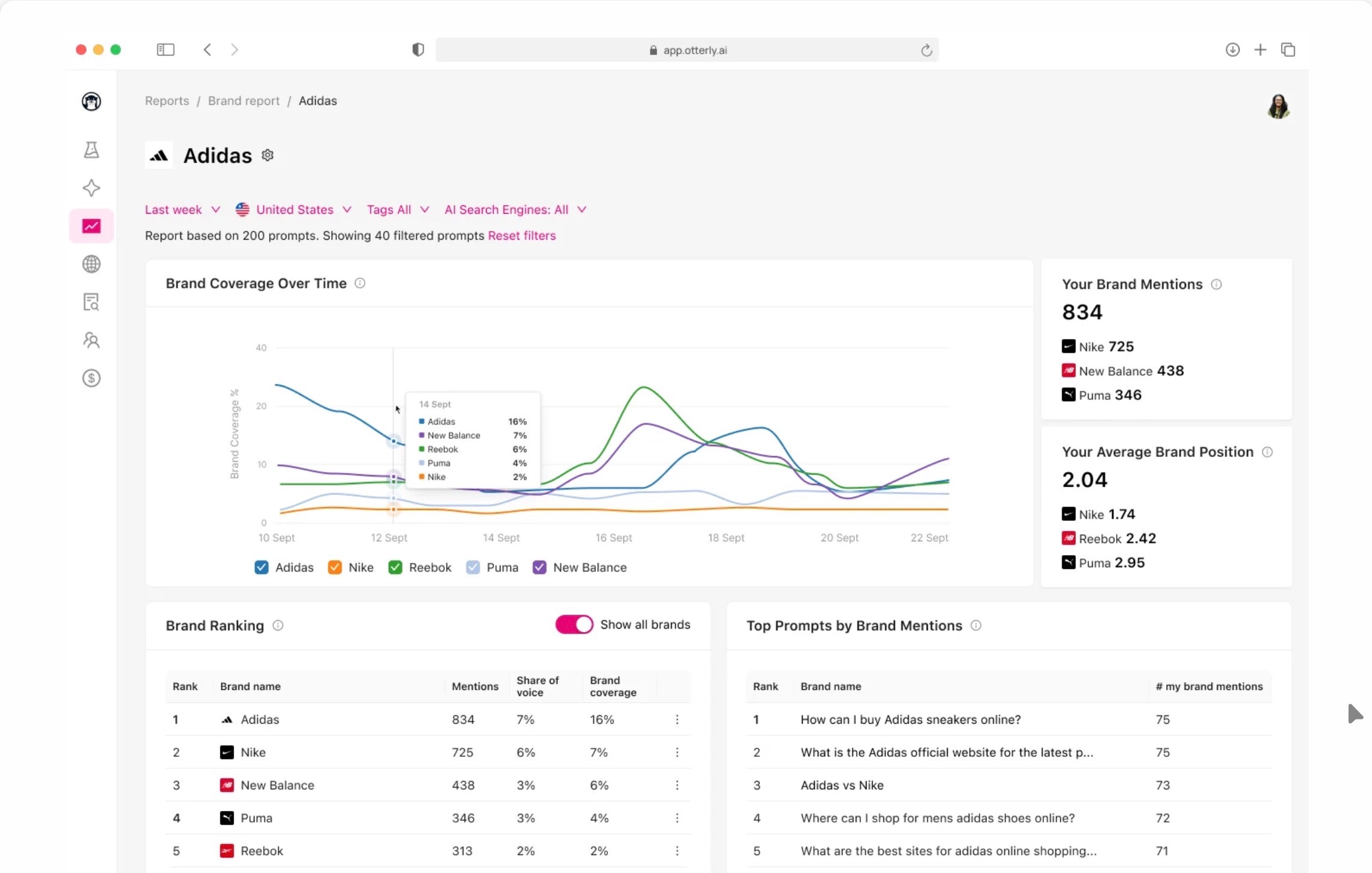
Otterly AI is a dedicated AEO monitoring platform for teams that need daily tracking without committing to an enterprise-priced suite. It measures brand and domain visibility across major AI search engines, tracks citations and competitors, and adds prompt research, GEO audits, exports, and multi-country reporting.
Its $29 monthly Lite plan is accessible, although it includes only 15 prompts and charges separately for Google AI Mode, Gemini, and Claude.
Key AEO analysis capabilities
- Monitors tracked prompts daily across ChatGPT, Google AI Overviews, Perplexity, and Microsoft Copilot.
- Offers Google AI Mode, Gemini, and Claude as paid add-ons on standard plans.
- Measures Brand Coverage, Domain Coverage, Share of Voice, brand rank, domain rank, sentiment, mentions, and citations.
- Stores prompt-level AI responses and shows whether the brand, its domain, or competitors appeared in each answer.
- Tracks cited domains and URLs, citation position, citation frequency, and competitor inclusion.
- Includes AI Prompt Research for discovering relevant questions from a website, brand, keywords, or industry.
- Provides GEO audits, recommendations, CSV and PDF exports, and multi-country monitoring across more than 65 countries and languages.
- Adds API, MCP, Looker Studio, and Agent Analytics access on higher plans.
Pros
- Provides daily monitoring on every paid plan.
- Starts at a lower price than most dedicated AEO analysis platforms.
- Includes unlimited brand reports and team members across all plans.
- Supports raw response, prompt, citation, brand report, and GEO audit exports.
- Offers a 7-day trial with 50 prompts and no credit card requirement.
Limitations
- Lite includes only 15 prompts and one workspace.
- Google AI Mode, Gemini, and Claude require paid add-ons.
- API, MCP, Looker Studio, and Agent Analytics are not included with Lite.
- Standard costs $189 per month, creating a large price jump from Lite.
- Otterly provides audits and recommendations but does not offer a full content creation and publishing workflow.
Pricing
- Lite: $29 per month, or $25 per month when billed annually
- Standard: $189 per month, or $160 per month when billed annually
- Premium: $489 per month, or $422 per month when billed annually
- Enterprise: Custom pricing
- Free trial: 7 days
Best for: Small and mid-sized SEO, content, and agency teams that need daily AI visibility, citation, and competitor monitoring at a flexible entry price.
Not ideal for: Teams that need broad engine coverage without add-on fees or an integrated content creation and publishing platform.
Considering Otterly for affordable daily monitoring? Read our Otterly AI review to see where it works and where it may feel limited.
What should I look for when choosing the best AEO tool?
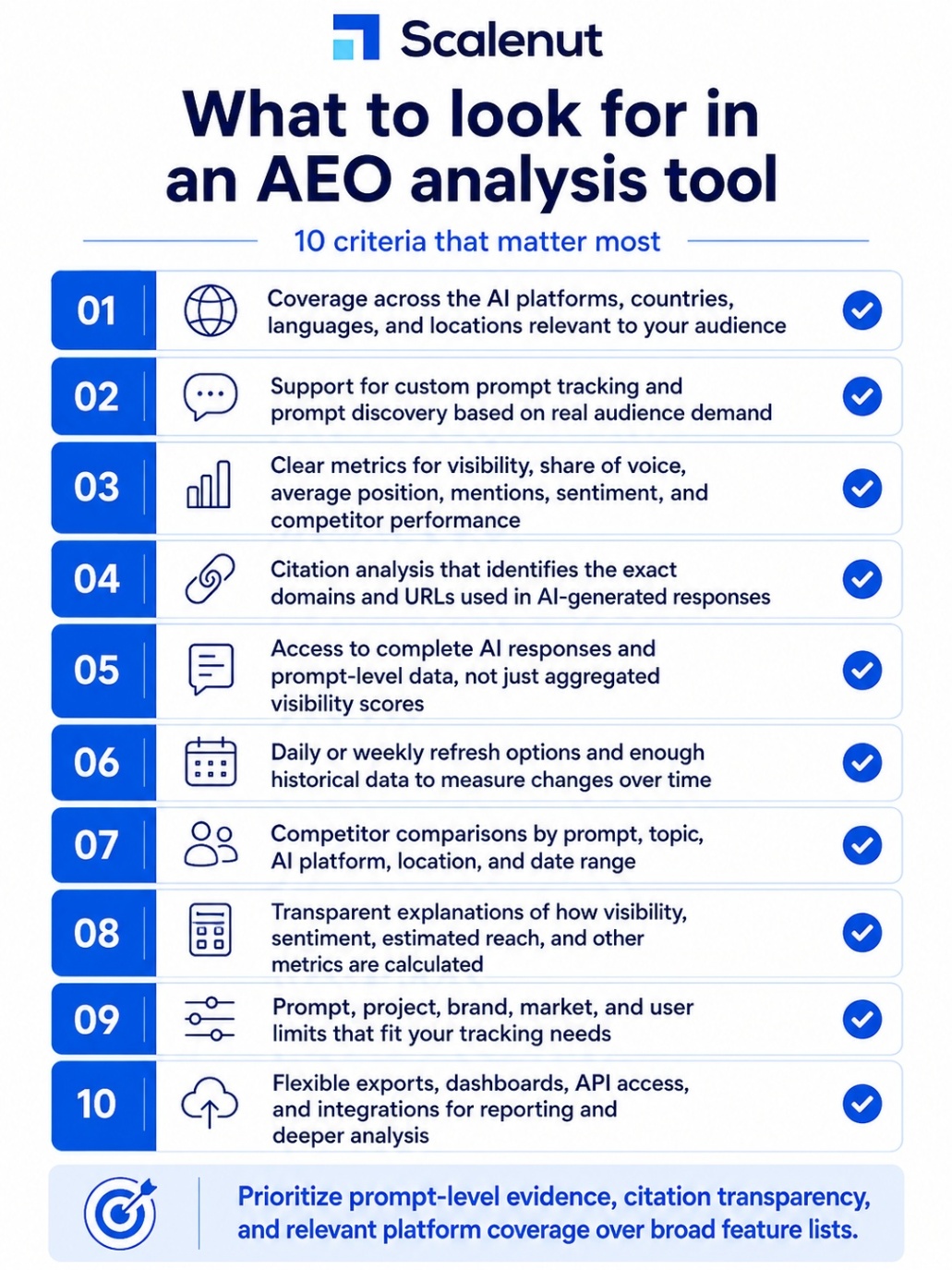
Choosing the best answer engine optimization tool should be based on the depth, accuracy, and transparency of its visibility data. It should show where your brand appears, how it compares with competitors, and which citations influence AI-generated answers.
Key factors to evaluate include:
- Coverage across the AI platforms, countries, languages, and locations relevant to your audience
- Support for custom prompt tracking and prompt discovery based on real audience demand
- Clear metrics for visibility, share of voice, average position, mentions, sentiment, and competitor performance
- Citation analysis that identifies the exact domains and URLs used in AI-generated responses
- Access to complete AI responses and prompt-level data, rather than only aggregated visibility scores
- Daily or weekly refresh options and sufficient historical data for measuring changes over time
- Competitor comparisons segmented by prompt, topic, AI platform, location, and date range
- Transparent explanations of how visibility, sentiment, estimated reach, and other proprietary metrics are calculated
- Prompt, project, brand, market, and user limits that can support your tracking requirements
- Flexible exports, dashboards, API access, and integrations for reporting and further analysis
Prioritize prompt-level evidence, citation transparency, and relevant platform coverage over broad feature lists. Current tools vary significantly in their tracked prompts, metric calculations, data refresh rates, and source analysis.
Working with a smaller budget? Compare the best AEO tools under $100 per month by features, limits, and use case.
How do you use insights from an AEO analysis tool?
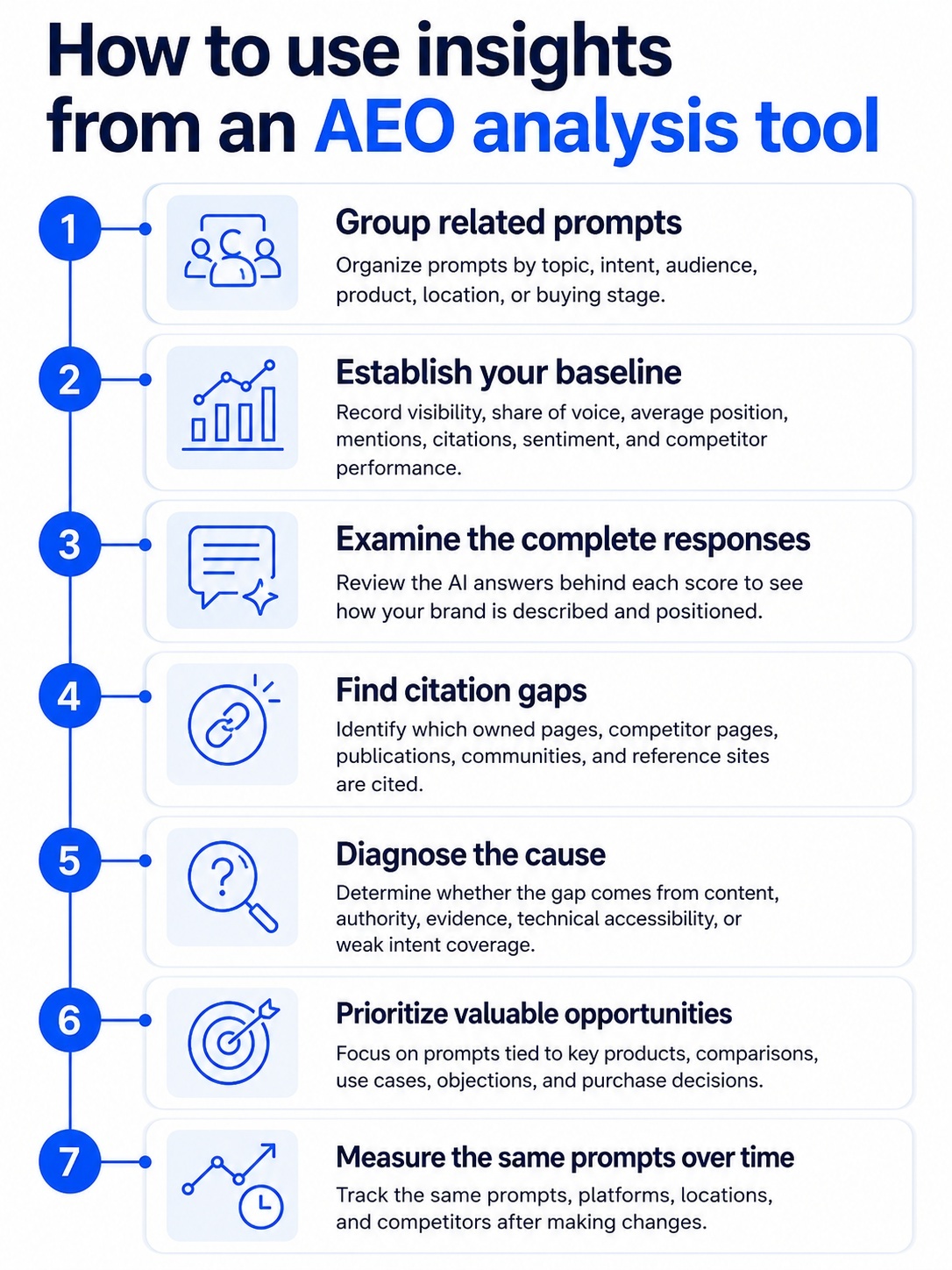
AEO analysis becomes valuable when it turns visibility data into specific actions. Use it to identify why your brand is missing, which sources influence AI answers, and where improvements can create the greatest business impact.
Follow this workflow to move from analysis to execution.
1. Group related prompts
Organize prompts by topic, search intent, audience, product, location, or buying stage. This makes it easier to identify patterns that an overall visibility score may hide.
2. Establish your baseline
Record your current visibility, share of voice, average position, mentions, citations, sentiment, and competitor performance. Use this baseline to measure progress accurately.
3. Examine the complete responses
Review the AI answers behind each score. Check how your brand is described, which competitors appear, what position each brand receives, and whether the response contains inaccurate or outdated claims.
4. Find citation gaps
Identify which owned pages, competitor pages, publications, communities, and reference sites are cited. Look for influential sources that mention competitors but exclude your brand.
5. Diagnose the cause
Determine whether the gap comes from incomplete content, weak third-party authority, missing evidence, poor technical accessibility, or inadequate coverage of the prompt’s intent.
6. Prioritize valuable opportunities
Focus on prompts connected to key products, comparisons, use cases, objections, and purchase decisions. Balance commercial value, competitor advantage, feasibility, and required effort.
7. Measure the same prompts over time
Track the same prompts, platforms, locations, and competitors after making changes. Compare visibility trends with full responses and citations to determine whether the improvement is consistent.
The goal is not simply to raise a visibility score, but to turn prompt, competitor, and citation data into measurable content, authority, and technical improvements.
Ready to act on your citation gaps? Learn how to improve AI citations across search and answer engines.
Final Thoughts
Choose an AI monitoring and optimization tool for AEO that explains changes in brand visibility, not just reports a score. Define your priority prompts, competitors, platforms, and markets, then track mentions, citations, sentiment, share of voice, and traditional rank tracking from a consistent baseline. Google confirms that established SEO practices still support visibility in its generative AI search experiences.
Use the findings to strengthen your content strategy, close citation gaps, improve authority, and resolve technical barriers. Generative engine optimization requires ongoing brand monitoring, so repeat the same prompts after each change and compare answers, citations, traffic, and conversions. Scalenut connects this analysis with clear content, backlink, and community recommendations.
Book a free strategy call with Scalenut today!
Frequently asked questions
What is an AEO analysis tool?
An AEO analysis tool measures how a brand appears in AI-generated answers over time. It tracks prompts, mentions, citations, sentiment, competitors, and visibility trends across platforms such as ChatGPT, Google AI, Perplexity, Gemini, and Claude.
Which is the best-rated answer engine optimization tool in 2026?
Scalenut is our top choice for teams that want AEO analysis and content execution in one platform. Profound suits enterprise intelligence, Ahrefs supports large-scale research, Peec AI simplifies daily tracking, and Otterly AI offers a lower entry price.
How do I choose the best AEO analysis tool?
Compare AI platform coverage, custom prompt limits, citation depth, complete response access, competitor and sentiment analysis, refresh frequency, historical data, locations, integrations, and total cost. Prioritize the capabilities your team will use regularly instead of the longest feature list.
Are there reliable free AEO analysis tools?
Yes. HubSpot AEO Grader provides a free, one-time brand assessment across ChatGPT, Perplexity, and Gemini, while Ahrefs offers a limited AI Visibility Checker. Free tools are useful for initial checks, but continuous prompt tracking and historical analysis usually require paid plans.
How do AEO analysis tools differ from traditional SEO tools?
Traditional search tools mainly measure rankings, keywords, backlinks, traffic, and technical performance. AEO analysis tools examine prompts, AI-generated responses, citations, brand mentions, sentiment, and competitor visibility. Some platforms combine both data sets, but they measure different stages of search visibility.
Do AEO analysis tools improve AI visibility automatically?
AEO analysis tools do not improve visibility automatically. They reveal where your brand is absent, which competitors appear, and which sources influence AI answers. Your team must then address the relevant content, citation, authority, reputation, or technical gaps.
Which metrics should an AEO analysis tool track?
Prioritize prompt-level visibility, brand mentions, average position, share of voice, citations, cited URLs, sentiment, competitor presence, and changes over time. The tool should also provide complete AI responses so you can verify what its aggregated scores actually represent.
How accurate are AEO visibility scores?
AEO visibility scores are directional rather than universal measurements. Each platform uses its own prompts, models, locations, update schedules, and calculation methods. Use scores to track changes within the same tool, then verify important findings through complete responses and citation data.
How often should AEO visibility data be refreshed?
Daily tracking is useful for campaigns, launches, reputation issues, and fast-moving categories. Weekly tracking is generally sufficient for ongoing content and visibility programs. Whichever frequency you choose, compare the same prompts, models, locations, and competitors over a consistent period.
What is the difference between an AI mention and a citation?
A mention occurs when an AI answer names your brand. A citation occurs when the answer links to or identifies a source associated with your website. Both matter, but citations provide stronger evidence about which pages and domains influence the generated response.
Which AEO analysis tool is best for small businesses?
Small businesses should prioritize affordable pricing, relevant platform coverage, simple reporting, and enough prompts for their main products or services. Scalenut suits teams that also need content execution, while lightweight monitoring tools may suit businesses with narrower tracking requirements.
Which AEO analysis tool is best for agencies?
Agencies should prioritize separate workspaces, multiple brands, prompt capacity, location support, exports, reporting integrations, user access, and scalable pricing. Scalenut supports analysis and content workflows, while enterprise platforms may provide broader APIs, regional tracking, and client reporting controls.
What is the best software for answer engine optimization in AI?
The best AEO checking software should track prompts, mentions, citations, sentiment, competitors, and visibility trends across relevant AI platforms. Scalenut is a strong option for teams that also want to turn these insights into content optimization and execution workflows.


.svg)


.webp)