How to Improve Brand Mentions in LLMs and Win AI Search?

Brand mentions in LLMs checklist
Use this checklist to turn AI brand mention tracking into a repeatable GEO workflow instead of a one-time prompt test.
- Identify 30 to 50 buyer-intent prompts your audience is likely to ask.
- Group prompts by category, competitor, feature, pricing, use case, persona, and funnel stage.
- Run those prompts across ChatGPT, Perplexity, Gemini, Claude, Copilot, and Google AI Overviews.
- Track how often your brand appears across prompts and platforms.
- Track which competitors appear in the same answers.
- Note where your brand appears in the answer, such as first, top three, middle, or end.
- Review sentiment and context to see whether the brand is described positively, neutrally, negatively, or inaccurately.
- Track cited URLs and check whether your owned pages are included.
- Identify which third-party sources influence the answer, such as review sites, listicles, forums, directories, or editorial pages.
- Update weak owned pages with clearer positioning, use cases, features, pricing, and comparison information.
- Create comparison and alternative pages for prompts where competitors appear but your brand does not.
- Strengthen credible third-party mentions through review profiles, product listings, partner pages, expert roundups, and editorial mentions.
- Refresh outdated review profiles, directory listings, and product descriptions.
- Monitor changes monthly to see whether your brand visibility, citation ownership, sentiment, and accuracy are improving.
What are brand mentions in LLMs?
Brand mentions in LLMs are references to your company, product, service, or website inside AI-generated answers from platforms like ChatGPT, Perplexity, Gemini, Claude, Copilot, and Google AI Overviews. These mentions can show up when users ask for recommendations, comparisons, alternatives, definitions, or buying advice, even when they never search for your brand directly.
Why are brand mentions in LLMs so important?
Brand mentions in LLMs are important because buyers are no longer relying only on Google search results to discover and compare brands. They are asking AI tools for product recommendations, alternatives, comparisons, and buying advice. If your brand does not appear in those answers, you may be invisible during the exact moment a user is forming their shortlist.
This shift is already happening. According to Capgemini, 58% of consumers have replaced traditional search engines with Gen AI tools for product or service recommendations, up from 25% in 2023. That is why tracking brand mentions in AI search is important. It helps you understand whether AI platforms are recognizing, recommending, or ignoring your brand when high intent users are asking for solutions.
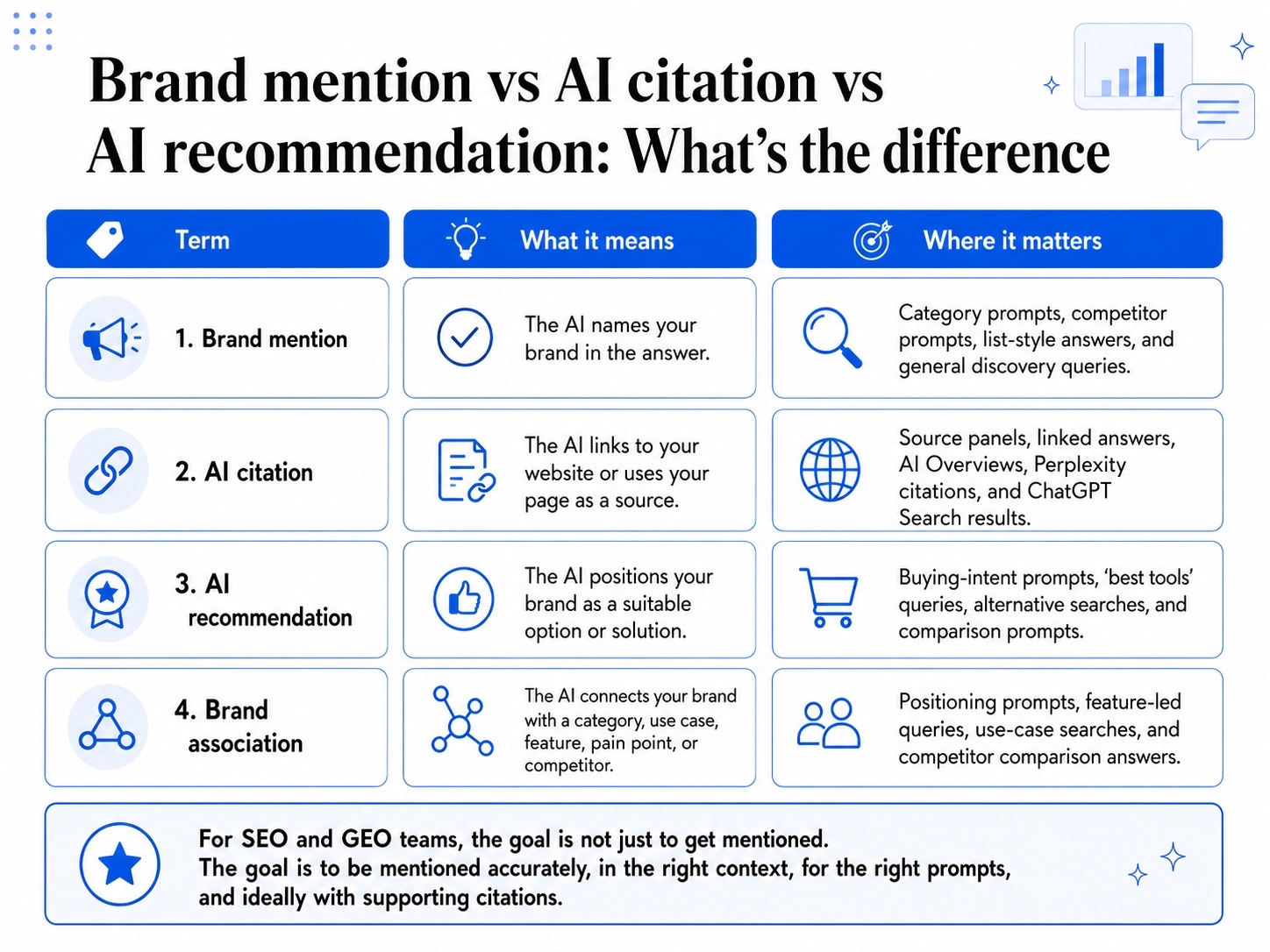
How do LLMs decide which brands to mention?
LLMs do not mention brands based on one fixed rule. Brand visibility is usually shaped by a mix of historical brand presence, real-time retrieval, citations, third-party sources, prompt phrasing, and how clearly your content explains what your brand does.
Here are the main factors that can influence whether your brand appears in AI-generated answers.
1. Training data and historical web presence
LLMs learn patterns from large amounts of text. If your brand is repeatedly associated with a category, feature, use case, competitor, or pain point across the web, AI systems are more likely to understand where your brand fits.
That does not mean you can force brand mentions. It means consistent, credible public information matters. If your website, review profiles, comparison pages, partner pages, PR mentions, and third-party listings all describe your brand differently, AI systems may struggle to connect your brand with the right topics.
2. Real-time retrieval and citations
Some AI systems can pull from live or near-live web sources depending on the platform and query. ChatGPT Search, Perplexity, Gemini, Google AI Overviews, and Claude with web search can use current sources to build or support an answer.
This is where crawlable, structured, helpful, and source-worthy content matters. A 2026 study found that nearly 30% of AI Overview cited domains did not appear in the traditional first-page results. That means AI search visibility is not always the same as classic Google ranking. Your content needs to be easy to access, easy to understand, and useful enough to support the answer.
3. Query fan-out and related prompts
AI search may not evaluate only the exact words in the user’s prompt. AI Overviews and AI Mode uses query fan-out, which means the system can issue multiple related searches across subtopics and data sources before generating a response.
For example, if someone asks, “best tools to improve AI brand mentions,” the system may also look for related ideas like “AI visibility tools” or “LLM brand tracking tools”. This is why one exact-match keyword is not enough. To improve visibility for brand mentions in LLMs, your content should cover the full topic cluster around the buyer’s question, not just the primary keyword.
4. Third-party validation and earned media
AI systems often rely on third-party sources to understand how a brand is discussed outside its own website. These sources can include review platforms, comparison articles, forums, editorial pages, videos, directories, partner pages, and industry publications.
This is why earned media matters for AI visibility. A Muck Rack study found that more than 95% of cited links in AI responses came from non-paid sources, 85% came from earned media, and 27% came from journalistic sources. Owned content still matters, but credible external mentions can strengthen how AI systems understand, verify, and position your brand in generated answers.
5. Content clarity and extractable evidence
AI systems are more likely to use content that is specific, structured, and easy to extract. Clear definitions, comparison tables, numbered workflows, feature lists, pricing details, pros and cons, FAQs, original examples, updated statistics, and expert commentary all make your content easier to understand and reuse.
This matters because AI-generated answers are built to summarize information quickly. If your content hides important details in vague paragraphs, AI systems may skip over it. But if your page clearly answers the question, supports claims with evidence, and explains where your brand fits, it has a better chance of being used in the answer.
In short, LLM brand visibility is not just about publishing more content. It is about making your brand easier for AI systems to understand, verify, connect, and confidently mention in the right context.
What should you track in LLM brand mentions?
Tracking brand mentions in LLMs is not just about checking whether your brand appears. You need to understand how often it appears, where it appears, which competitors show up with it, and how accurately AI platforms describe it.
Here are the key LLM brand mention metrics SEO and GEO teams should track.
1. Brand mention frequency
Track how often your brand appears across selected prompts and AI platforms. This gives you a baseline for AI visibility, but it should not be treated as the only success metric.
2. Share of voice against competitors
Compare your brand visibility with competitors for the same set of prompts. This helps you see whether AI platforms recognize your brand as strongly as other players in your category.
3. Prompt-level visibility
Track which prompts trigger your brand mentions. Include category, competitor, alternative, feature, pricing, use-case, and buying-intent prompts to see where your brand appears in the buyer journey.
4. Mention position
Check whether your brand appears first, in the top three, in the middle, near the end, or only as an additional option. Placement matters because AI answers often influence which brands users notice first.
5. Sentiment and context
Look at how the AI describes your brand. A mention can be positive, neutral, negative, or inaccurate, and the surrounding context can shape how users understand your strengths and limitations.
6. Citation ownership
Track which sources AI platforms cite when mentioning your brand. These may include your website, competitor pages, review platforms, forums, listicles, editorial sources, YouTube videos, or software directories.
7. Accuracy of brand description
Check whether the AI answer includes outdated pricing, missing features, wrong positioning, inaccurate competitor comparisons, old product names, or claims that no longer match your current offering.
Tracking AI brand mentions only becomes useful when you measure visibility, context, competitors, citations, and accuracy together.
To go deeper into the sentiment side of AI visibility, read our guide on what is LLM brand sentiment and how can you track it?
How can you see if AI mentions your brand?
You can start by checking AI answers manually, but random prompt testing will not give you reliable insights. To understand whether AI systems recognize, recommend, or ignore your brand, you need a structured process across prompts, platforms, dates, and cited sources.
Here are the key steps to check if AI mentions your brand.
1. Start with manual prompt testing
Choose 30 to 50 prompts your buyers are likely to ask and test them across ChatGPT, Perplexity, Gemini, Claude, Copilot, and Google AI Overviews. Record whether your brand appears, which competitors appear, and how the answer describes each brand.
2. Group prompts by buyer intent
Do not test only broad category prompts. Group your prompts by category, competitor, alternative, pricing, feature, use case, and problem-aware queries. This helps you see where your brand appears across different stages of the buyer journey.
3. Record the answer, platform, date, and cited sources
AI answers can change over time, so document what appeared, where it appeared, and when. Also note which sources were cited because those pages may be influencing how the AI system understands your brand.
4. Check AI referral traffic in GA4
AI referral traffic can show clicked visits from platforms like ChatGPT, Perplexity, Gemini, Claude, and Copilot. However, this only shows users who clicked through to your website. It does not show every prompt where your brand appeared or was ignored.
5. Use AI visibility analytics tools for brand mentions
AI visibility analytics tools for brand mentions can help you track this at scale. Instead of manually checking every prompt, these tools can monitor brand mentions, competitor visibility, citations, sentiment, AI share of voice, and historical changes across AI platforms.
The goal is to move from random prompt checks to a repeatable tracking system that shows where your brand is visible, missing, or misrepresented.
If you want to move from manual prompt checks to scalable tracking, this guide on the best LLM optimization tools for AI visibility can help you compare platforms built for prompt monitoring, citations, competitors, and brand visibility.
How can you improve brand mentions in LLMs? (A practical 90-day plan)
Improving AI brand mentions is not about tricking AI systems. It is about making your brand easier to understand, verify, compare, and recommend when users ask category, comparison, alternative, or buying-intent prompts.
Here is a practical 90-day workflow SEO and GEO teams can follow.
1. Days 1 to 15: Build your AI visibility baseline
Start by choosing 30 to 50 prompts your buyers are likely to ask. Include category prompts, competitor prompts, alternative prompts, feature prompts, pricing prompts, and problem-aware prompts.
Run these prompts across ChatGPT, Perplexity, Gemini, Claude, Copilot, and Google AI Overviews. For each answer, record whether your brand appears, which competitors appear, where your brand is placed, what sources are cited, and whether the description is accurate.
2. Days 16 to 30: Find the patterns behind missing mentions
Once you have the baseline, look for repeat gaps. For example, your brand may appear for branded prompts but not for “best tools” prompts. Or competitors may appear in alternative searches because they have stronger comparison pages, review profiles, or third-party mentions.
Do not treat every missing mention the same way. Separate the gaps into four buckets: content gaps, citation gaps, competitor gaps, and accuracy gaps. This makes the next step easier to prioritize.
3. Days 31 to 50: Fix owned content and entity clarity
Update the pages that help AI systems understand your brand. Start with your homepage, product pages, feature pages, pricing page, use-case pages, comparison pages, and alternative pages.
Each page should clearly answer what your brand does, who it serves, what category it belongs to, which problems it solves, how it compares with competitors, and what proof supports your claims. Avoid vague product language. Make the positioning specific enough for both users and AI systems to understand.
4. Days 51 to 65: Create content for prompts where competitors appear
Use your prompt baseline to decide what to create next. If competitors appear for alternative prompts, create alternative pages. If they appear for comparison prompts, create comparison pages. If they appear for feature-led prompts, create feature or use-case pages.
The goal is not to publish more content randomly. The goal is to create pages that directly answer the prompts where your brand is missing, weak, or poorly positioned.
5. Days 66 to 80: Strengthen third-party sources
Check the external sources that AI systems cite or seem to rely on. These may include review platforms, software directories, editorial listicles, partner pages, YouTube reviews, Reddit discussions, podcast pages, and expert roundups.
Update the profiles you control first. Then look for credible places where your brand should be included, reviewed, compared, or mentioned. Third-party mentions help reinforce how your brand is understood outside your own website.
6. Days 81 to 90: Re-test prompts and measure movement
Run the same prompt set again and compare the results with your baseline. Check whether your brand appears more often, ranks higher in the answer, receives stronger context, earns better citations, or shows up for new prompt categories.
Also check whether outdated or inaccurate descriptions have changed. If not, identify which sources may still be influencing the answer and update your next content or outreach cycle accordingly.
The stronger and clearer your brand footprint is across owned content, third-party sources, and buyer-intent prompts, the easier it becomes for AI systems to connect your brand with the right answers.
What mistakes reduce LLM brand visibility?
Most brands do not lose AI visibility because of one missing keyword. The bigger issue is usually weak positioning, thin content, outdated information, or missing third-party signals that make the brand harder for AI systems to understand and verify.
Here are the common mistakes SEO and GEO teams should avoid.
1. Tracking only branded prompts
Asking “What is [brand]?” is not enough. Your brand also needs to appear in category, comparison, alternative, feature, and buying-intent prompts where users are still deciding which solution to trust.
2. Treating brand mentions as the only metric
A mention alone does not mean strong visibility. Teams should also track citations, sentiment, accuracy, mention position, competitor presence, and the sources influencing the answer.
3. Ignoring third-party sources
AI systems may rely on review sites, directories, listicles, forums, media mentions, and partner pages to understand how your brand is positioned outside your website. If those sources are weak, missing, or outdated, your AI visibility can suffer.
4. Publishing generic AI content
Repetitive, shallow content is unlikely to help users or AI systems. Stronger content gives clear answers, original examples, useful comparisons, updated information, and evidence that explains why your brand belongs in the answer.
5. Letting outdated information stay live
Old pricing, outdated features, past positioning, and stale third-party listings can lead to inaccurate AI answers. If the web still reflects an older version of your product, AI systems may repeat that version.
Most LLM visibility issues come from weak signals across content, sources, positioning, and authority.
Why is manual tracking not enough?
Manual tracking is useful when you are starting out, but it becomes difficult to rely on once you are checking multiple prompts, platforms, competitors, and citations. AI answers can also change over time because of platform updates, source freshness, location, retrieval behavior, and small changes in how a prompt is phrased.
One broad prompt also does not represent your full buyer visibility. Your brand may appear for a category query but disappear from comparison, alternative, feature, or use-case prompts. A mention can also be misleading if the answer favors a competitor, cites outdated sources, or describes your brand too narrowly. Manual tracking can show a snapshot, but AI visibility needs trend data, competitor context, and source-level insight.
If you are comparing tools for AI visibility tracking, our guide on the best AI visibility platform for your brand can help you understand which features matter before you choose.
How does Scalenut help track and improve AI brand mentions?
Manual tracking can tell you whether your brand appeared in one AI answer. Scalenut helps you understand the bigger picture: where your brand is visible, where competitors are winning, which prompts trigger mentions, which sources AI engines rely on, and what needs to be fixed next.
With Scalenut, we help SEO and GEO teams track the brand mention signals that actually matter:
- Brand mentions to see how often your brand appears in AI-generated answers.
- Prompt coverage to understand which buyer questions surface your brand and which ones do not.
- Visibility trends to monitor whether your AI presence is improving, dropping, or staying flat.
- Share of Voice to compare your brand’s presence against competitors in AI conversations.
- Average Position to see whether your brand appears near the top of AI answers or lower in the response.
- Competitor mentions to identify the brands AI engines repeatedly surface alongside or ahead of you.
- Sentiment Analysis to understand whether your mentions are positive, neutral, or negative.
- Citations and Mentions to separate simple brand name-drops from answers that cite your website as a source.
- Query Fanout to see the related sub-queries AI systems may use before generating an answer.
- Content Gaps to find prompts where competitors are cited, but your brand is missing.
- AI bot visits and source engines to understand how AI crawlers interact with your website.
The real advantage is what happens after tracking. Once you know where your brand is missing, weakly positioned, or misrepresented, Scalenut helps you act on those gaps through GEO content creation, Content Optimizer, content audit, keyword planning, and more. That means your team is not just watching AI visibility change. You are building the content, structure, and authority signals that can help improve future brand mentions.
Want to know more? Book a strategy call with our team today!
Conclusion
Brand mentions in LLMs are no longer just a visibility bonus. They show whether AI systems understand your brand, connect it with the right category, compare it against the right competitors, and surface it when buyers ask high-intent questions. Start by tracking the prompts that matter, checking where your brand appears, reviewing cited sources, and identifying where competitors are getting mentioned instead.
From there, turn the gaps into action. Update weak owned pages, create comparison and alternative content, refresh outdated third-party profiles, strengthen credible external mentions, and re-test your prompts every month. The goal is not just to get mentioned more often, but to make sure your brand is mentioned accurately, confidently, and in the right buying context.
Frequently Asked Questions
Why is tracking brand mentions in AI search important for business visibility?
Tracking brand mentions in AI search helps you see whether large language models connect your brand name with the right category, competitors, and buyer questions. It also shows if your digital marketing efforts are improving brand awareness where discovery is shifting.
What drives brand mentions in AI answers?
Brand mentions in AI answers are usually shaped by clear owned content, credible third-party references, fresh product information, consistent positioning, and strong trust signals. Search-enabled AI systems may also use citations, reviews, directories, case studies, and source quality to form responses.
How do you get your brand to show up in AI?
Start by making your product pages, comparison pages, alternative pages, and use-case content clear and crawlable. Then strengthen your brand’s visibility across review sites, editorial mentions, partner pages, and trusted third-party sources that AI systems may use.
What is an example of a brand mention?
An example of a brand mention is an AI answer saying, “Scalenut is an AI-powered SEO and content platform for teams that want to plan, create, optimize, and monitor content.” The brand is named directly in the response.
Are there any risks if I don’t track my brand mentions in AI search?
Yes. If you do not track AI brand mentions, you may miss inaccurate descriptions, competitor-led comparisons, outdated pricing, or negative sentiment. Your brand’s presence may look stronger in traditional search while AI answers are quietly shaping buyer perception elsewhere.
Can tracking AI brand mentions help improve my brand’s reputation?
Yes. Tracking helps you find how AI platforms describe your brand, whether the context is positive or negative, and which sources influence that framing. It supports sentiment analysis, reputation monitoring, and content updates that correct weak or misleading narratives.
What tools are available for tracking brand mentions in AI search results?
AI visibility analytics tools can track brand mentions, competitor mentions, citations, sentiment, and share of voice across AI platforms. Scalenut helps teams monitor LLM mentions and turn those insights into content actions for stronger AI search optimization.
What benefits does tracking brand mentions in AI search offer compared to traditional search engines?
Traditional search tracking shows rankings, clicks, and keywords. AI brand mention tracking shows whether your brand is recommended, compared, cited, or ignored inside generated answers. That gives teams actionable insights into AI-led discovery, not just search engine performance.
How can I monitor my brand mentions in ChatGPT and other AI platforms?
Create a prompt set, test it across ChatGPT, Perplexity, Gemini, Claude, Copilot, and AI Overviews, and record mentions, competitors, citations, sentiment, and accuracy. Include category prompts, buying prompts, comparison prompts, and reddit threads where buyers discuss alternatives.
How does AI search impact the frequency of my brand being mentioned online?
AI search can increase or reduce how often your brand appears, depending on how clearly large language models connect your brand with relevant topics, sources, and prompts. Strong owned content, third-party mentions, citations, and trust signals can improve brand visibility across AI answers.


.svg)


.webp)