.jpg)
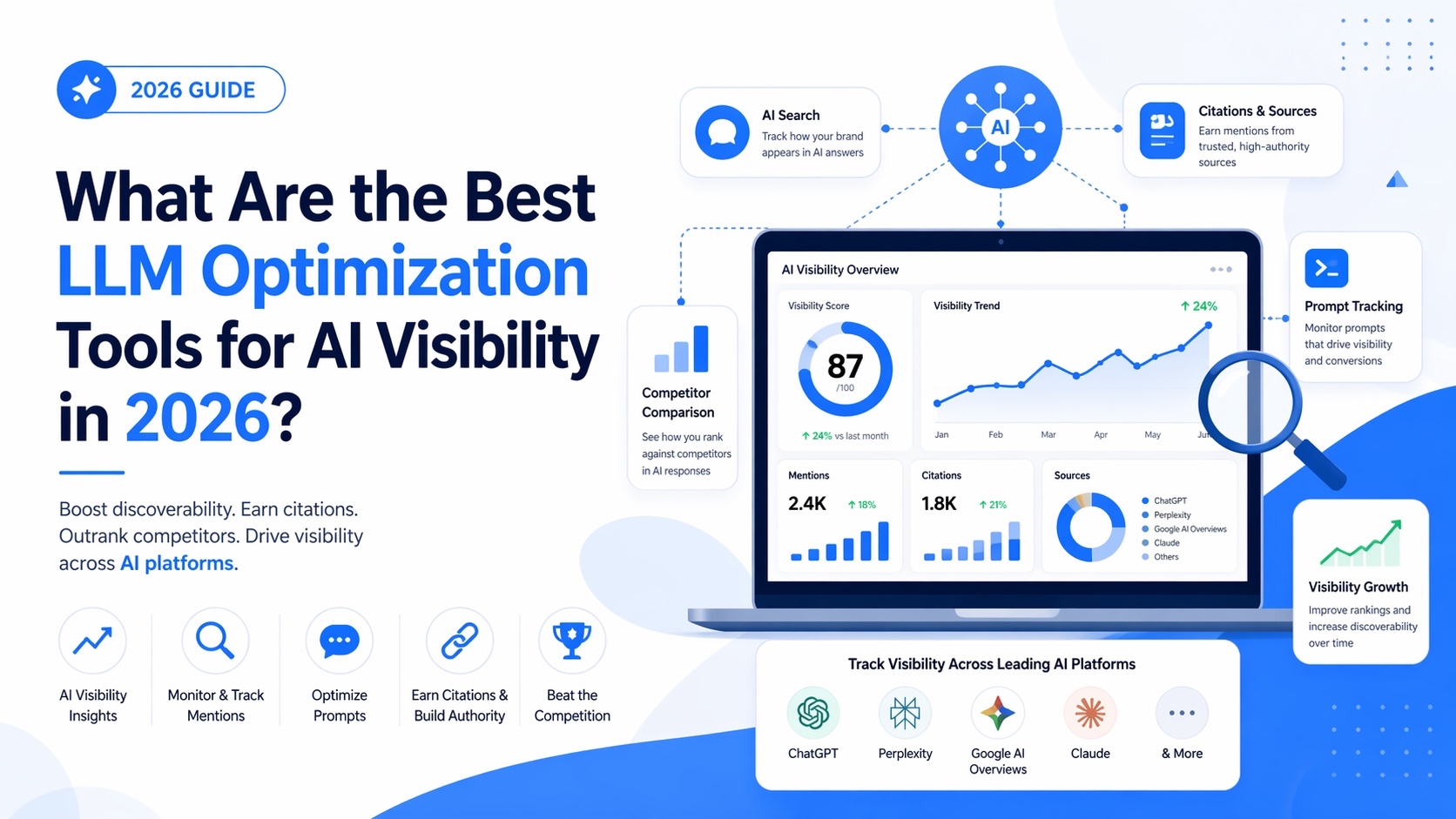
What Are the Best LLM Optimization Tools for AI Visibility?
Key Highlights
- The best LLM optimization tools help brands track AI presence through prompts, citations, competitor visibility, and source-level insights, not just basic mentions.
- Different platforms serve different needs, so team size, workflow complexity, and reporting requirements should shape the shortlist more than brand familiarity alone.
- Some tools are built mainly for monitoring, while others support generative engine optimization through recommendations, workflow guidance, and execution-oriented features.
- Scalenut stands out by combining AI visibility tracking with SEO research, content creation, optimization, and linking support in one platform instead of relying on multiple dedicated tools.
- Peec AI, Scrunch AI, Ahrefs Brand Radar, and Semrush Enterprise AIO each take a different approach, with stronger focus areas like prompt tracking, technical diagnostics, large-scale research, or enterprise reporting.
- For buyers comparing options, ease of use, platform coverage, citation visibility, and actionability matter just as much as dashboards or reporting depth.
- Teams focused on answer engine optimization should prioritize tools that connect visibility data with clear next steps, not tools that stop at passive tracking.
- The right choice comes down to workflow fit, budget, and standout features, whether that means lightweight monitoring, broad multi-engine tracking, or full visibility-plus-execution support.
You can rank well in Google and still barely show up in AI answers. That is the problem many teams are running into now as buyers rely more on ChatGPT, Perplexity, Gemini, and other AI tools to research brands, products, and services.
The challenge is that traditional SEO tools do not give a full picture of AI visibility. They can show rankings and traffic, but not always prompt-level visibility, citations, competitor presence, or how AI systems are actually representing your brand.
This guide breaks down the best LLM optimization tools for AI visibility in 2026, what each one does well, who each tool is best for, and why Scalenut stands out as the strongest overall choice for teams that want both visibility insights and execution.
Quick Analysis: How These LLM Optimization Tools Compare
Here is a quick comparison of the clearest differentiator for each platform before we break them down in more detail.
- Scalenut: Combines AI visibility tracking with SEO research, content creation, and optimization, so teams can move from prompt gaps and citation insights straight into execution.
- Peec AI: Strongest when prompt-level tracking is the priority, with a clear focus on monitoring visibility shifts, competitors, and source patterns across AI search experiences.
- Scrunch AI: Stands out for combining AI visibility monitoring with a stronger technical layer, including citations, competitor analysis, and AI bot or discoverability signals.
- Ahrefs Brand Radar: Best known for large-scale AI visibility benchmarking, with strong share of voice analysis, citation tracking, and cited page or domain insights inside the Ahrefs ecosystem.
- Semrush Enterprise AIO: Brings AI visibility into a broader enterprise reporting workflow with competitor tracking, sentiment analysis, source visibility, and ROI-focused reporting.
- OtterlyAI: Offers a lighter, monitoring-focused workflow built around prompts, mentions, citations, and cross-platform AI visibility tracking.
- Profound: Focuses on deeper answer engine analysis for enterprise teams, with broad multi-platform visibility tracking, citation visibility, and a stronger reporting orientation.
- Hall: Keeps the workflow centered on visibility, citations, and answer engine insights, making it a clean option for teams that want clarity without extra complexity.
- Rankscale: Differentiates itself through broad multi-engine coverage, making it useful for teams that want visibility, citation, and sentiment tracking across a wider AI search landscape.
- AthenaHQ: Goes beyond monitoring by combining GEO and AEO tracking with workflow guidance, optimization recommendations, and action-oriented visibility management.
- Bluefish AI: Positions AI visibility within a wider enterprise AI marketing stack, with added emphasis on brand perception, narrative control, and message consistency.
What Are The Best LLM Optimization Tools For Increasing AI Visibility In 2026?
The best LLM optimization tools do more than track mentions. They help teams understand prompt-level visibility, citations, competitor presence, and what actions can improve brand visibility across AI search experiences.
Below, we break down the best AI search visibility tracking platforms for LLM search optimization, what each one does best, and which type of team each one is right for.
1. Scalenut
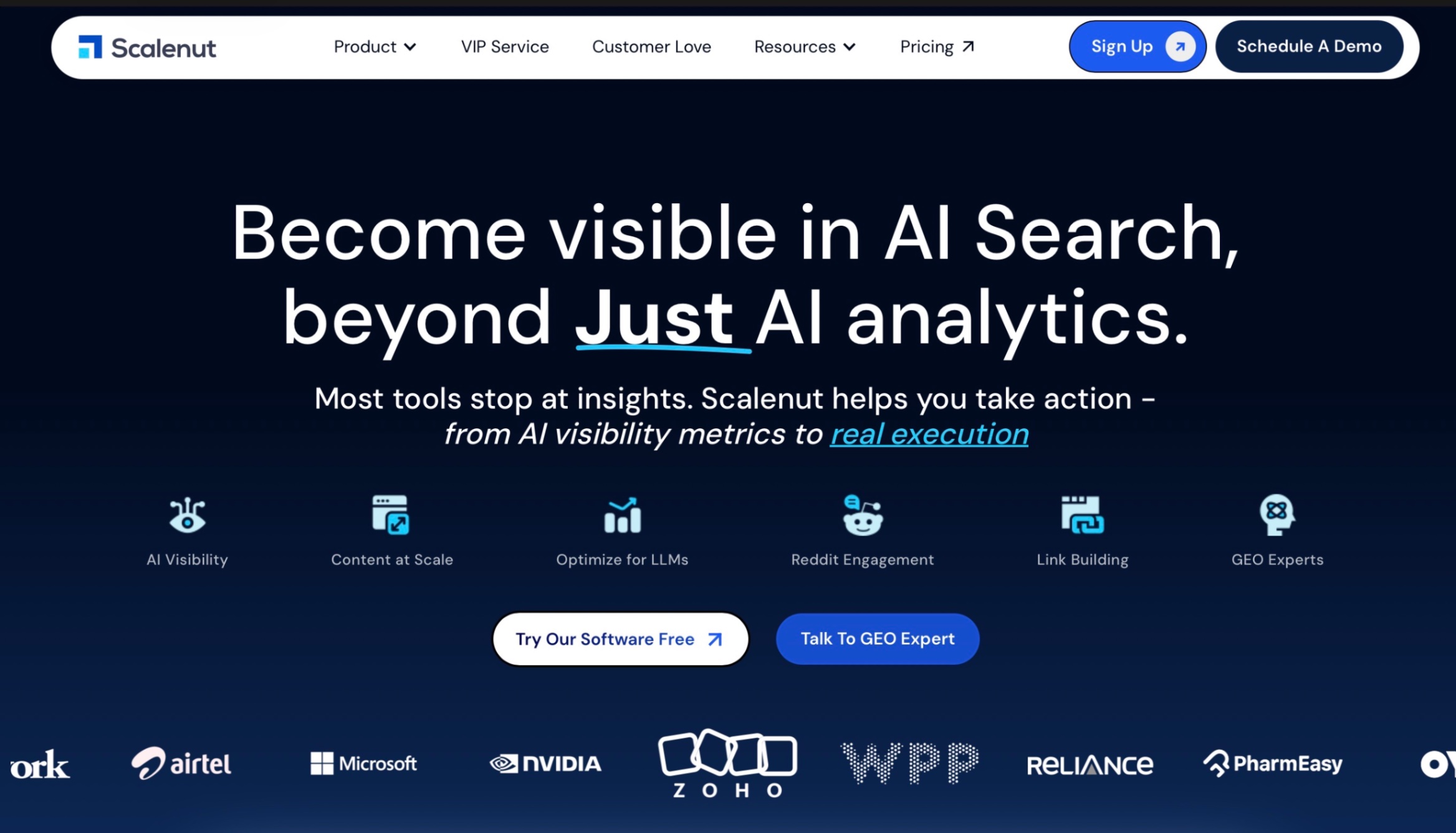
Scalenut brings AI visibility tracking, SEO research, content creation, and optimization into one workflow. Instead of stopping at reporting, Scalenut helps teams understand how they show up in AI answers and what to do next to improve that visibility.
Best For: Teams that want AI visibility tracking plus hands-on SEO and GEO execution in one platform, especially if managing separate tools for monitoring, planning, writing, optimization, and internal linking feels inefficient.
How Does Scalenut Help With LLM Optimization?
1. AI Visibility Tracking And Brand Monitoring
Scalenut tracks how often a brand appears across AI platforms such as ChatGPT and Perplexity, then compares that visibility against competitors. Metrics like Visibility Score, Average Position, Share Of Voice, Visibility Heatmap, and Brand Visibility Rank give teams a clearer view of overall presence across prompts, topics, and platforms.
2. Prompt-Level Intelligence And Competitive Insights
Scalenut shows which prompts trigger brand mentions, where those mentions appear, and which competitors are frequently mentioned alongside them. Prompt Tracking, Competitor Visibility Insights, Query Fanouts, and Sentiment Analysis make it easier to see where visibility is being won, where it is being lost, and how AI systems are framing that exposure.
3. Citation Tracking And Source Visibility
Scalenut highlights the sources referenced in AI-generated answers and surfaces the pages AI systems seem to rely on most often. That gives teams a more practical way to understand what content is shaping AI answers and where authority gaps still exist.
4. GEO Recommendations That Lead To Action
One of the strongest parts of Scalenut is that the workflow does not stop at visibility data. AI-Led Content Ideas, Authority And Backlink Suggestions, Platform Engagement Opportunities, and Action Paths help turn reporting into practical next steps.
5. AI Traffic Visibility And LLM Interaction Signals
Scalenut also connects AI visibility with on-site behavior. AI Bot Tracking, Cloudflare integration, Top AI Sources, Most Referenced Pages, and AI Traffic Trends help teams see how AI agents are interacting with their content and whether those interactions are increasing, leveling off, or dropping.
6. Cruise Mode For Content Creation
Cruise Mode supports outlining and drafting with SERP-informed guidance, which makes it easier to create content based on real search demand and visibility opportunities.
7. Content Optimizer And Content Scoring
Scalenut also supports on-page improvement through Content Optimizer and Content Scoring. These features help teams strengthen intent match, content depth, structure, and overall SEO quality.
8. Keyword Planning And Research Tools
Keyword Planner, Competitor Coverage Analysis, Traffic Analyzer, and Content Audit help teams cluster topics by intent, study competing pages, identify quick wins, and prioritize updates more effectively.
9. Technical SEO And Linking Support
Scalenut also supports internal linking and on-page improvements through features like Link Manager and On-Page Pro. These are useful for improving site structure, metadata, and page-level optimization in ways that support both search performance and citation potential.
Why Should You Consider Scalenut For LLM Optimization?
- Most Complete Workflow On This List: Scalenut stands out because AI visibility monitoring, SEO planning, content creation, optimization, and internal linking all sit inside one platform.
- Built For Action, Not Just Reporting: Many tools in this category are useful for showing what is happening. Scalenut is more useful when the goal is to turn those insights into actual content and SEO work.
- Strong Fit For Content-Led Teams: For teams that respond to visibility gaps by creating, updating, and improving content, Scalenut feels much more practical than a monitoring-only tool.
- Better Connection Between SEO And GEO: Scalenut is one of the few tools here that makes sense for teams still investing heavily in traditional SEO while also adapting for AI-driven discovery.
- Clearer Path From Insight To Execution: Prompt insights, citation data, AI traffic signals, and optimization recommendations all feed into a workflow that helps teams move faster.
When Is Scalenut Not The Best Option?
- Pure Monitoring Needs: Teams that only want a lightweight tracker for mentions, citations, or prompt visibility may find Scalenut broader than necessary.
- Enterprise Reporting Priorities: Organizations looking mainly for highly customized executive dashboards, governance layers, or revenue-first reporting may prefer a more enterprise reporting-focused product.
What Does Scalenut’s Pricing Look Like?
- Starter starts at $59/month
- Plus starts at $89/month
- Professional starts at $199/month
- VIP Service pricing is custom
How Do Users Rate Scalenut?
G2 Rating: 4.7/5
2. Peec AI
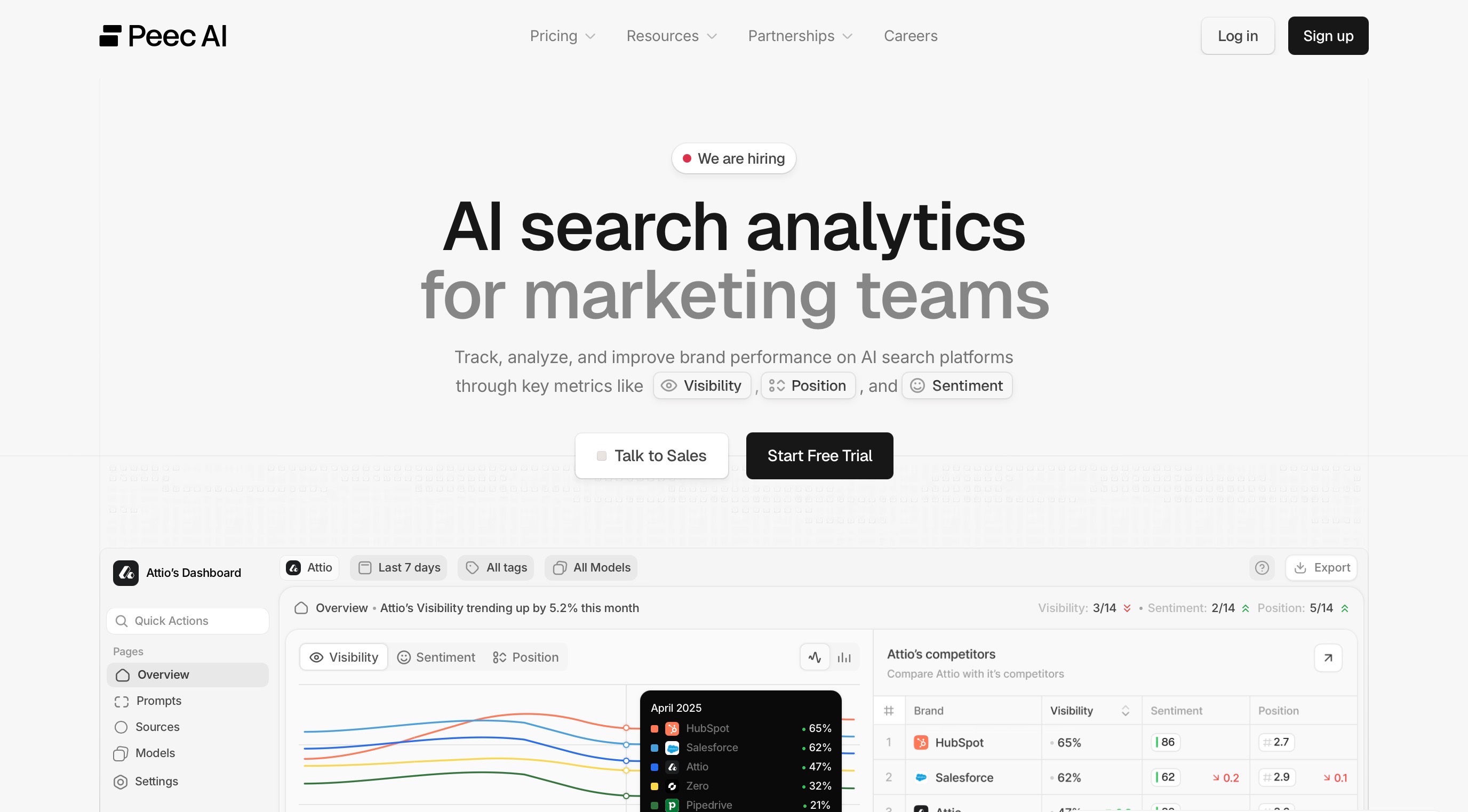
Peec AI is built for marketing teams that want a clearer view of how their brand shows up in AI search. It focuses on prompt tracking, rankings, competitor movement, and source-level visibility.
Best For: Teams that want prompt level AI visibility tracking and competitor monitoring across platforms like ChatGPT, Perplexity, Gemini, and related AI search experiences.
How Does Peec AI Help With LLM Optimization?
- Prompt Discovery And Tracking: Helps teams uncover, organize, and monitor the prompts that matter most to their AI search strategy.
- Visibility And Ranking Monitoring: Tracks how a brand performs in AI search over time, including rankings and visibility shifts.
- Competitor Benchmarking: Shows when competitors gain ground, which makes it easier to spot visibility gaps early.
- Citation And Source Analysis: Identifies the sources influencing AI responses and shows what is being cited, which is useful when deciding what content to improve or create next.
- Actionable AI Search Insights: Turns visibility data into clearer priorities instead of leaving teams with raw monitoring alone.
Why Should You Consider Peec AI For LLM Optimization?
- Strong Fit For Marketing Teams: The product feels built for marketers, which makes it easier to connect visibility data with content and competitive strategy work.
- Clear Competitive Lens: One of its strongest points is how directly it ties AI visibility to competitor movement.
- Useful Source-Level Insight: Seeing which domains, pages, or content types shape AI answers gives teams a more practical path to improvement than a basic brand mention count.
- Good For Prioritization: It is useful for teams that want help figuring out what to focus on next, not just what changed.
- Broad Platform Coverage: It tracks visibility across major AI environments, which makes it relevant for teams looking beyond a single AI interface.
When Is Peec AI Not The Best Option?
- Technical Diagnostics Needs: Teams that need a heavier technical layer around crawl issues or AI bot accessibility may want a more diagnostics-focused tool.
- Built-In Execution Workflows: It is not the best fit if you want a platform that directly handles content creation or optimization inside the product.
- Enterprise Governance Needs: Teams looking for broader enterprise governance or a larger marketing suite around AI visibility may need something more expansive.
What Does Peec AI’s Pricing Look Like?
- Starter starts at $95/month
- Pro starts at $245/month
- Advanced starts at $495/month
- Enterprise pricing is custom
How Do Users Rate Peec AI?
G2 Rating: 5/5
3. Scrunch AI
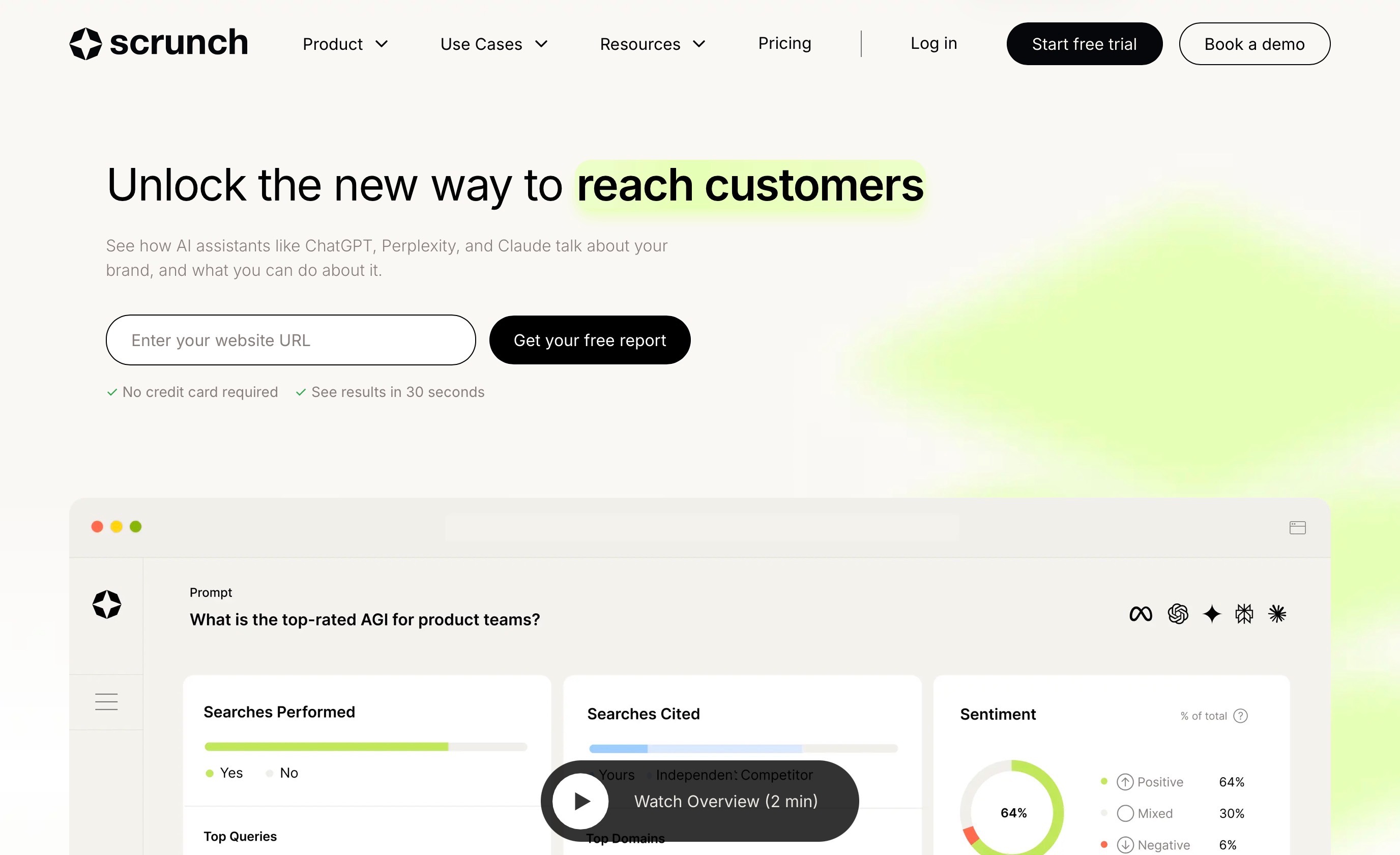
Scrunch AI is aimed at brands that want to measure and improve how they appear in AI-driven search. It leans more heavily into citations, competitive benchmarks, and technical visibility signals than many lighter monitoring tools.
Best For: Teams that want AI monitoring plus technical visibility diagnostics, especially around prompts, citations, competitors, rankings, and AI bot crawl visibility.
How Does Scrunch AI Help With LLM Optimization?
- Prompt-Level Visibility Tracking: Helps teams track brand presence and performance for specific prompts, which is important for understanding how AI answers change across queries.
- Citation Monitoring: Tracks where and how a brand is referenced in AI results.
- Competitive Benchmarking: Emphasizes share of voice and competitor comparisons, which helps teams understand who AI models surface instead of them.
- Brand Presence And Rankings: Helps monitor company appearance and ranking against competitors in AI search environments.
- AI Bot And Agent Visibility Signals: Adds a stronger technical layer through AI agent traffic and related visibility indicators.
Why Should You Consider Scrunch AI For LLM Optimization?
- Stronger Technical Angle: It stands out when AI visibility is not just a content problem but also a discoverability and access problem.
- Helpful For Competitive Strategy: It works well for comparing brands against competitors and spotting which patterns are driving visibility.
- Useful For Reporting: Visual reporting around sentiment, presence, and competitor evaluation can make AI visibility performance easier to explain.
- Built Around Practical AI Search Metrics: Its focus on brand presence, citations, referral traffic, AI agent traffic, and share of voice makes the reporting easier to use.
- Better For Ongoing Optimization: It fits more naturally into ongoing AEO and GEO work than tools built only for passive monitoring.
When Is Scrunch AI Not The Best Option?
- Lightweight Monitoring Needs: Teams looking for a simpler monitoring tool with a lighter learning curve may find it more involved than necessary.
- Narrow Prompt Tracking Use Cases: If all you need is a focused prompt dashboard, its technical visibility layer may be more than you need.
- Content Workflow Priorities: It is not the strongest fit for teams that want built-in content creation or a broader SEO content workflow in the same product.
What Does Scrunch AI‘s Pricing Look Like?
- Lite starts at $129/month
- Standard starts at $249/month
- Advanced starts at $449/month
- Enterprise pricing is custom
How Do Users Rate Scrunch AI?
G2 Rating: 4.6/5
Want to improve how your brand shows up in ChatGPT? Explore the best AI SEO agency for ChatGPT ranking in 2026.
4. Ahrefs Brand Radar
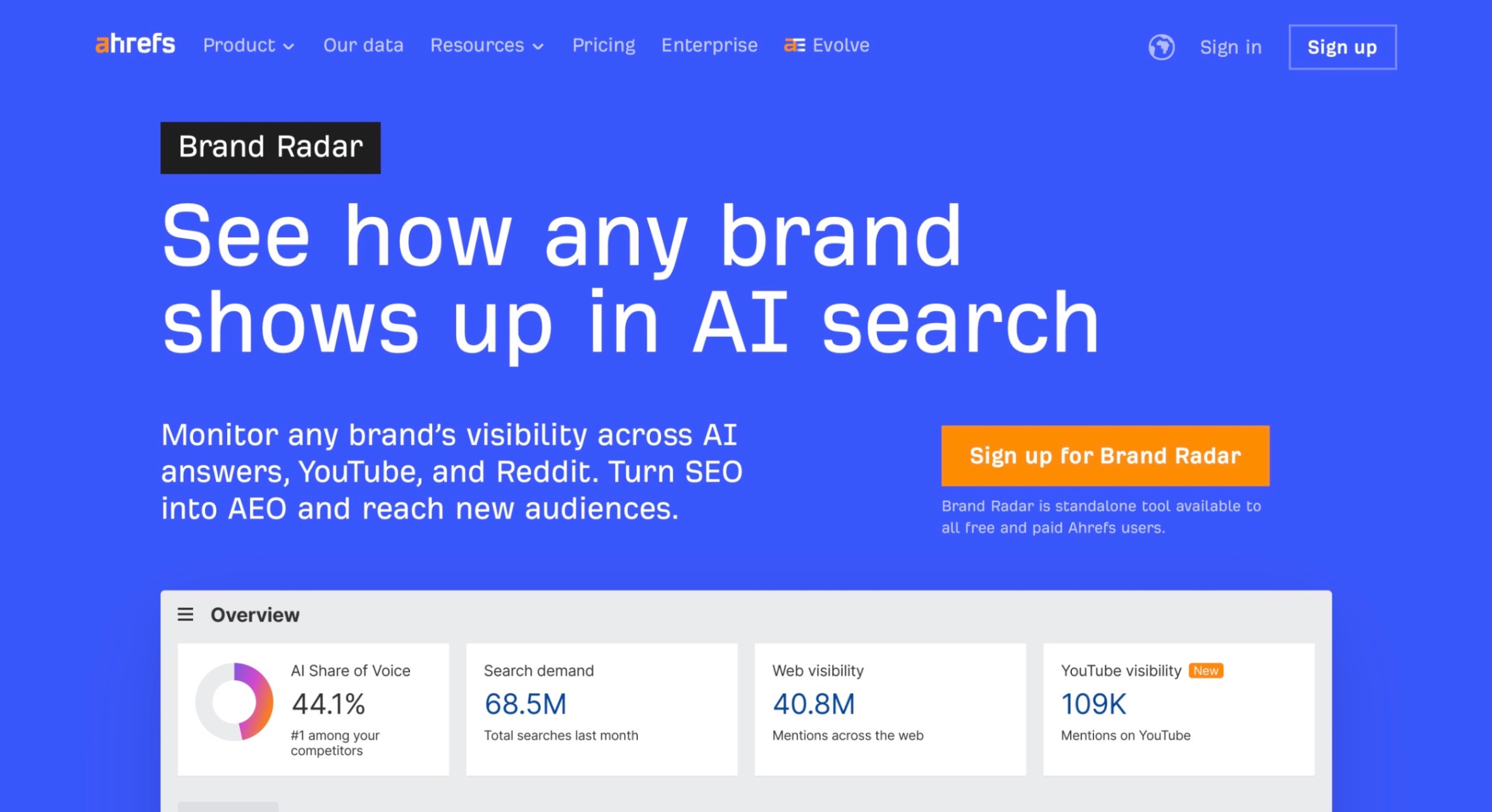
Ahrefs Brand Radar is built for teams that want to understand how brands show up across AI search at scale. It is especially useful for tracking mentions, citations, and share of voice inside the Ahrefs ecosystem.
Best For: Teams that want large scale AI brand visibility research inside the Ahrefs ecosystem, especially existing Ahrefs users who want citation tracking and competitive AI visibility data in one place.
How Does Ahrefs Brand Radar Help With LLM Optimization?
- AI Share Of Voice Tracking: Measures how often brands are mentioned or cited in AI responses and reports AI share of voice against competitors.
- Citation And Mention Monitoring: Distinguishes between mentions and citations, which helps teams see not just whether a brand appears, but whether it is actually cited as a source.
- Top Cited Pages And Domains: Identifies the pages and domains most often cited in AI answers, which is useful for understanding what sources are shaping responses in your category.
- Competitor Benchmarking: Benchmarks your AI share of voice against competitors and helps surface opportunities to get mentioned more often.
- Large Prompt Coverage: Tracks brand visibility across more than 350 million search-backed prompts modeled on real keywords.
- Coverage Across Major AI Platforms: Calculates AI share of voice using responses from ChatGPT, Perplexity, Gemini, Microsoft Copilot, and Google AI surfaces.
Why Should You Consider Ahrefs Brand Radar For LLM Optimization?
- Useful For Large-Scale Research: The size of the prompt dataset makes Brand Radar a strong fit for broad market and competitor analysis, not just a small custom prompt list.
- Helpful Citation Visibility: The distinction between mentions and citations gives teams a clearer picture of whether a brand is simply appearing or actually being referenced.
- Good Fit For Existing Ahrefs Users: Teams already using Ahrefs can add AI visibility research without creating a completely separate workflow.
- Strong Competitive Analysis Layer: With share of voice, top cited pages, top cited domains, and competitor benchmarking in one place, it works well for visibility research.
When Is Ahrefs Brand Radar Not The Best Option?
- Execution-Focused Teams: Brand Radar is better suited to visibility research than content production or execution workflows.
- Lightweight Monitoring Needs: Teams looking for a simpler, narrower prompt tracking setup may find it more research-heavy than necessary.
- Revenue Or Sentiment Priorities: It focuses more on visibility, mentions, citations, and share of voice than on revenue reporting or sentiment analysis.
What Does Ahrefs Brand Radar‘s Pricing Look Like?
- Lite starts at $129/month
- Standard starts at $249/month
- Advanced starts at $449/month
- Enterprise pricing is custom
How Do Users Rate Ahrefs Brand Radar?
G2 Rating: 4.5/5
5. Semrush Enterprise AIO
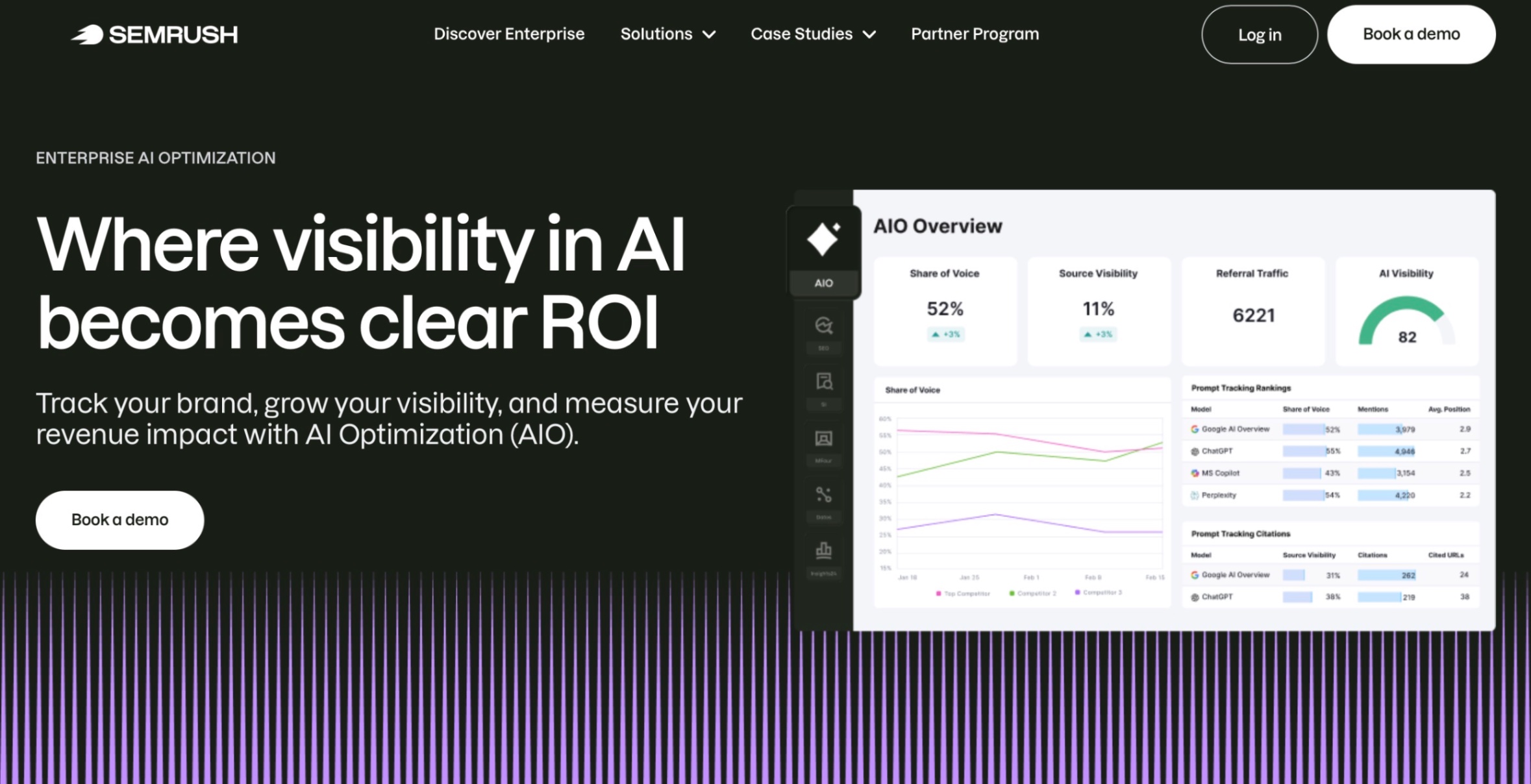
Semrush Enterprise AIO is built for organizations that want AI visibility tied to brand performance, competitor reporting, and business impact. It is much more enterprise and reporting focused than lightweight prompt tracking tools.
Best For: Enterprise teams that want AI visibility tied to reporting and revenue discussions, with brand tracking, competitor analysis, sentiment tracking, and enterprise workflow support.
How Does Semrush Enterprise AIO Help With LLM Optimization?
- Brand Visibility Tracking: Tracks brand visibility across AI search environments.
- Competitor Monitoring: Tracks competitors and competitive positioning as part of its AI visibility workflows.
- Sentiment Analysis: Tracks sentiment in AI mentions, which is useful for larger brands that care about how they are represented, not just how often they appear.
- Revenue Impact Measurement: Helps users measure revenue impact, making this one of the clearest ROI-oriented tools in the category.
- Source Analysis: Helps teams see which sources fuel AI answers.
- Large Prompt Database And Supporting Data Layers: AIO includes a database of more than 213 million prompts and combines that with LLM training data, traffic logs, authority signals, and existing SEO data.
- Analytics Integrations: Contextualizes AIO data with GA4 or Adobe Analytics traffic data.
Why Should You Consider Semrush Enterprise AIO For LLM Optimization?
- Good For Executive Reporting: One of its biggest strengths is how clearly it connects AI visibility to ROI and revenue impact.
- Useful For Brand-Sensitive Teams: Sentiment tracking adds an extra layer for larger brands that care about how they are being talked about in AI answers.
- Better Suited To Enterprise Workflows: Customized dashboards, competitor monitoring, collaboration features, and API support make it a stronger fit for larger teams.
- Connects Visibility With Business Data: The ability to bring in analytics data makes the reporting more useful than a simple AI mention tracker.
When Is Semrush Enterprise AIO Not The Best Option?
- Smaller Team Use Cases: Smaller teams looking for a simple monitoring tool may find Enterprise AIO heavier than they need.
- Narrow Prompt Tracking Needs: Teams that only want a focused prompt tracker without sentiment, revenue reporting, or analytics context may find it more extensive than necessary.
- Editorial Execution Needs: It is built more for AI visibility measurement and business reporting than for content production or editorial execution.
6. OtterlyAI
OtterlyAI is a lightweight AI visibility monitoring tool built for teams that want a simpler way to track brand mentions and citations across major AI search surfaces. It keeps the focus on prompt tracking, visibility trends, and competitor monitoring without feeling overly heavy.
Best For: Teams that want lightweight AI visibility monitoring across platforms like ChatGPT, Perplexity, Google AI Overviews, and AI Mode.
How Does OtterlyAI Help With LLM Optimization?
- Prompt Library Tracking: Lets teams define and monitor prompts that reflect real user questions across AI search platforms.
- Brand Mention Monitoring: Tracks when and where a brand appears in AI-generated answers.
- Website Citation Tracking: Shows when your site is cited as a source in AI responses, which is useful for understanding source visibility.
- Competitor Visibility Comparison: Compares your visibility against competitors so it is easier to spot gaps in AI search presence.
- Trend Monitoring Over Time: Helps teams see how mentions and citations shift over time instead of relying on one-off checks.
Why Should You Consider OtterlyAI For LLM Optimization?
- Simple To Get Started With: OtterlyAI is easier to understand than more enterprise-heavy platforms because it stays focused on core visibility tracking.
- Good For Early-Stage Monitoring: It works well for teams that want to start tracking prompts, mentions, and citations without jumping straight into a more complex platform.
- Useful For Practical Visibility Checks: The combination of prompt monitoring, citations, and competitor comparison gives smaller teams enough signal to see where they are winning or losing.
- Clear Multi-Platform Coverage: It covers the main AI search environments most teams already care about.
When Is OtterlyAI Not The Best Option?
- Enterprise Workflow Needs: Larger organizations that want deeper reporting, governance, or advanced collaboration may outgrow it.
- Technical Diagnostics Priorities: Teams looking for a stronger technical visibility layer around crawl access or AI bot diagnostics may need a more specialized tool.
- Broader Execution Workflows: It is better suited to monitoring than full content creation or editorial execution inside the product.
What Does Otterly AI’s Pricing Look Like?
- Lite starts at $25/month
- Standard starts at $160/month
- Premium starts at $422/month
- Enterprise pricing is custom
How Do Users Rate Peec AI?
G2 Rating: 4.8/5
7. Profound
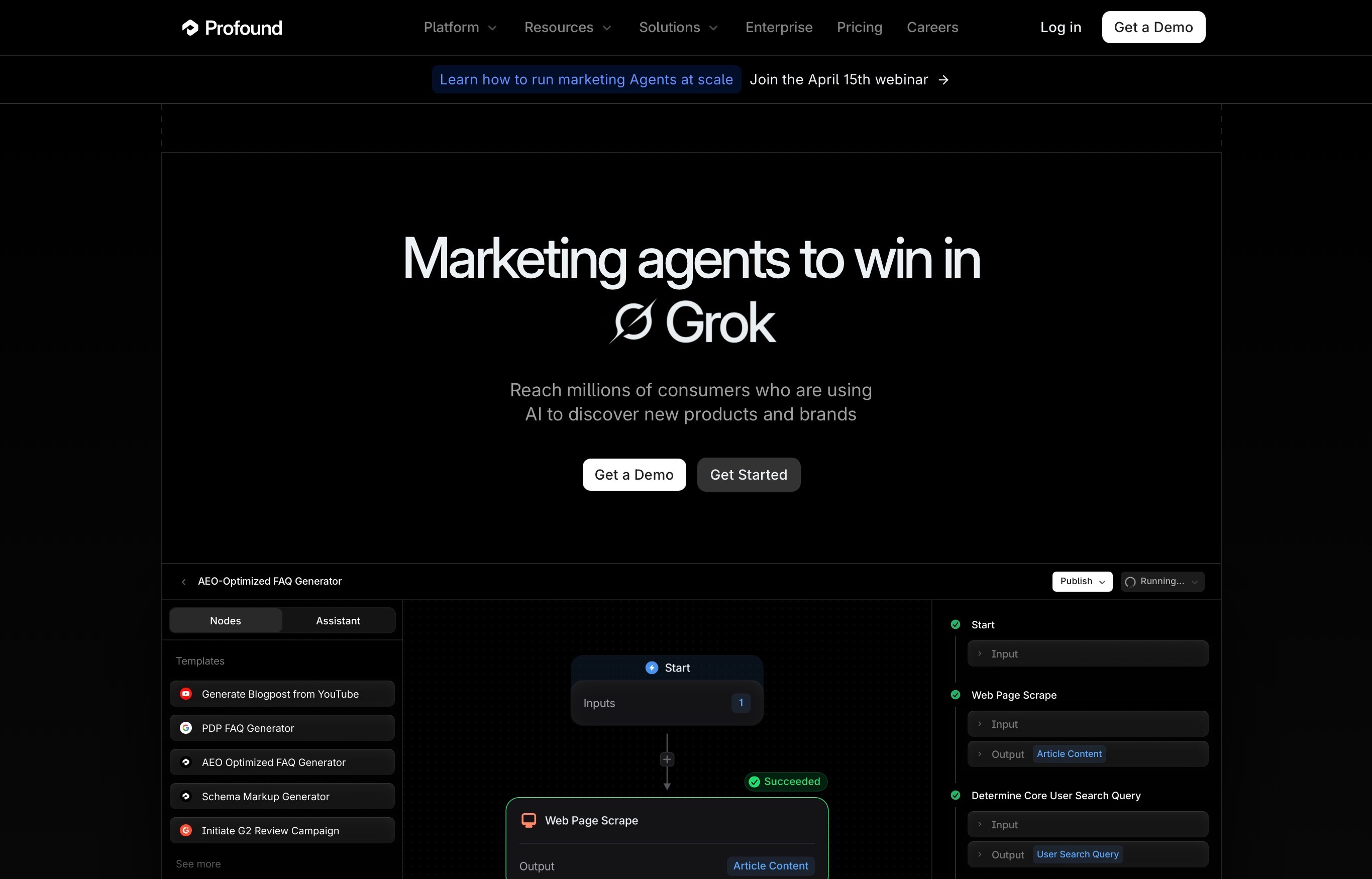
Profound is an enterprise AI visibility platform built for brands that want deeper answer engine analysis across multiple AI platforms. It is more enterprise-oriented than lightweight monitoring tools and is designed for teams that care about visibility, citations, and broader business reporting.
Best For: Enterprise teams that want AI visibility and answer engine analysis across multiple platforms, with a stronger focus on scale, reporting, and enterprise use cases.
How Does Profound Help With LLM Optimization?
- Multi-Platform AI Visibility Tracking: Tracks how a brand appears across major AI search and answer engines rather than limiting monitoring to one or two interfaces.
- Answer-Level Brand Analysis: Helps teams see where and how AI mentions their brand inside generated answers.
- Citation Visibility: Shows which websites and sources are shaping AI responses about your brand.
- Prompt And Topic Research: Helps teams understand what users are asking across answer engines and how those prompts connect to brand visibility.
- Traffic And Attribution Insight: Connects AI mentions and answer visibility with downstream traffic signals.
Why Should You Consider Profound For LLM Optimization?
- Built For Enterprise Teams: Profound is clearly aimed at larger brands that want a more serious AI visibility and reporting setup.
- Strong Multi-Engine Coverage: It is a better fit for teams that want visibility across a wider set of AI engines instead of focusing only on the biggest few.
- Useful For Deeper Answer Engine Analysis: The platform goes beyond basic mention tracking by looking at how AI talks about a brand and what sources are influencing those answers.
- Better Fit For Strategic Reporting: Features like trend analysis, API access, and enterprise support make more sense for organizations treating AI visibility as an ongoing reporting layer.
When Is Profound Not The Best Option?
- Lightweight Monitoring Needs: Smaller teams that just want a simple prompt and citation tracker may find it more than they need.
- Budget-Sensitive Use Cases: Teams looking for a lower-cost or more self-serve entry point may prefer lighter tools first.
- Content Workflow Priorities: Profound is stronger as an AI visibility and answer analysis platform than as a built-in content production workflow.
What Does Profound’s Pricing Looks Like?
- Starter starts at $99/month, billed yearly
- Growth starts at $399/month, billed yearly
- Enterprise pricing is custom
How Do Users Rate Profound?
G2 Rating: 4.6/5
8. Hall
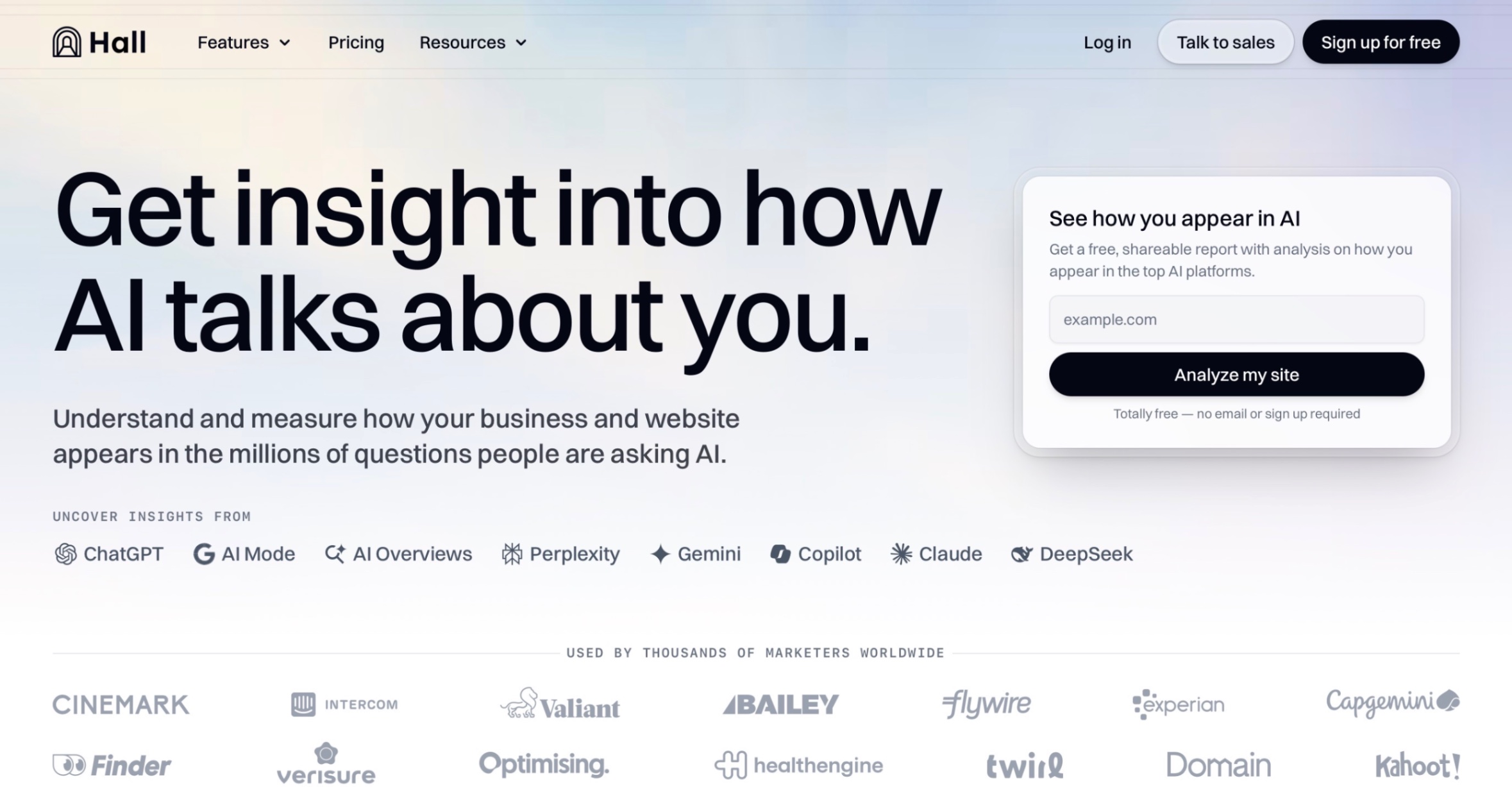
Hall is built for teams that want a clearer view of how their brand appears in AI conversations. It focuses on visibility, citations, competitive positioning, and answer engine insights without feeling overly technical.
Best For: Teams that want visibility, citations, and answer engine insights across AI search environments.
How Does Hall Help With LLM Optimization?
- Brand Visibility Tracking: Tracks when and how your brand appears in AI conversations so teams can understand their visibility across answer engines.
- Citation Insights: Shows where your website and pages are cited in AI conversations, which helps teams understand what content is actually being referenced.
- Competitive Positioning: Tracks competitive positioning alongside brand visibility, which makes it easier to see where competitors are showing up more often.
- Generative Answer Insights: Helps teams see how AI systems talk about their brand inside generated answers, not just whether they are mentioned.
- Agent Analytics: Includes agent analytics, which adds another layer for teams that want to understand how AI agents and crawlers are interacting with their site.
Why Should You Consider Hall For LLM Optimization?
- Clean Visibility And Citation Focus: Hall keeps the workflow centered on the things most teams actually need first, namely visibility, citations, and competitive context.
- Useful For Answer Engine Analysis: Its answer-focused framing makes it a good fit for teams that want to understand how AI conversations represent their brand, not just track mentions in isolation.
- Balanced Product Scope: It gives teams more than a basic mention tracker without feeling as enterprise-heavy as some larger platforms.
- Helpful For Website Citation Analysis: The citation insights feature is especially useful for teams trying to understand which content assets are actually getting picked up in AI responses.
When Is Hall Not The Best Option?
- Heavy Technical Diagnostics Needs: Teams looking for a stronger technical diagnostics layer around crawl access or AI bot troubleshooting may want a more specialized tool.
- Large-Scale Enterprise Reporting Priorities: Teams that need deeper reporting tied closely to revenue or extensive internal dashboards may prefer a more enterprise-oriented platform.
- Built-In Content Execution Workflows: Hall is more clearly focused on visibility insights than on content production or editorial execution inside the product.
Need enterprise-level execution beyond software? Explore who the best GEO agencies for enterprise SaaS companies are and which one fits your growth goals best.
9. Rankscale
Rankscale is built for broad AI visibility tracking across a large number of engines. It focuses on mentions, citations, sentiment, and centralized monitoring for teams that want a wider multi-engine view of AI search performance.
Best For: Teams that want broad multi engine visibility tracking across a wide set of AI search and answer platforms.
How Does Rankscale Help With LLM Optimization?
- Multi-Engine Visibility Tracking: Tracks brand visibility across 17+ AI engines, which makes it useful for teams that want wider platform coverage.
- Mention And Citation Tracking: Measures mentions, citations, URLs, and domains appearing in AI answers so teams can see who is winning visibility and citation share.
- Sentiment Analysis: Tracks how LLMs speak about your brand across monitored prompt sets, which adds a brand perception layer beyond raw visibility.
- Centralized Dashboard Monitoring: Brings brands, search terms, mentions, and citations into one dashboard for ongoing tracking.
- Engine-Specific Tracking: Offers dedicated tracking for specific engines such as Gemini, including mentions, citations, visibility, and competitive intelligence.
Why Should You Consider Rankscale For LLM Optimization?
- Strong Multi-Engine Coverage: Rankscale is a good fit for teams that do not want to limit tracking to just a few major AI interfaces.
- Good Citation And Sentiment Depth: The combination of citation pattern analysis and sentiment tracking gives teams a broader view of both visibility and brand perception.
- Useful For Centralized Monitoring: The dashboard approach makes it easier to monitor multiple brands, search terms, and engines in one place.
- Better For Cross-Engine Research: Teams comparing how they appear across multiple answer engines may find Rankscale more useful than tools built around a narrower platform set.
When Is Rankscale Not The Best Option?
- Lightweight Monitoring Needs: Teams that only want a simple tracker for a few prompts or a couple of major AI platforms may find Rankscale broader than necessary.
- Content Workflow Priorities: Rankscale is more clearly built for visibility analytics and tracking than for built-in content creation or editorial execution.
- Tighter Team Simplicity Requirements: Smaller teams that prefer a very simple setup may not need the wider engine coverage and deeper analytics layers.
10. AthenaHQ
AthenaHQ is built for teams that want more than just AI visibility tracking. It combines AEO and GEO monitoring with workflow features that help teams move from insight to optimization inside one platform.
Best For: Teams that want dedicated AEO and GEO monitoring plus optimization workflows, especially across multiple AI platforms.
What Does AthenaHQ Help With LLM Optimization?
- Cross-Platform AI Visibility Tracking: Tracks brand visibility across 8+ LLMs, which makes it useful for teams monitoring performance beyond a single AI interface.
- AEO And GEO Workflow Management: Gives teams a centralized setup for managing AI search optimization work instead of treating monitoring and action as separate tasks.
- Content Optimization Recommendations: Surfaces recommendations that help teams improve content based on what AI engines are citing and rewarding.
- Citation Source Analysis: Shows which sources and links are influencing AI answers, which is useful for both content planning and authority building.
- Competitor And Visibility Monitoring: Tracks citations and competitive visibility so teams can see how they stack up against rivals in AI search.
Why Should You Consider AthenaHQ For LLM Optimization?
- Built Around Monitoring Plus Action: AthenaHQ stands out because it is not just a tracking layer. It is built to connect visibility monitoring with actual optimization workflows.
- Good Fit For Dedicated GEO Work: The platform is clearly designed for teams treating GEO and AEO as ongoing workstreams, not just one-off reporting exercises.
- Useful Citation Visibility: Citation monitoring and source analysis make it easier to understand what content is influencing AI answers and where the gaps are.
- Stronger Workflow Orientation: Compared with lighter trackers, AthenaHQ is better suited to teams that want visibility data tied more directly to actions and prioritization.
When Is AthenaHQ Not The Best Option?
- Lightweight Monitoring Needs: Teams that only want a basic AI visibility tracker may find AthenaHQ more workflow-heavy than necessary.
- Done-For-You Execution Expectations: It supports optimization workflows, but it is still a platform your team uses rather than a fully managed execution service.
- Very Simple Team Setups: Smaller teams that do not need a structured GEO workflow may prefer a simpler monitoring-first tool.
11. Bluefish AI
Bluefish AI is built for large brands that want AI visibility as part of a broader enterprise AI marketing stack. It combines monitoring, optimization, and brand perception analysis across major AI channels.
Best For: Larger enterprise brands that want AI visibility within a wider AI marketing stack, especially when brand reputation, message consistency, and enterprise scale matter.
What Does Bluefish AI Help With LLM Optimization?
- AI Monitoring: Tracks how AI platforms define and shape your brand across digital and AI-native experiences.
- Brand Visibility And Reputation Analysis: Analyzes brand visibility, accuracy, safety, and related signals in AI responses, which makes it useful for enterprise brand monitoring.
- AI Optimization Workflows: Includes AI optimization and GEO-related capabilities aimed at improving visibility and message consistency across AI channels.
- Multi-Channel AI Coverage: Supports major AI channels including ChatGPT, Meta AI, and Google AI environments.
- Narrative And Source Influence Analysis: Helps brands see where their own content shapes AI answers and where outside sources are driving the narrative instead.
Why Should You Consider Bluefish AI For LLM Optimization?
- Built For Enterprise Brands: Bluefish is clearly designed for large organizations that care about scale, governance, and brand control.
- Broader Than Basic Visibility Tracking: It goes beyond simple mention monitoring by looking at accuracy, favorability, safety, and message consistency.
- Useful For Brand-Sensitive Use Cases: It makes more sense for teams that care not just about whether they appear in AI answers, but whether those answers are accurate and on-brand.
- Better Fit For Wider AI Marketing Strategy: Because it sits inside a broader AI marketing stack, it is more relevant for enterprise teams that want monitoring and optimization connected to larger brand strategy.
When Is Bluefish AI Not The Best Option?
- Smaller Team Use Cases: Smaller teams looking for a straightforward prompt and citation tracker may find Bluefish more enterprise-focused than they need.
- Narrow Monitoring Needs: If all you need is lightweight visibility monitoring, Bluefish may feel broader than necessary because it also leans into optimization, reputation, and AI commerce layers.
- Content Workflow Priorities: Bluefish is better suited to enterprise AI visibility and brand intelligence than to editorial execution or content production inside the product.
Need expert help creating prompt-optimized content that performs in AI search? Read what’s the best AI SEO agency for prompt-optimized LLM content and find the right fit.
What Should You Look For In An LLM Optimization Tool For AI Visibility?
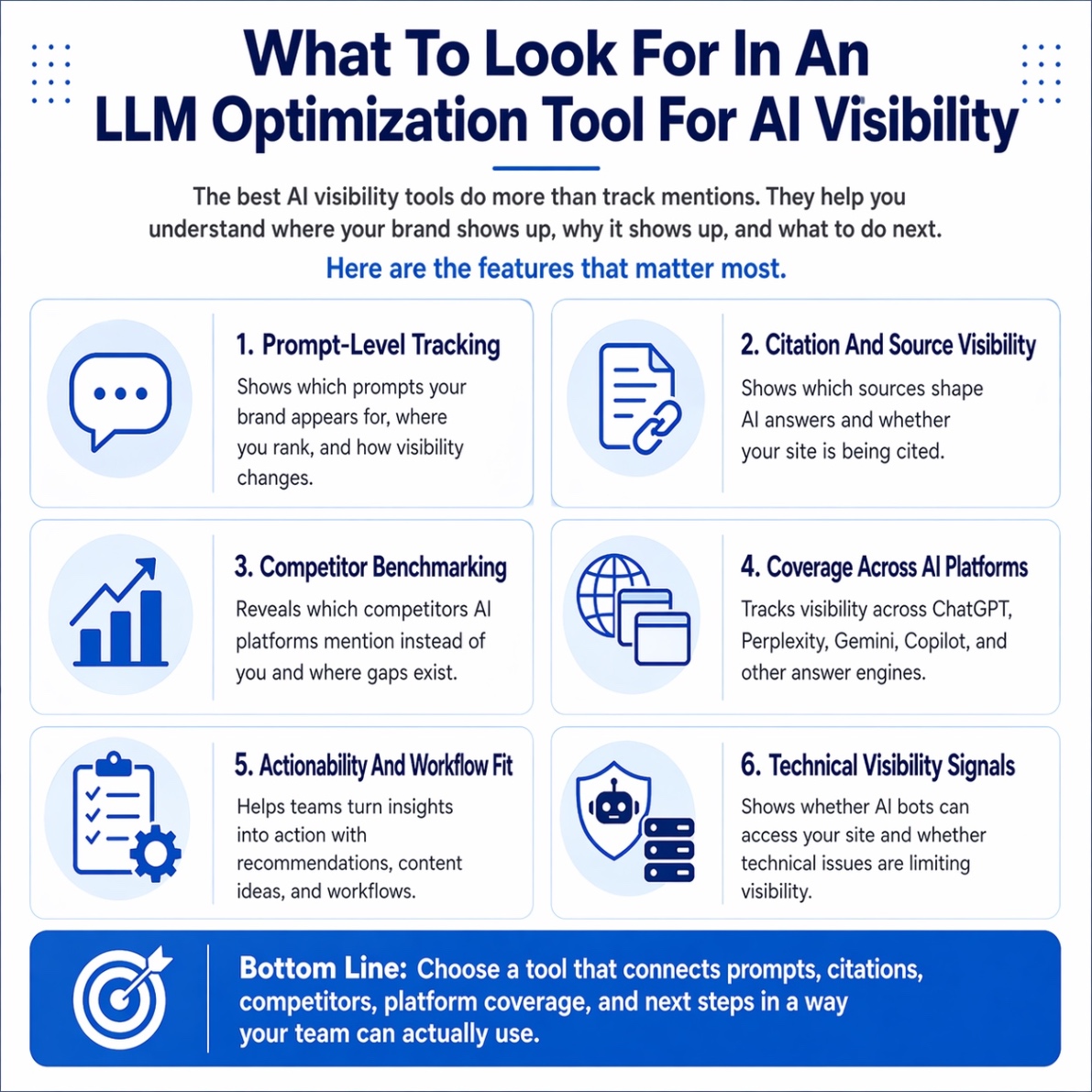
Not every AI visibility tool is actually useful once you get past the dashboard. The best LLM optimization tools to monitor brand in ChatGPT answers and other AI platforms are the ones that help you see where your brand shows up, why it shows up, where competitors are winning, and what you should do next.
Here are the features that matter most.
1. Prompt-Level Tracking
A good tool should show which prompts your brand appears for, where you rank in those answers, and how that visibility changes over time. This matters because AI visibility is rarely consistent. You might show up for one high-intent query and disappear for a very similar one.
2. Citation And Source Visibility
It is not enough to know that your brand was mentioned. You also need to know which sources are shaping the answer and whether your site is actually being cited. This is one of the most useful signals because it tells you what content and authority signals are driving visibility.
3. Competitor Benchmarking
Your tool should show who AI platforms mention instead of you. That makes it easier to spot visibility gaps, compare share of voice, and understand which competitors are owning the prompts that matter most in your category.
4. Coverage Across AI Platforms
A tool that tracks only one platform gives you an incomplete picture. Visibility can look very different across ChatGPT, Perplexity, Gemini, Google AI experiences, Copilot, and other answer engines. Broader coverage helps you see where your strategy is actually working.
5. Actionability And Workflow Fit
Some tools are built mainly for monitoring. Others help you turn insights into action. The right choice depends on your team. If you need content ideas, optimization guidance, source analysis, or next-step recommendations, a reporting-only tool will feel limited pretty quickly.
6. Technical Visibility Signals
Sometimes the problem is not your content. It is access. Technical visibility signals help you understand whether AI bots can reach your site, how AI agents interact with your pages, and whether crawl or infrastructure issues are holding visibility back.
The best LLM optimization tools do more than track mentions. They help you connect prompts, citations, competitors, platforms, and next steps in a way your team can actually use.
Need help beyond tools? Explore the 10 best answer engine optimization services and find the right partner for improving AI visibility.
Which LLM Optimization Tool Is Best For Your Team?
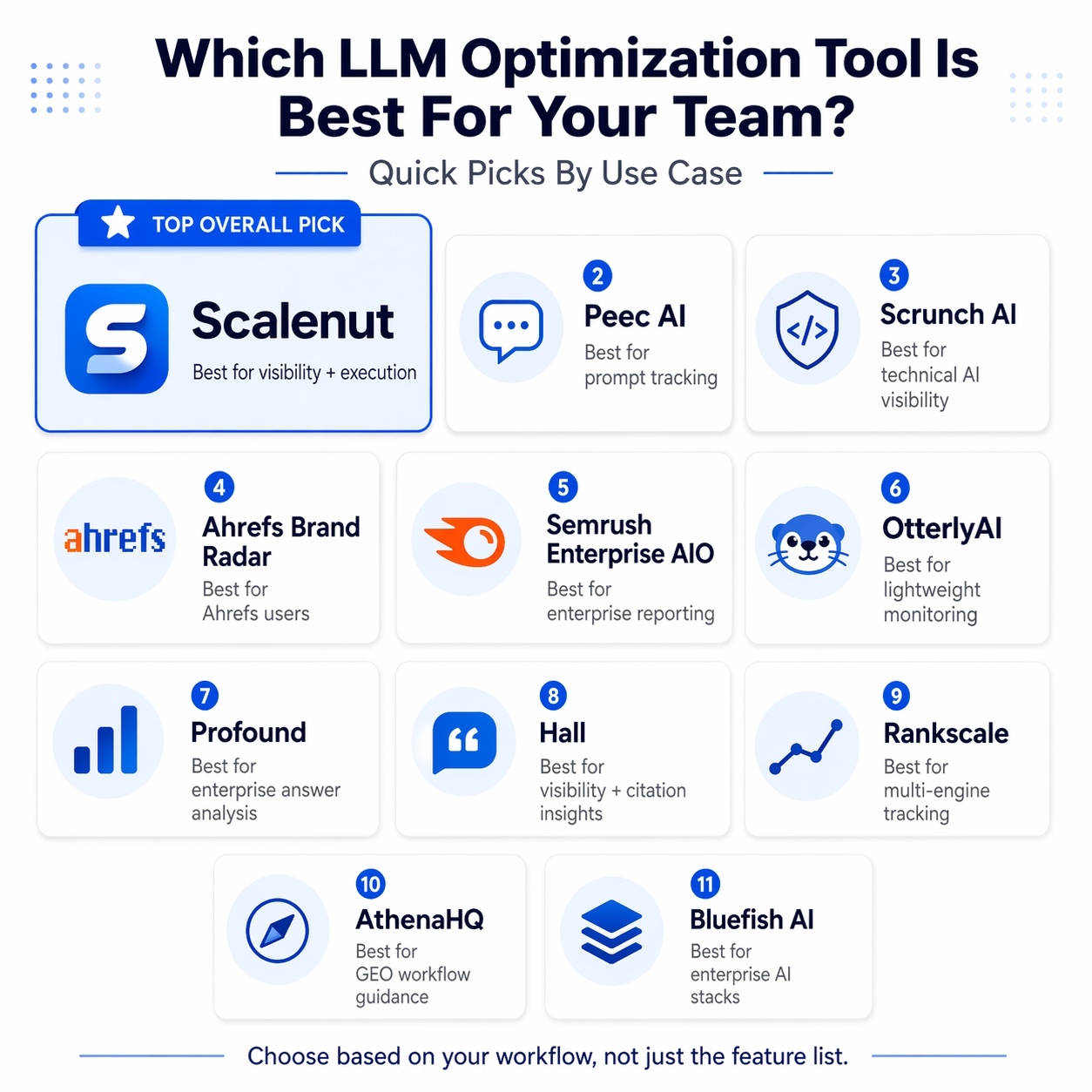
The best tools for tracking brand performance in ChatGPT results and other AI platforms depends on what your team actually needs to do with AI visibility data. Some teams need execution. Some need prompt intelligence. Others need enterprise reporting, technical diagnostics, or broader answer engine analysis.
Here is how to choose the right fit.
Choose Scalenut If You Want Visibility Plus Execution
Choose Scalenut if your team does not just want to monitor AI visibility, but also act on it inside the same platform. Scalenut is the strongest fit for teams that need AI visibility tracking, prompt insights, citation visibility, SEO planning, content creation, optimization, and internal linking in one workflow.
Choose Peec AI If Prompt Tracking Is Your Top Priority
Choose Peec AI if your biggest priority is tracking the prompts that matter, watching how your visibility shifts over time, and comparing that performance against competitors. It is a strong fit for marketing teams that want prompt-led AI visibility monitoring without getting pulled too far into technical diagnostics.
Choose Scrunch AI If Technical AI Visibility Matters
Choose Scrunch AI if your team needs more than prompt tracking and brand mentions. Scrunch makes more sense when technical visibility matters too, especially if you want citation monitoring, competitor benchmarking, rankings, and clearer signals around AI bot activity and site discoverability.
Choose Ahrefs Brand Radar If You Already Use Ahrefs
Choose Ahrefs Brand Radar if your team already works inside Ahrefs and wants AI visibility research added to that workflow. It is especially useful for large-scale brand monitoring, citation analysis, and share of voice tracking across a broad prompt dataset.
Choose Semrush Enterprise AIO If You Need Enterprise Reporting
Choose Semrush Enterprise AIO if your team needs AI visibility tied to reporting, sentiment, competitor tracking, and business impact. It is a stronger fit for enterprise teams that want executive-ready visibility data rather than a lightweight monitoring tool.
Choose OtterlyAI If You Want A Lightweight Monitoring Tool
Choose OtterlyAI if you want a simpler way to track prompts, mentions, citations, and competitor visibility without committing to a heavier platform. It works well for teams that want useful monitoring without a more complex enterprise workflow.
Choose Profound If You Need Enterprise Answer Engine Analysis
Choose Profound if your team wants deeper answer engine analysis across multiple AI platforms and has a more enterprise-level reporting need. It makes the most sense for larger brands that want broad visibility tracking plus deeper insight into how AI systems talk about them.
Choose Hall If You Want Clean Visibility And Citation Insights
Choose Hall if your team wants a clean, focused view of visibility, citations, and answer engine insights without going too far into technical or enterprise-heavy territory. It is a good fit for teams that care about how AI conversations represent their brand and what content is being picked up.
Choose Rankscale If You Need Broad Multi-Engine Tracking
Choose Rankscale if you want visibility tracking across a wide set of AI engines, not just the biggest platforms. It is a stronger fit for teams that care about broad multi-engine monitoring, citation visibility, sentiment, and centralized tracking across a larger AI search landscape.
Choose AthenaHQ If You Want GEO Monitoring Plus Workflow Guidance
Choose AthenaHQ if your team wants GEO and AEO monitoring tied more directly to optimization workflows. It is a good fit for teams that want visibility tracking, citation analysis, competitor monitoring, and clearer next steps inside a more structured GEO workflow.
Choose Bluefish AI If You Need AI Visibility Inside A Broader Enterprise AI Stack
Choose Bluefish AI if your organization wants AI visibility as part of a broader enterprise AI marketing and brand intelligence setup. It is best suited to larger brands that care about visibility, reputation, narrative control, and message consistency across AI channels.
If your team wants the most complete mix of visibility tracking and execution, Scalenut is the strongest overall choice. If your needs are narrower, the best tool is usually the one that matches your workflow, not the one with the longest feature list.
Want to go deeper into AEO execution? Explore the 9 best platforms for optimizing content for AEO and see which one wins.
Conclusion
AI discovery is no longer a side channel. As buyers rely more on large language models, brands need tools that can track both traditional search performance and what is happening inside AI search results. The right platform should help with prompts, citations, competitors, and the next actions that improve AI search visibility over time.
The best next step is to choose based on workflow, not feature overload. Small teams may do well with lighter monitoring tools, while SEO teams that need stronger LLM visibility and execution should look for a more complete AI visibility toolkit. If your goal is to improve visibility across search engines instead of just watch dashboards, Scalenut is the strongest place to start.
Frequently Asked Questions
Which are the best LLM optimization tools for AI visibility in the USA?
For most teams in the USA, Scalenut, Peec AI, and Scrunch AI are strong picks. Scalenut is best for visibility plus execution, Peec AI is strong for prompt tracking, and Scrunch AI is useful when technical AI visibility also matters.
Are there tools that help track and optimize my presence in ChatGPT search results?
Yes. Scalenut, OtterlyAI, and Peec AI can help track visibility in ChatGPT-related AI search experiences. Scalenut is especially useful if you also want SEO and content execution, while OtterlyAI focuses more on monitoring prompts, mentions, and citations.
Which LLM optimization tools work best for SaaS businesses targeting AI traffic?
For SaaS businesses, Scalenut is a strong fit because it combines AI visibility tracking with content planning and optimization. OtterlyAI is useful for ongoing monitoring, while Peec AI works well when prompt-level visibility and competitor tracking are top priorities.
How can I use AI visibility tools to monitor mentions of my company in LLMs?
Start by building a prompt set around your brand, category, competitors, and buyer questions. Then use a tool like Scalenut or OtterlyAI to track mentions, citations, prompt visibility, and competitor presence over time instead of checking AI answers manually.
Which are the best apps for competitor analysis, AI search optimization and LLM visibility?
Scalenut, Scrunch AI, and Peec AI are among the best options here. Scalenut is strongest when you want optimization plus execution, Scrunch AI is useful for technical visibility and competitors, and Peec AI is strong for prompt-level benchmarking.
How to improve LLM visibility?
Improve LLM visibility by targeting prompt-driven topics, strengthening source-worthy content, improving internal linking, earning relevant mentions, and tracking which prompts and citations already drive visibility. Scalenut is useful here because it combines AI visibility insights with content and SEO workflows.
What are the best practices for LLM optimization with AI visibility tools?
The best practices are to track prompts by intent, monitor citations instead of mentions alone, compare competitor visibility, watch source patterns, and act on those findings through content updates. Scalenut is especially useful when you want those insights tied to execution.
What are the best tools for generative AI optimization and LLM visibility tracking?
Scalenut, Scrunch AI, and OtterlyAI are strong choices for generative AI optimization and LLM visibility tracking. Scalenut is the better fit for teams that want action and execution, while Scrunch AI and OtterlyAI are more monitoring-led.
What are the best GEO tools for brand reputation management in ChatGPT?
For ChatGPT brand reputation management, Scalenut, Scrunch AI, and OtterlyAI are relevant picks. Scalenut helps connect visibility with content action, Scrunch AI adds technical visibility signals, and OtterlyAI helps monitor mentions and citations across AI search platforms.
Which are the best tools to monitor ChatGPT brand mentions?
Scalenut and OtterlyAI are two strong options for monitoring ChatGPT brand mentions, with Peec AI also relevant for prompt-level tracking. If you are comparing the best tools to track mentions in ChatGPT, Scalenut is stronger for execution while OtterlyAI is lighter for monitoring.
Which are the best analytics tools to monitor brand presence in ChatGPT?
Scalenut, OtterlyAI, and Peec AI are useful analytics tools for this use case. If you are comparing the best tools to measure ChatGPT brand mentions in search, Scalenut adds execution value, while OtterlyAI and Peec AI are more visibility-tracking focused.
Which AI visibility tracking tools have been proven effective for 2026?
Scalenut, Peec AI, Scrunch AI, Ahrefs Brand Radar, and Semrush Enterprise AIO are strong AI visibility tracking tools for 2026. Scalenut stands out because it combines AI visibility tracking with SEO planning, content optimization, and execution workflows.


.svg)


.webp)